

Two people wake on the same morning. One reaches for the phone before her feet touch the floor. The other is out the door by 6:40 for fifteen minutes of light, and the two days that follow barely resemble each other by noon.
Most people arrive here with a generic healthy-habits list already behind them, or with a parent in mind whose days have quietly gotten shorter, and what they want is not more encouragement. They want times and portions. In the example this article is built on, the day holds together because of fixed cues: a 6:30 wake, outdoor light within the hour, a 25 to 30 gram protein breakfast at 7:15, a 30-minute walk at 8:30.
Energy at 70 reads as a personality trait. It is closer to a sequence, one you can hold your own day up against.
Your job is to pick one anchor to copy tomorrow, then decide which exact clock times fit your own sleep, your medication schedule, and your working hours.
| Time | What they do | Why it matters |
|---|---|---|
| 6:30 a.m. | Wake up, out of bed within 10 minutes | Sets the cue for every anchor that follows |
| 6:40 a.m. | 15–20 minutes outdoors before the phone | Anchors the body clock and mood |
| 7:15 a.m. | Breakfast with 25–30 g protein, one 8-oz coffee | Stabilizes energy through the morning |
| 8:30 a.m. | 30-minute walk at conversational pace | Locks in movement before the day fills |
| 12:30 p.m. | Seated lunch for at least 20 minutes | Creates a real midday pause |
| 1:30 p.m. | 20-minute nap with an alarm | Restores focus without stealing the night |
| 2:00 p.m. | Last caffeine of the day | Protects the 10:30 bedtime |
| 5:30 p.m. | Early dinner, lighter than lunch | Leaves a long runway before wind-down |
| 9:00 p.m. | Lights dim, screens off by 9:30 | Signals the brain that the day is ending |
| 10:30 p.m. | Lights out, held within 30 minutes on weekends | Mirrors the fixed wake and closes the loop |
Wake time stays fixed, even Saturday
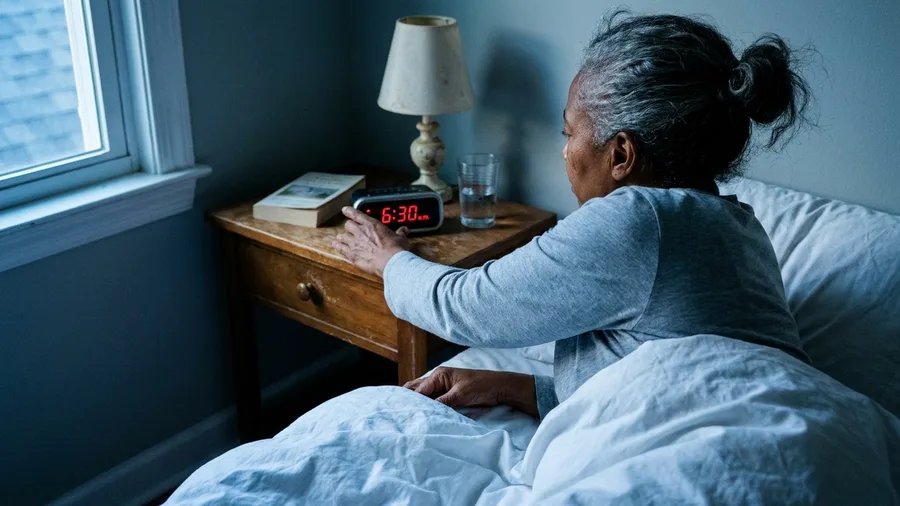
The people who feel energetic at 70 get up at the same time on a Saturday as they do on a Tuesday.
The wake time is 6:30, and the second half of the cue matters as much as the first: out of bed inside 10 minutes. Not sitting on the edge of the mattress, not reading in the dark, not letting the first thought of the day be a decision about whether to get up. The feet hit the floor before the coffee starts and before a hand reaches for the phone on the nightstand.
Weekends bend the rule by half an hour, not two. That is the boundary most people miss when they try this. A free Sunday morning feels like the place to sleep in until 8:30, and one long lie-in on Saturday does not cost much by itself.
It costs the next Monday. A two-hour shift in wake time pushes the body's clock the same way a short flight does, and the bill lands at the front of the workweek, when the morning already asks more of you than usual.
That is the hidden cost of the fixed 6:30: it means getting up on a morning when nothing forces you to. The payoff is that every hour after it has a stable floor. The light has an hour to land in, the 7:15 breakfast has a time, and the 8:30 walk has a fixed start rather than a slot that drifts to 10 or falls off the day.
Set the alarm for 6:30 tomorrow and treat Saturday as a 7:00 at the latest.
Outdoor light comes before the phone

The morning without a phone in hand is 15 to 20 minutes outside, started inside the first hour after waking.
A porch, a yard, a short walk down the block, all of it counts, and the point is the light reaching the eyes before anything else does. Not the phone, not the news, not email, not even the first cup of coffee. The 6:30 wake is what makes this possible: it can put you outdoors by 7:00, before the day starts making requests.
Cloud cover is not a reason to skip it. An overcast morning is still far brighter than any kitchen ceiling light, and when weather keeps you in, sitting near a bright window beats sitting in a dim room. The fallback is weaker than the real thing, but the sequence holds either way.
The catch is the phone by the bed. Most people reach for it in the first minute of the day, which is exactly when the light ought to be the thing that gets to your brain first. I have noticed that the worst mornings for me start with twenty minutes of email in a dark bedroom. Those are the ones when the day is already behind by the time I stand up.
Nothing has to be checked in the first hour that cannot wait another fifteen minutes. The light is the first input of the day, set before the first meal, and one of the differences between a morning that feels controlled and one that does not.
💡 PRO TIP
The Phone Can Wait 20 Minutes
Set your phone on airplane mode before bed and leave it in another room until after your light exposure. The first 20 minutes of your day set the tone for the next 12 hours, and the scroll can wait.
Breakfast carries 25–30 grams of protein

Breakfast is 25 to 30 grams of protein, eaten seated at 7:15, after the light and before the walk.
Two eggs plus a small tub of Greek yogurt cover that range in a few minutes. A bowl of oatmeal with yogurt stirred in does it too, and neither choice takes more skill than boiling water. The number to memorize is 25 to 30. A piece of toast with butter and jam is not breakfast by this standard, however much it feels like one.
The case for the range is about protein well spent. Past 50, muscle builds more slowly on the protein you eat than it did at 30, and a breakfast of almost none leaves the day behind. Spread the load across the meals and the body has something to work with.
The coffee is one 8-ounce cup, not a pot. Not a separate all-morning supply you keep refilling through lunch.
That single cup is a change for anyone used to nursing a mug from 7 to 11. But the smaller portion is what makes the 2 p.m. cutoff later on feel bearable, and a fixed cup helps the day hold its shape.
This is the bridge into the 8:30 walk: enough protein to get you up the hill and back without the mid-morning dip that sends you back to the kitchen at 10.
The first walk happens before errands

The walk has a clock time, 8:30, and it happens before the first errand, not after. Thirty minutes, conversational pace – a pace where you could hold a sentence without gasping. That is the entire prescription.
Morning is the one window the day has not yet claimed. By 10, the pharmacy run, the grandkid pickup, the call to the insurance company are all bidding for the same hour, and movement loses to every one of them. Put the walk in front of the list and the list can't take it.
The 8:30 slot is not a preference for fitness people. It is the cue that keeps the rest of the morning on pace, because a body that has moved and breathed hard for half an hour handles the errands differently than one that rolled from breakfast to the car.
Not a morning person? The point isn't the hour – it's that the walk comes first.
Morning Rhythm: Myths vs. Facts
Lunch is seated, not eaten over the sink

Lunch is a meal at a table, 12:30, and it takes at least 20 minutes to eat. Not at the desk, not standing at the counter with the fridge door open.
The plate is simple to build and needs no recipe: half vegetables, a palm-sized portion of protein – roughly the size and thickness of your own hand – and a glass of water. That's the whole formula. It works because it requires no decision-making at 12:30 when you're hungry and busy.
The 20-minute floor matters more than the food. Sitting slows the pace of eating, and slower eating lets the fullness signal arrive before the plate is empty. Standing at the sink, the same food is gone in six minutes and you're back at the task before your body has registered that it ate.
The seated lunch is a real stop between the morning's movement and the afternoon's tasks, not a refuel between them. Midday pacing starts here – with sitting down. That pause is what makes a nap possible an hour later, because you can't rest a body you never let stop.
A 20-minute nap is scheduled, not open-ended

It starts at 1:30, the alarm is set for 20 minutes, and it is over before 2:30 regardless of whether sleep came.
That last part is the rule most people skip. If you lie there awake, you rest quietly in the same slot and you get up when the alarm sounds. You do not extend the nap to make it count. The plan has a fixed end, and the fixed end is what keeps the nap from eating the afternoon.
The failure mode is the open-ended nap – lying down at 1:30 with no alarm and surfacing at 3:15, groggy, the afternoon gone. That nap does two kinds of damage: it swallows the hours you had for anything else, and it threatens the 10:30 bedtime, because a body that slept ninety minutes at midday isn't sleepy at 10:30.
The nap has a start, a limit, and an alarm. This scheduled pause protects the night and protects the caffeine cut-off, because a person who didn't oversleep at midday doesn't need the 3 p.m. cup to get through the afternoon.
Caffeine stops by early afternoon

The afternoon needs a boundary more than it needs a rescue. The last caffeine lands by 2 p.m., and it is one 8-oz cup of coffee or tea, not an open supply that runs until the light goes flat.
After that hour, the switch is decaf or water. That is the whole rule, and it is easier to keep than it sounds because the cup was already a morning tool back at breakfast, not something to keep topping up all day.
it does not show up as jitters, it shows up as a lighter, choppier night.
If the plan is a 10:30 lights-out and a 6:30 wake, the 2 p.m. stop is what protects both ends. It also does not do the job people ask of it. Caffeine does not fix the afternoon slump, because the slump is not a caffeine shortage; the nap slot at 1:30 is the honest answer to that dip, and a second pot just dresses it up.
So the real question is not how much coffee is too much. It is when the cup stops.
Afternoon Reset — At a Glance
⏱️ Nap Length
20 minutes, alarm set
☕ Last Caffeine
2:00 p.m.
🥗 Lunch
12:30 p.m., seated 20+ minutes
💧 Hydration
Water at lunch and after
Why It Works
A short nap restores alertness without grogginess, and stopping caffeine by early afternoon protects sleep pressure for the night.
Dinner is early and lighter than lunch

Dinner at 5:30 is early enough that the last swallow lands four and a half hours before lights dim, which is the whole point of the timing.
The portion is smaller than lunch, deliberately: about 4 oz of fish or chicken with vegetables, a plate that looks almost modest next to the midday one. The larger meal already happened at 12:30, when there were hours of daylight left to use it up.
What the 2 p.m. caffeine stop bought was a clear afternoon, and dinner spends it. A later, heavier plate asks the body to work a second full shift right when it is winding toward 9 p.m., and that shift is what makes the recliner feel like a decision instead of a slump.
Kitchen closed by 6:15. Not a rule about willpower but a boundary on the day, so the evening is sitting and talking and reading rather than a slow return to the counter every twenty minutes, and the gap between the last bite and lights dim stays empty of food.
For the reader, the question is not how to eat less at night but when the day's eating intends to end. Move dinner thirty minutes earlier, keep the plate under lunch's size, and check whether the stretch before bed gets easier or harder.
People who hold this rhythm describe the same result: the hour before dimming at 9 is quiet rather than restless, and 10:30 comes as a stop instead of a negotiation.
The Language of a Good Day
Screens dim an hour before bed

Winding down is a sequence with a start time, not a switch you flip at bedtime. It begins at 9 p.m. when the lights drop low, and it continues at 9:30 when the screens go off.
The gap from 6:15 to 9 is what makes this possible. Because dinner is over early, there is no rush; the hour before bed is not spent cleaning up a late kitchen or finishing what you started at 8. The dimming has somewhere to land.
What fills that last hour matters. A paper book, quiet music, a conversation on the couch. No work email, no scrolling, no checking one more thing. The point is to lower both light and demand at the same time, so the body gets a clear signal that the day is closing.
This is where the whole chain shows its logic. The 2 p.m. caffeine stop, the 5:30 dinner, the 9 p.m. dim, the 9:30 screens-off, all of it pointing at 10:30 in bed.
Skip the wind-down and you are asking a bright, busy brain to stop on command at 10:30. It rarely does, and the cost lands on tomorrow's 6:30 wake.
The evening protects the morning. That is the trade.
Evening: Wind-Down vs. Winding Up
Wind-Down Routine
- Lamps at 9 p.m., not overheads
- Settle in by 9:30, in bed by 10:30
- Low-demand: book, music, easy talk
- Keep the 10:30 target within 30 minutes
Winding Up
- Ceiling lights on until you lie down
- Email or scrolling under the covers
- News or a cliffhanger right before bed
- 10:30 one night, midnight the next
Bedtime holds within a half hour
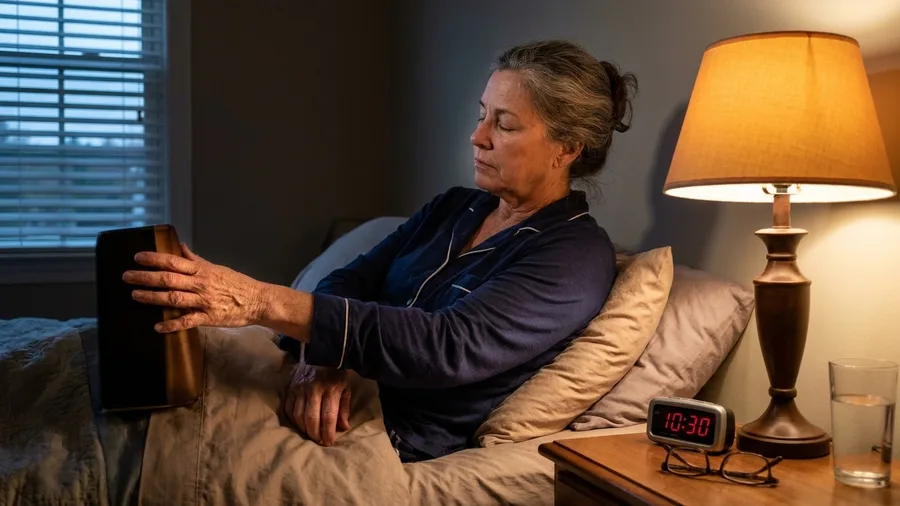
Lights out at 10:30, and Saturday night is the same Saturday as the rest of them, give or take thirty minutes. That window is not an inconvenience to work around. It is the third panel of a fence, and the first two went up at nine and nine-thirty.
The same sequence runs every night, in order. Lights drop at 9, screens go dark at 9:30, and then the bed. No step is skipped because the night is going well, and no step is added because it is going badly.
So what happens when the clock says 10:30 and sleep does not arrive? You lie there for twenty minutes, and then you get up. You sit somewhere dim and quiet and do something dull until your eyes get heavy. You do not reach for the phone and scroll, because that resets the whole hour you just spent dimming the room.
15 bedtimes does not feel like anything until the following Monday, when the 6:30 wake suddenly costs more than it used to. The late nights are paid for at the other end of the clock.
For anyone who has watched a parent drift loose of their hours, this is the panel that holds the rest. The 10:30 bedtime mirrors the 6:30 wake, and together they close the day's chain. Stretch one and the other goes with it.
One live conversation is booked daily

Fifteen minutes, booked into the calendar, with a person on the other end of it, is the day's last anchor. It is not left to whether you feel like it that morning. Its whole job is to keep a well-run day from becoming a quiet one.
The booking matters more than the length. Fifteen minutes of coffee or a call is small enough to fit into almost any afternoon and long enough to be real. You put it where it does not crowd the nap or dinner, and then it happens.
A text is not this. Neither is a comment under a photo. Both are contact, but neither puts a voice in the room, and the difference after a week of texts is not tiredness but flatness.
If you are someone who finds a phone call exhausting, the same slot works with a neighbor and a walk. Fifteen minutes, one person, on the books. That counts as the whole thing.
The catch is that the day's structure cuts both ways. Wake, light, breakfast, walk, lunch, nap, early dinner, dim lights, bed. Every one of those is a good idea, and followed exactly, they also mean you can go days without talking to anyone at length. So the contact holds the line between a rhythm and a rut.
And then the day is closed. It ends at 10:30, and the next one starts at 6:30.
⏰ The Day's Anchor Chain
6:30 a.m. Wake
Alarm across the room. Out of bed before the snooze can negotiate.
6:40 a.m. Light
Porch or sidewalk first. Phone stays inside until you are back.
7:15 a.m. Breakfast
Two eggs plus yogurt, or oatmeal with yogurt. Coffee is one cup, not a pot.
8:30 a.m. Walk
Thirty minutes before the first errand. If you can talk, you are going fast enough.
12:30 p.m. Lunch
Half the plate vegetables, protein the size of your palm. Sit for twenty minutes minimum.
1:30 p.m. Nap
Twenty minutes, alarm set. Past 2 p.m. and it starts eating the night.
2:00 p.m. Caffeine Cut-off
One 8-oz cup or tea, then done. This is the line that protects 10:30.
5:30 p.m. Dinner
About 4 oz fish or chicken. Kitchen closed at 6:15, no grazing after.
9:00 p.m. Wind-Down
Lights down. Screens dark by 9:30, charger in another room.
10:30 p.m. Bedtime
Weekend wake stays within 30 minutes of 6:30, or Monday hurts.
Frequently Asked Questions
Do I have to follow these exact times to see a benefit?
No. The specific clock times are a template, not a rule. The important part is the sequence and consistency: a fixed wake time, light before the phone, protein at breakfast, movement before the day fills, a seated lunch, an early caffeine cut-off, and a wind-down that starts an hour before bed. Shift the times to fit your own sleep, medication, and work schedule.
What if I am not hungry at 7:15 a.m.?
Start smaller. A half-portion of Greek yogurt or one egg still gives you protein and establishes the habit. The goal is to have breakfast seated after light exposure, not to force a large meal. Your appetite will often adjust within a week or two once your wake time is consistent.
I take medication that makes me drowsy. Can I still nap?
Yes, but talk to your doctor about timing. A 20-minute nap with an alarm is generally safe, but if your medication causes significant drowsiness, you may need to adjust the nap or your dosage schedule. Never change medication timing without your doctor's guidance.
Does the 20-minute nap actually help, or is it a waste of time?
A short nap can improve alertness and mood without the grogginess of a longer nap. The key is keeping it to 20 minutes and setting an alarm. If you regularly need a longer nap to function, that is worth mentioning to your doctor.
What if I live alone and have no one to call?
The live contact can be a neighbor, a family member, a friend, or even a brief chat with a cashier or librarian. The point is real-time interaction, not a specific person. You can also schedule a recurring video call or join a local club that meets regularly.
Is it okay to have a glass of wine with dinner?
That is a conversation for you and your doctor. Alcohol can affect sleep quality, especially in the hours before bed. If you do drink, having it with dinner at 5:30 leaves more time for your body to process it before the 10:30 bedtime.
Tomorrow Morning, Start With Two Anchors
The energetic day at 70 is not a collection of heroic habits. It is a chain of fixed cues: 6:30 wake, light before the phone, 7:15 protein breakfast, 8:30 walk, 12:30 seated lunch, 1:30 nap, caffeine stopped by 2, 5:30 dinner, lights dimmed at 9, screens off at 9:30, bed at 10:30, and one live call in between. Each link carries the next.
Start tomorrow with two of them: set the alarm for a fixed time, then get 15 minutes of outdoor light within the first hour, before you pick up the phone. That is the whole first change, and it costs nothing.
Hold the clock times loosely. Your own sleep needs, medication schedule, and work hours should bend the template, because the order matters more than the minute hand.
You wanted a concrete day to hold your own against, and here it is. But the point was never the template. Tomorrow morning, one person reaches for the phone and one steps outside. Copy the second one.
Try the Two-Anchor Start Tomorrow
Set your alarm for the same time you woke today, and step outside for 15 minutes before you check your phone. Compare how the rest of your morning feels.