What Happens to Your Body When You Lose 1 Pound a Week
One pound a week sounds frustratingly slow. Most people want to lose 10 pounds in a week not one. But here is what nobody tells you when you lose 1 pound a week consistently, your body goes through a cascade of real, measurable changes that make the next pound easier to lose, your health markers meaningfully better, and the results far more likely to stay off permanently.

This is not a motivational speech. This is the actual science of what happens inside your body to your fat cells, your hormones, your blood pressure, your skin, your energy when you choose the slow, boring, proven path of losing one pound a week.
Track your recode with best weight loss check list for beginners.
Is Losing 1 Pound a Week Healthy?
Is losing 1 pound a week a healthy rate of weight loss?
Yes. The CDC, Mayo Clinic, and most health authorities recommend losing 1 to 2 pounds per week as the safest, most sustainable rate of fat loss. At this pace, the body loses primarily fat rather than muscle, hunger hormones stay more stable, metabolism does not significantly slow down, and the habits that create the loss are manageable enough to maintain long term. Faster loss often includes significant muscle loss and metabolic slowdown.
Week 1: What Your Body Loses First (It’s Not All Fat)
The Water Weight Phase
In the first week of a calorie deficit, most people lose more than one pound sometimes three to five. Almost none of it is fat. Your body stores carbohydrates as glycogen in your liver and muscles, and glycogen binds to water. When you reduce carbohydrate intake or create a calorie deficit, glycogen stores deplete and the water attached to them releases with it. This is why the scale drops fast at first and why it slows down afterward.
💧 First-week loss is mostly water and glycogen not fat. This is normal and expected. True fat loss begins in week two onward, and it looks slower on the scale because one pound of fat takes a full week to burn off.
What Is Actually Happening to Your Fat Cells
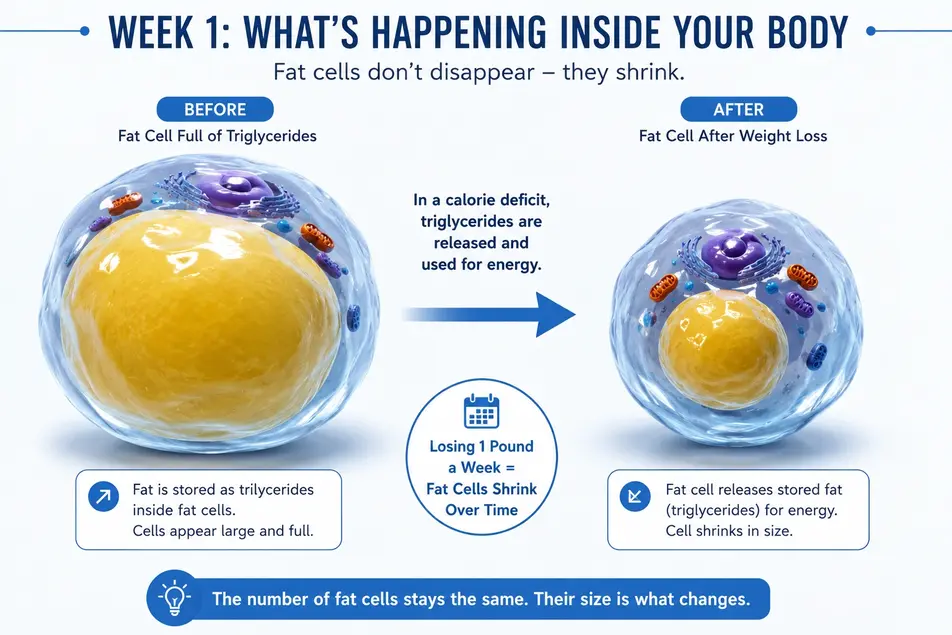
Fat is stored inside fat cells as triglycerides. When your body needs energy and food is not immediately available, it releases these triglycerides into your bloodstream to be burned as fuel. The fat cells themselves do not disappear they shrink. A 2011 study published in the journal Diabetes found that fat cells can shrink to a fraction of their original size. The number of fat cells in your body stays relatively constant; their size is what changes as you lose 1 pound a week over time.
Your Liver and Muscles Start Doing More Work
As glycogen stores reduce, your liver increases fat oxidation the process of converting stored fat into usable energy. This is the metabolic shift that makes consistent fat loss possible. Your muscles also become more efficient at using fat for fuel during low intensity activity like walking. This is why people who have been in a mild deficit for several weeks often notice they feel better during light exercise even though they are eating less.
What Happens to Your Hunger Hormones
Ghrelin Rises And That Is Normal
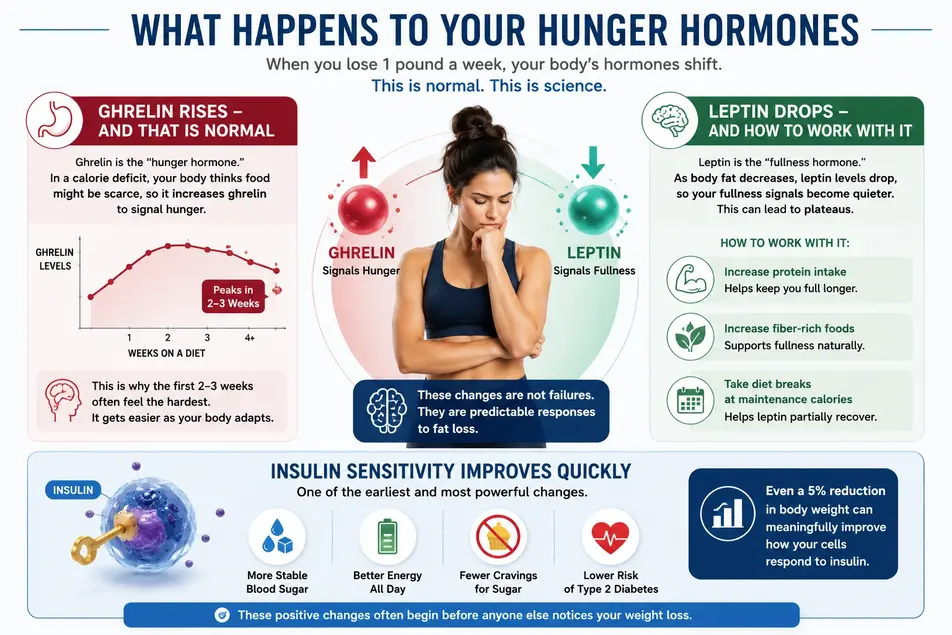
When you create a calorie deficit to lose 1 pound a week, your stomach produces more ghrelin the hormone that signals hunger. This is a physiological response, not a willpower failure. Your body does not know you are trying to lose weight. It reads a calorie deficit as a potential food shortage and responds by increasing appetite signals. This is why the first two to three weeks of a diet often feel hardest ghrelin peaks before your body adapts to the new intake level.
Leptin Drops And How to Work With It
Leptin is the hormone that signals fullness and satisfaction. As body fat decreases, leptin levels also decrease which means your fullness signals become quieter over time. This is part of why weight loss plateaus happen. The practical response is to increase protein and fiber intake, which trigger other fullness pathways independent of leptin, and to take occasional diet breaks at maintenance calories to allow leptin levels to partially recover before resuming the deficit.
🧠 Higher ghrelin and lower leptin are not failures of your metabolism. They are predictable responses to fat loss. Knowing this removes the guilt from feeling hungry and helps you plan practical responses rather than assume something is wrong.
Insulin Sensitivity Improves Quickly
One of the earliest positive hormonal changes when you lose 1 pound a week is improved insulin sensitivity. Even a 5% reduction in body weight has been shown to meaningfully improve how well your cells respond to insulin. This matters because better insulin sensitivity means more stable blood sugar, fewer energy crashes during the day, reduced cravings for sugary food, and a lower long term risk of type 2 diabetes. This change often begins before anyone else notices your weight loss.
What Happens to Your Metabolism

Metabolic Adaptation Is Real
As your body weight drops, your body needs fewer calories to maintain its functions. A smaller body burns fewer calories at rest and during movement than a larger one. This is called metabolic adaptation, and it is the main reason weight loss slows naturally over weeks even when you do not change anything about your routine. The AICR notes that this effect begins even after losing just one or two pounds which is why weight loss rarely stays at the same pace week after week.
Why the 3,500 Calorie Rule Is Imperfect
The commonly cited rule that losing one pound requires a 3,500 calorie deficit is a useful starting framework but an imperfect prediction. Research from 2013 examining seven closely monitored weight loss studies found that most participants lost significantly less than the rule predicted over time, because metabolic adaptation narrowed the calorie deficit as weeks progressed. Losing 1 pound a week is realistic at the start but the deficit may need to be recalculated every four to six weeks as body weight decreases.
📊 The National Institutes of Health offers a free Body Weight Planner tool that accounts for metabolic adaptation and gives more accurate weight loss predictions than the static 3,500-calorie rule. It is worth using to set realistic expectations.
Muscle Preservation Changes Everything
The single biggest variable in metabolic health during fat loss is muscle mass. Muscle tissue burns more calories at rest than fat tissue. If you lose weight through severe calorie restriction without adequate protein or strength training, a significant portion of the weight lost is muscle which lowers your resting metabolic rate and makes future fat loss harder. Losing 1 pound a week through a moderate deficit with high protein intake preserves muscle far better than faster loss through crash dieting.
What Happens to Your Health Markers
Blood Pressure Responds to Early Loss
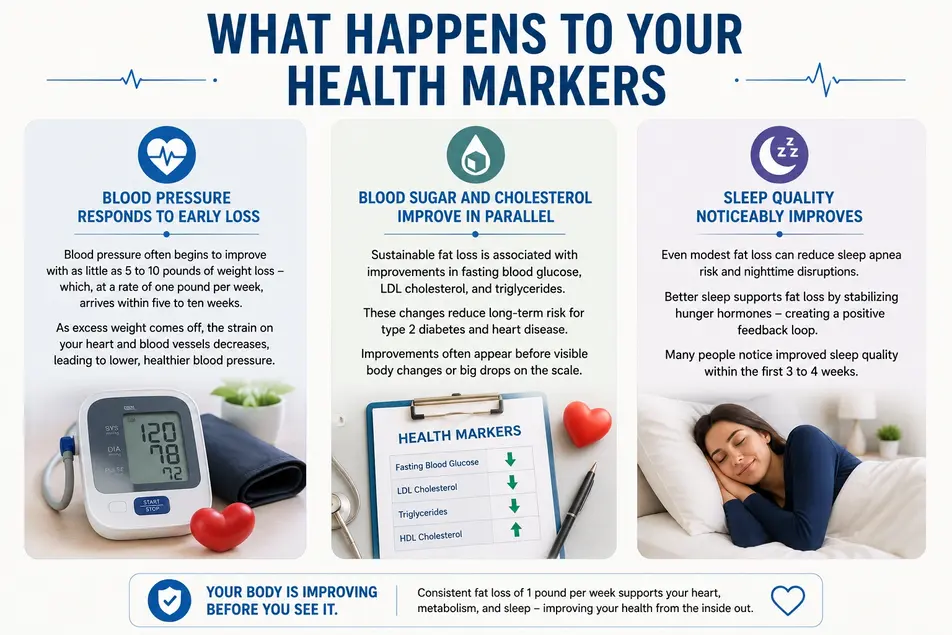
Blood pressure often begins to improve with as little as 5 to 10 pounds of weight loss which, at a rate of one pound per week, arrives within five to ten weeks. Excess body weight forces the heart to work harder to pump blood through additional tissue. As that tissue reduces, the strain on the cardiovascular system decreases. This effect is most pronounced in people who started with elevated blood pressure, but even people in the normal range see measurable improvement with consistent fat loss.
Blood Sugar and Cholesterol Improve in Parallel
Fat loss at a sustainable rate including losing 1 pound a week over several weeks is associated with improvements in fasting blood glucose levels, LDL cholesterol, and triglycerides. These changes reduce long term risk for type 2 diabetes and cardiovascular disease. Importantly, these improvements often appear before visible body changes and before the scale drops significantly. Your internal health is improving faster than the mirror shows.
Sleep Quality Noticeably Improves
Excess body weight is a significant risk factor for sleep apnea and poor sleep quality. Even modest fat loss can reduce the pressure on the airway during sleep and decrease the frequency of disruptions. Better sleep then supports the fat loss process itself by stabilizing hunger hormones creating a positive feedback loop. People who lose weight at a steady, sustainable pace often report that improved sleep quality is one of the first noticeable life changes, sometimes appearing within the first three to four weeks.
What Your Body Looks and Feels Like Over Time
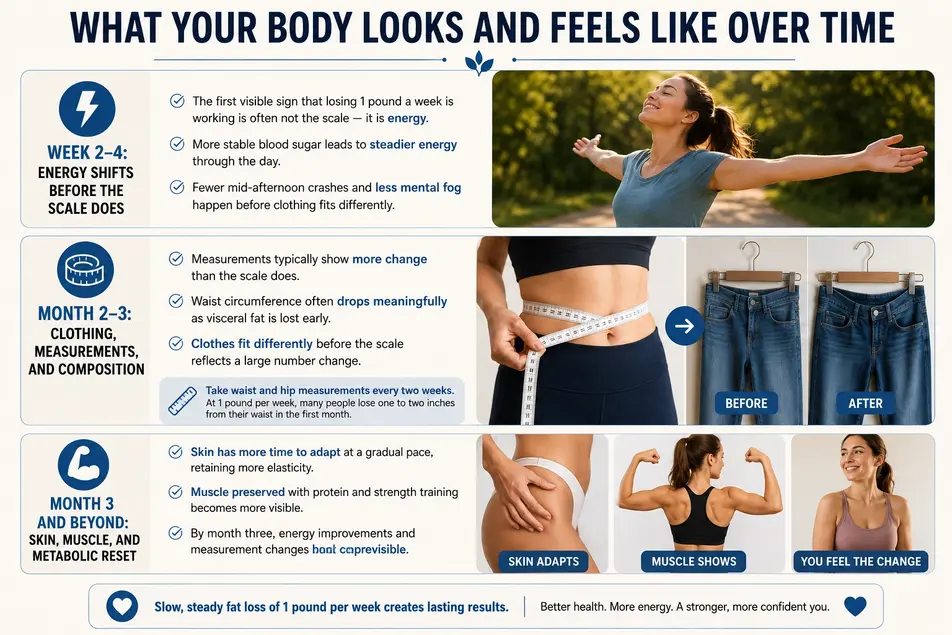
Week 2–4: Energy Shifts Before the Scale Does
The first visible sign that losing 1 pound a week is working is often not the scale it is energy. Once the initial water weight fluctuations settle and blood sugar becomes more stable from better eating habits, most people notice steadier energy through the day, fewer mid-afternoon crashes, and less mental fog. These changes happen before clothing fits differently and before anyone outside your home notices a physical difference.
Month 2–3: Clothing, Measurements, and Composition
By weeks six to twelve of consistent fat loss, measurements typically show more change than the scale does. Waist circumference often drops meaningfully even when scale weight moves slowly, because the body preferentially loses visceral fat the fat stored around internal organs early in the fat loss process. Visceral fat is metabolically active and responds quickly to calorie deficits. This is why clothes fit differently before the scale reflects a large number change.
📏 Take waist and hip measurements every two weeks. At 1 pound per week, many people lose one to two inches from their waist in the first month a change that rarely shows clearly on a scale but is obvious on a measuring tape.
Month 3 and Beyond: Skin, Muscle, and Metabolic Reset
At a gradual pace of one pound weekly, skin generally has enough time to partially adapt to a smaller body retaining more elasticity than it would after rapid loss. This is a significant advantage of slow, steady fat loss over crash dieting. Muscle preserved through adequate protein and strength training becomes more visible as the fat layer above it decreases. By month three, what began as energy improvements and measurement changes becomes visible body composition improvement.
📊 Lose 1 Pound a Week vs. Crash Dieting
What actually happens when you choose each path over 12 weeks:
| Body Factor | Lose 1 Pound a Week (Moderate Deficit) | Crash Diet (Very Low Calorie) |
| Fat vs. muscle loss ratio | Mostly fat — muscle preserved | Significant muscle loss alongside fat |
| Metabolic rate | Moderate slowdown — manageable | Significant slowdown — harder to maintain |
| Hunger hormone (ghrelin) | Elevated but stabilizes over weeks | Significantly elevated — constant hunger |
| Energy levels | Improves by week 2–3 | Fatigue and brain fog common |
| Blood pressure improvement | Begins at 5–10 lbs lost | May improve but hard to sustain |
| Skin adaptation | Better — time for elasticity adjustment | Poorer — rapid loss can leave loose skin |
| Long-term results | Higher — habits formed, muscle intact | Lower — weight regain common within months |
| Gallstone risk | Lower at moderate pace | Higher with very rapid loss |
| How long to lose 20 lbs | ~20 weeks — with lasting results | Faster but usually regained |
| Best for | Sustainable fat loss and health | Short-term events only |
Author Words:
Losing 1 pound a week means your fat cells are shrinking, your blood pressure is dropping, your insulin sensitivity is improving, your sleep is getting better, and your hunger hormones are stabilizing all at the same time. None of this happens dramatically or overnight. It happens quietly, consistently, and in a way your body can sustain without fighting back as aggressively as it does against crash diets.
The scale only shows total weight. It cannot show you that your visceral fat is shrinking, your cardiovascular risk is falling, your energy is building, and your body is adapting in a direction it can maintain. One pound a week is not a consolation prize. It is the only pace that produces results that last.
Disclaimer
The physiological information in this article about what happens when you lose 1 pound a week is for general educational purposes only and is not a substitute for medical advice. Individual responses to weight loss vary based on age, starting weight, health conditions, medications, and hormonal factors. Statements about blood pressure, blood sugar, and metabolic changes are based on general research findings and may not apply to every individual. Consult a qualified healthcare provider before beginning any weight loss program, especially if you have existing medical conditions.
FAQ’S
. Is losing 1 pound a week enough to see real results?
Yes, and the results go deeper than the scale shows. At one pound per week, you lose primarily fat rather than muscle, your blood sugar and blood pressure improve, energy increases, and clothing fits differently within four to six weeks. Over 12 weeks, that is 12 pounds of actual fat loss a meaningful, visible change in body composition that is far more sustainable than faster approaches.
2. Why is my weight loss slower than 1 pound a week after a few weeks?
This is normal metabolic adaptation. As your body weight drops, your body requires fewer calories to function, which narrows your calorie deficit even if nothing about your eating or exercise changes. The AICR has confirmed this in multiple monitored weight loss studies. The fix is to slightly reduce calories or increase movement every four to six weeks to maintain the deficit as your weight changes.
3. What does 1 pound of fat actually look like?
One pound of body fat is roughly the size of a small orange and contains approximately 3,500 calories of stored energy. Unlike muscle, fat tissue is low density and takes up more space per pound. This is why losing even five pounds of fat can produce noticeable visual and clothing fit changes because fat volume is larger than its weight suggests.
4. Can you lose 1 pound a week without exercising?
Yes, through diet alone specifically by creating a 500 calorie daily deficit through food choices. However, adding even light exercise (daily walking, two bodyweight sessions per week) preserves muscle during fat loss, which keeps your metabolic rate higher and makes the fat loss look better on your body. Losing 1 pound a week through diet and movement together produces better body composition than diet alone.
5. At what point does losing 1 pound a week become visible to others?
Most people report that others begin noticing physical changes after 15 to 20 pounds of loss, though this varies significantly by starting weight, height, and where fat is distributed on the body. Measurement changes, clothing changes, and visible facial changes often appear sooner around 8 to 12 pounds for many people. Your own eye notices changes later than a tape measure does.