

If you want the short answer, it is this: two 10-minute walks, standing up every hour, a set of chair stands, and a few seconds balancing on each foot. Not a gym program. Not a class you have to keep showing up for. The hard part is not knowing what to do. It is that the small movements everybody already knows about are the first thing dropped in a busy week, and they are the ones that carry the most weight.
You have probably been told to stay active, which is true and useless in equal measure. Picture someone 68 who sits about seven hours a day, walks twice for 10 minutes, and wakes stiff in the right hip and lower back every morning. That is not a catastrophe. It is a signal that the body is doing exactly what the day asks of it, and nothing more.
The load after 60 is carried by frequency, not intensity. Two short walks, standing every hour, errands and stairs, fingertip balance, chair stands, slow lowering, two stretches, and a floor transfer once a week cover most of the work, because each one copies something daily life already demands and each has a version that survives rain, mood, and a bad night's sleep. Start with the walks before breakfast and after lunch. Add 8 chair stands in week three. If you are already unsteady or in pain, skip the balance and floor practice until a physical therapist has watched you.
Quick Tips Before You Start
Two shorter > one longer
Split your walking into two 10-minute blocks around fixed daily points.
Stand every hour
Set a phone alarm or use a kitchen timer to break up long sitting stretches.
Fingertips only
When balancing near the counter, rest just your fingertips, not your whole hand.
Practice the floor once a week
Rehearse getting up from the floor on a soft surface with a chair nearby.
Lower slowly
Take three seconds to sit down in a chair; that slow descent builds strength.
Moving in small doses
Most people past 60 do not need a formal exercise program.
They need to move more often, in small bursts that fit the day they already have. The theme is volume and frequency, not intensity — going harder is not the point, going more often is. The goal is to make movement a background habit, the way brushing your teeth became one without anyone scheduling it.
Two habits do most of that work: short walks and standing breaks.
They are the easiest to start, which also makes them the easiest to drop the moment a morning gets busy. They are also the ones that pay off fastest — within a few weeks the morning stiffness that sent you looking for advice tends to ease. Get these two steady and you have a foundation for everything that comes after, because every other habit builds on a body that already moves a dozen times a day rather than once.
| Habit | How often | What it changes |
|---|---|---|
| Two 10-minute walks | Twice daily | Cardiovascular health, mood, joint lubrication |
| Stand up every hour | Every hour | Reduces hip and lower back stiffness |
| Chair stands | Once daily | Leg strength for getting up from low seats |
| Balance on one foot | Daily, 30 seconds each | Ankle and hip stability, fall prevention |
| Floor transfer practice | Once a week | Confidence and safety if you fall |
| Hip flexor stretch | Twice daily, 30 seconds | Counteracts sitting tightness |
1. Two short walks stick better than one long walk

Walking counts in whatever pieces you can fit into a day.
Two blocks of 10 minutes – one before breakfast, one after lunch – come to 20 minutes total, and they attach to meals that already happen rather than to a slot you have to invent and defend. The walk ends before your coffee is cold and before the afternoon mail is opened.
The rain test is where one long walk fails.
A single 40-minute walk requires a free hour, dry pavement and a decent mood, and on the day any one of those goes missing the whole thing goes with it. The second short block survives a bad night's sleep because the price of starting it is 10 minutes, not 40.
The failure is common and quiet: you plan the one long walk, the day fills up, and you skip it entirely – a whole day of walking lost to an all-or-nothing plan. Splitting the same intention into two smaller pieces means the day still gets its load even when the morning collapses.
This suits the reader who already walks hard once a week and sits the rest of it – the Saturday hero whose other six days look nothing like Saturday. Two short blocks spread the same minutes across the week instead of saving them for one heroic outing that a rainy forecast can erase.
💡 Tip: Pair the second walk with a daily anchor you already have, like checking the mail or finishing lunch.
2. Standing up every hour beats one morning workout
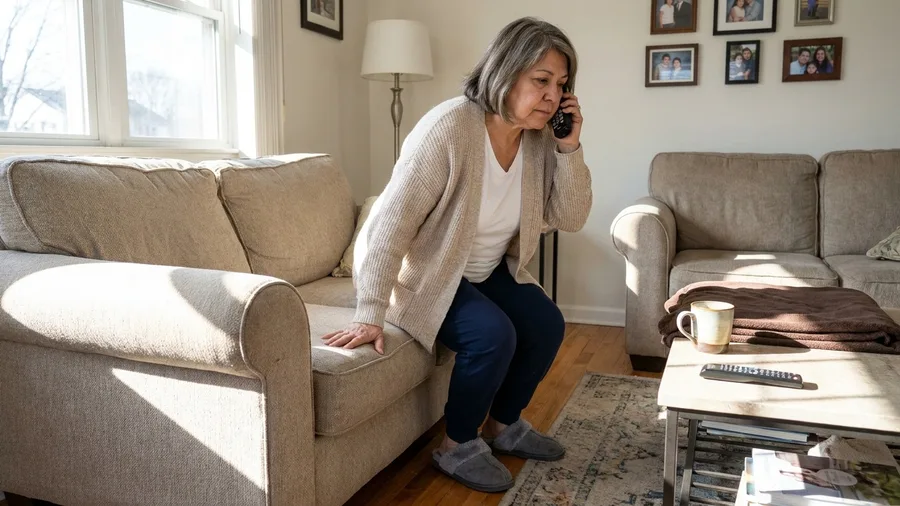
Splitting the walking into two short blocks leaves a question about the hours in between – and what fills them is sitting.
A typical day settles around seven of those hours: a car seat, a desk, a sofa, a long lunch, an evening of television. By mid-afternoon the hips have been folded so long that the fronts ache and the lower back stiffens, which is exactly the soreness a 68-year-old rolls out of bed with at six in the morning.
A morning workout does not buy you out of that.
The hips and back stay in their folded shape for hours after the last set is finished, whether the workout ended at seven or at nine. Training early and then sitting from ten until dinner gives those joints one long stretch of stillness that the workout did not touch.
Two interruptions cost nothing and need no equipment.
Stand to make tea at the kettle and take a call on your feet instead of in the armchair. Each break is under two minutes and asks only that the hips come out of the fold, and a day with six of them never holds one long block of stillness.
If your day is already broken into pieces by work, errands or caring for someone, you are not the person this is aimed at. The target is the unbroken stretch, the two- or three-hour block where nothing asks you to move – not a day that keeps you going and just needs the movement pointed in a useful direction.
💡 Tip: Set a recurring phone alarm for 50 minutes during your usual sitting time. When it goes off, stand for two minutes.
Balance is built by wobbling
Balance is not a switch you turn on. It is a skill you practice by letting yourself be slightly unsteady, and that feels wrong the first dozen times you try it.
Most people grip the counter tightly when they practice, which defeats the purpose entirely. The grip turns a balance drill into an arm exercise: the hands take the load, the ankles and hips never have to make the small corrections that keep a body upright. Fingertips resting on the counter keep a safe edge without doing the work for you.
Falls are the leading cause of injury after 60, and most of them happen during ordinary movement, not exercise. Turning to answer a phone, stepping off a curb, reaching into the back of a low cupboard. Practicing balance and floor recovery is what changes that trajectory, because the body learns to catch itself in exactly those ordinary moments.
The safe setup matters as much as the practice. Work near a counter or a sturdy chair, clear the floor of rugs and cords, and wear supportive shoes rather than socks on tile. If you have already fallen, or a clinician has told you that you are at risk, do not start this unsupervised; a physical therapist should watch the first attempts and tell you what to modify.
3. Holding the counter the whole time trains nothing

Errands and stairs load the legs and hips well enough. What they almost never ask for is the moment the weight rides on one foot and the body has to sort itself out.
That is the gap the kitchen counter practice fills, and it costs nothing but 60 seconds and a little nerve.
Stand near the counter, rest your fingertips on the edge and lift one foot. Thirty seconds on each side is the whole set, and the fingertips are there to catch you, not to carry you.
The distinction matters more than it sounds. A firm grip converts the drill into an arm exercise, with the shoulders and hands doing the steadying the ankles were supposed to learn.
Fingertips resting on the edge give you a safe boundary at hip height and take almost none of the load. One hand flat, pressing down, is the tell that the grip has quietly become support.
Now the part that goes against every instinct you have about protecting yourself. The wobble is the point. Small corrections in the ankle and hip, the ones that fire when the floor feels briefly unreliable, only get trained if they are allowed to happen.
Grip the counter like a ladder rung and the body never meets that uncertainty, so it never practices the fix. You get 30 seconds of standing on one leg with your arm doing the balancing, which trains the arm.
It feels wrong to let yourself sway at first. Most people reach for the counter automatically the first three or four times, and the reaching is worth noticing rather than correcting.
Keep the surface plain, the floor clear and shoes on your feet rather than socks on tile. Slip is the one hazard that makes this exercise a bad idea instead of a good one.
One boundary is firm. If you have already fallen, or a doctor or therapist has told you that you are at risk of falling, this is not a drill to start alone in the kitchen. Ask a physical therapist to watch the first attempt and say whether it is right for you now.
💡 Tip: Time yourself with a kitchen timer. Thirty seconds feels longer than you think.
Balance Practice — At a Glance
⏱️ Hold Time
30 seconds per foot
📅 Frequency
Daily
🖐️ Support
Fingertips only
🏠 Where
Near kitchen counter
📈 Results In
4–6 weeks
Why It Works
Fingertip support gives you a safety net while still allowing the tiny ankle adjustments that train balance.
4. Balance practice must include losing your balance
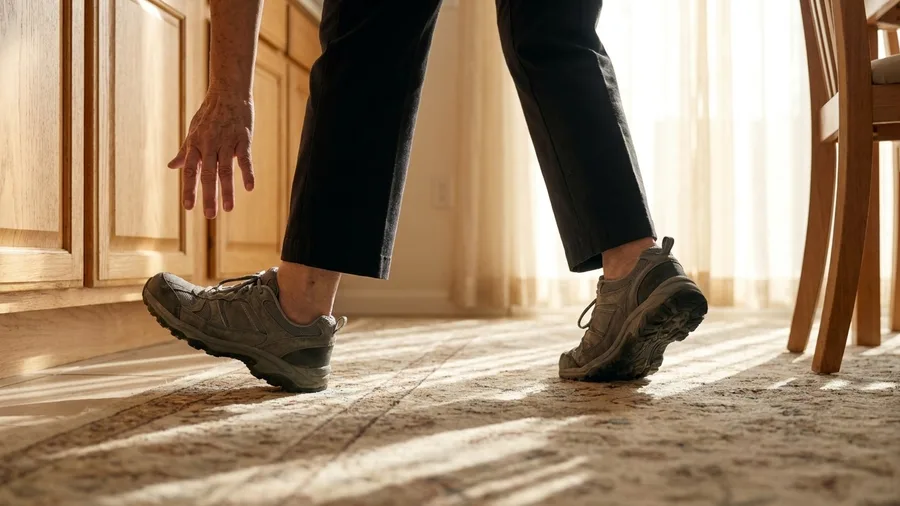
Standing on one leg builds the wobble, but a real stumble is caught by a quick step. If the feet never move, the person goes down.
That is why single-leg standing alone does not seem to stop the near-falls. The skill you actually need in a parking lot or on a wet porch is stepping sideways or backward fast enough to get the feet back under the body before balance is fully gone. Stiffening and freezing do the opposite: the feet stay planted, the hips keep going, and down you go.
You can rehearse that moment on purpose. Stand near the kitchen counter with your fingertips ready at the edge. Take a few small sideways steps on cue, then a few backward steps, letting the feet move quickly and the arms stay loose. Say the direction out loud if it helps. Two or three rounds is enough, and the counter stays within reach the whole time.
Safe place means the counter at your fingertips, a clear floor, and supportive shoes rather than socks. If you have a fall history or have been told you are at risk, have a physical therapist watch before you practice on your own; the stepping drill is worth doing, but it is not something to sort out by guessing.
💡 Tip: Practice stepping sideways in both directions. Most people favor one side without realizing it.
⚠️ COMMON MISTAKE
Don't Grip the Counter Tightly
Holding on with your whole hand turns balance practice into arm support. You will never train your ankles to react. Rest just your fingertips on the counter and let your body wobble a little. That wobble is the workout.
5. Getting off the floor is a skill, not luck

Stepping under yourself is only half the recovery. The other half is what happens when the body is already down, because a stumble on a wet curb or a trip over the dog does not always end with you upright.
The floor transfer is a sequence, not a single heave: roll onto your side, push up to hands and knees, walk the hands onto a chair seat, then stand. Practiced once a week, it is rehearsal, not a fitness set.
Fear is what erases this skill first. People stop trying because they are afraid of getting stuck down there, and the ability fades long before the strength does, which is why someone who could get up at 62 cannot at 70.
That weekly run-through takes two minutes and does more for your confidence on an icy driveway than any strength set. If a knee, hip or shoulder is sore, have a physical therapist or a family member watch the first attempt.
The floor is not the danger. Never having practiced getting off it is.
💡 Tip: Keep a sturdy chair in the room where you practice. The seat height should let you put your hands flat on it comfortably.
Strength you actually use
The last leg of a floor transfer is a small push out of a crouch, and the muscle that carries it is the same one that lifts you off a toilet seat at two in the morning. So the floor practice and the daily strength habit share a target, which is why chair stands belong in the same week.
The whole set is 8 stands from a dining chair, no hands on the arms, once a day. Put the chair where the light is good and drop a cushion on the floor beside it in case you sit back too far. Done right, it takes less than a minute.
What it copies is the exact shape life keeps asking for: swinging your legs out of a car seat, rising off a low sofa that has swallowed you, getting up from a toilet in a public restroom with nothing to grab. A leg-press machine at a gym moves your legs through a path your body never actually uses, so the strength can sit there unused.
If your hands still need the arms to get up, raise the chair instead of forcing it. Stack a cushion on the seat or use a taller kitchen chair until the movement is possible with arms folded across your chest, then work the cushion down over a few weeks.
The catch is that the set quietly stops working. Once 8 stands feel like nothing, the same 8 become a warm-up, not a stimulus, and you have to add a rep, slow the descent, or lower the seat again.
6. Chair stands build the strength that getting up needs

Every floor transfer you rehearse ends the same way: a push out of a low crouch with your hands off the ground. That push is leg strength, and the cleanest place to build it is the chair you already own.
The set is 8 stands from a dining chair, no hands, once a day.
Do it after your morning walk while your legs are warm, not at night when the knees are tired. Fold your arms across your chest, lean the chest forward over the toes, and drive up through the heels. Eight takes under a minute.
It trains the exact pattern daily life keeps asking for, one you cannot rehearse at a machine: easing out of a car seat at the curb, rising off a low sofa that has swallowed you, getting up from a toilet in a restroom with nothing to hold. A leg-press machine pushes your legs along a track your body never uses, so the strength it builds can sit there unused when you need it.
If your hands still need the arms, raise the seat before you push harder. Stack a firm cushion on the chair or switch to a taller kitchen chair until you can stand with arms folded, then remove one cushion every couple of weeks.
The catch is that the set stops working the moment it gets easy. When 8 stands feel like nothing, they are maintenance, not training. Add a rep, lower the seat two inches, or slow the way down until your thighs are working by the third stand.
💡 Tip: Keep your feet flat and shoulder-width apart. Push through your heels, not your toes.
🪑 A Week of Chair Stands
Day 1
Count your stands out loud. If you hit 8 and could do 4 more, the seat is too high – no cushion, hands on thighs.
Day 2
Rest means walking only. Do not swap in squats or stairs – the point is letting the thigh soreness peak and fade.
Day 3
Hands hover at your sides, not on the arms. Brushing the chair counts as a fail; reset and go again.
Day 4
Back-to-back days are the test. If Day 3 left you wincing on the stairs, repeat Day 2 instead of pushing through.
Day 5
Set a timer: 3 seconds down exactly. Most people drop in one second and wonder why the stand feels easy.
Day 6
If 8 hands-free stands felt like nothing, that is your cue – add a ninth rep before you touch the seat height.
Day 7
Only now lower the seat: two inches, or one firm cushion. One change per week, never two at once.
7. Lowering slowly builds more than lifting does
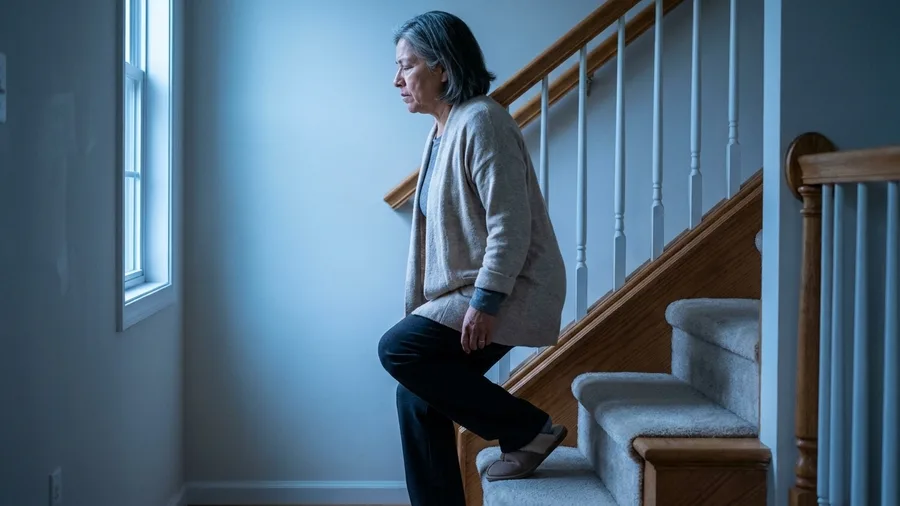
The easiest way to make 8 chair stands harder without adding a single repetition is to slow the way down. The push up stays the same; the descent is where the work moves.
Lower over about 3 seconds into the chair instead of dropping. Count it out at first – one, two, three – because the body's instinct is to fall the last few inches and call it sitting.
The descent, and the same descent on stairs, is the part almost everyone rushes. It is also where most of the strength gain and the joint protection live, because your thigh and hip muscles are working while they lengthen rather than just letting gravity finish the job. Going down a flight of stairs the slow way trains the same thing for free.
Expect soreness in the thighs and buttocks the day after a first slow-lowering set. That is the muscle responding, not damage, and it settles over a couple of days as the movement becomes familiar.
There is one line to hold. An acute knee or hip flare – hot, swollen, sharp on the stairs – is not the day to add slow lowering; skip it and ask a physical therapist before you start. That is the difference between a stiff body adapting and an angry joint being pushed.
💡 Tip: Practice on a stair step as well as a chair. Lowering down a step is a real-life version of the same move.
Speed Matters: Slow vs. Fast Reps
Slow Lowering
- Builds more strength in the tendon
- Improves control and stability
- Feels harder but is safer
- Takes 3 seconds down
Dropping Fast
- Skips the most beneficial phase
- Increases joint impact
- Feels easier but trains less
- Takes under 1 second
8. Stretch the hip front that sitting shortens
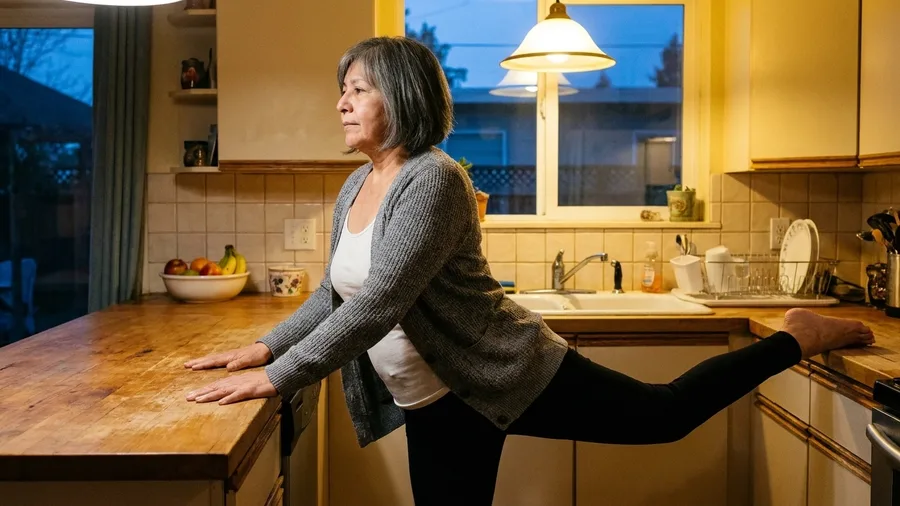
You can add all the slow lowering and chair stands you like, and the front of the hip will stay exactly as short as sitting made it. Strength gives the muscle something to hold. It does not give back the length the chair took.
So the daily stretch earns its place, but only two spots earn it: the front of the hip and the front of the chest. Those are the two that fold closed over a long sitting day, and those are the two that pull the lower back and the shoulders forward with them.
The whole routine is a countertop and one minute. Stand side-on to the kitchen counter, hand on it for balance, back foot behind you, tuck the hips under until you feel a pull across the top of the front thigh. Hold 30 seconds, switch sides, twice a day.
Do the second one facing the counter, forearm up against the door frame or the wall, and turn your chest away from the arm until the front of the shoulder and chest open. Another 30 seconds a side. That is the entire daily stretch bill.
Here is the part most people get wrong, and it explains why stretching so often disappoints. The spot that aches is rarely the spot that is short. The right hip that greets a 68-year-old every morning is usually the front of that hip, pulled tight by seven hours of sitting, quietly tipping the pelvis and loading the lower back instead.
So chasing the ache and stretching only what feels tight leaves the actual problem untouched. Work the front of the hip and the front of the chest, and let the low back and the achy spots be the messengers rather than the target.
A stretch is not a treatment, either. If it hurts going in, or the pain is sharp, one-sided, or has changed how you walk, stop stretching harder and get it looked at by a physical therapist or your physician. More effort on a sore joint is not the fix.
What to expect: a month of twice-daily holds before the morning stiffness starts to ease, and the first week you will feel the pull more than you feel any change. It is one minute at the counter, twice a day. The hip that sitting shortened is the one habit that gets the length back.
💡 Tip: Do this right after your standing break. The two habits pair naturally.
Our Top Picks for Daily Movement
Ranked by ease of starting and impact on daily function.
Making it survive a bad week
A bad week is not a failure. It is a test, and the only question is whether your habit can shrink to its smallest version and still happen.
If it can, it survives. If it cannot, it was never a daily habit – it was a plan that depended on a good mood, decent weather and a free hour, none of which you can promise yourself on a Tuesday in February.
The practical answer is to hang the habit off something the day already does. Chair stands while the kettle boils. The second walk straight after lunch, before the plate hits the sink. The existing event is the cue, so no decision gets made and no motivation gets consulted.
On a genuinely wrecked day, cut the walks first and keep the chair stands – eight stands take under a minute, so the smallest load still happens and the streak stays unbroken. That is the whole point of a minimum: it fits inside a bad day.
One boundary matters here. If pain is new, sharp or one-sided, or it changes how you walk, stop adjusting the plan and get it looked at – a physical therapist can tell you what to keep and what to drop. Shrinking a habit is discipline. Working around a symptom is guessing.
9. New habits survive when they hang off old ones

A habit that needs a fresh decision every morning is a habit that will not last past the first bad week.
The best stretch in the world still fails if you have to remember it from scratch each day. The fix is not willpower. It is attaching the new thing to something the day already does without asking you.
Take the pair that does most of this work. Do the 8 chair stands while the kettle boils in the morning, and take the second 10-minute walk straight after lunch, before you sit back down.
The kettle is the cue. The lunch plate going into the sink is the cue. You do not decide. The day decides for you.
A plan built around a time of day is the one that quietly collapses. "I will do my exercises at 9am" sits there waiting for you to act on it, and some mornings by the time you think of it, it is ten past eleven and the moment is gone.
An after-something plan is different. The kettle will boil whether you feel like it or not. The trigger shows up on its own, and your only job is to follow it.
Now the hard day. You slept badly, the weather is foul, or the calendar is full and the walks are the first thing to fall off. Let them. Keep the chair stands.
The streak survives on the smallest load. Eight stands is under a minute, and the point on a bad day is not the training volume. It is that tomorrow you are still someone who does the chair stands.
"Hang-off" anchoring is one version. Some days are more elastic, so use a visible cue sitting in plain sight, such as the kettle or the counter where you do the stretch, or a phone reminder tied to one task you already complete.
That is the one detail people get wrong: shrinking the set. When the day falls apart, do 4 stands instead of 8, or one walk instead of two. Shrink it, don't skip it. A shrunken habit is still a habit. A skipped one is a decision you now have to keep making.
💡 Tip: Write your cue on a sticky note and put it where you will see it: the kettle, the front door, the lunch plate.
10. New pain deserves a PT visit, not a workaround

Some soreness is the sound of the work landing; some pain is a question only a professional can answer.
The first few days of chair stands and slow lowering will leave the thighs and buttocks talking to you. That is expected. It shows up the next day, feels like a dull ache spread evenly across the muscle, and eases over a couple of days as the tissue adapts.
New pain is a different animal. Sharp, one-sided, or pain that changes how you walk, is not soreness. It is a diagnostic question.
Watch for the tell: you start limping, or the knee catches on the way down. You are not being asked to tolerate that and push through.
Bring three things to the first appointment. When the pain started, exactly, and whether it followed a particular chair stand or stretch. What makes it worse, and what makes it better. And what you have quietly stopped doing because of it.
That last one matters more than people expect. The car, the stairs, the low sofa, the floor practice you now avoid, all tell the clinician where the real limit is.
A first physical therapy visit runs about 45 minutes. The whole job of that visit is to turn a vague worry into a plan you can act on.
Before you leave, get four things straight. The home plan. What to avoid while it settles. When to come back if it does not. And whether your balance or floor practice should be supervised while you work through it.
Then the line. This article is not a diagnosis, and nothing here is. Sharp, new or one-sided pain goes to a PT or physician, and so does anything that changes how you move.
The point of all this is to spend your effort where it lasts and hand the rest to someone who can actually see the problem. Guess wrong on a symptom and you lose weeks; get it looked at and you keep the streak going.
💡 Tip: Bring a list of the movements that hurt. Your PT will ask, and it saves time.
Frequently Asked Questions
How long before I notice a difference?
Most people feel less morning stiffness in 2–3 weeks. Balance and strength gains take 4–6 weeks of consistent practice. The key is consistency, not intensity.
I already exercise. Do I still need these habits?
Yes, if you sit for long stretches. A morning workout does not cancel seven hours of sitting. The standing breaks and short walks fill the gaps that formal exercise leaves.
What if I miss a day?
Do the smallest version instead of skipping entirely. One chair stand or a 2-minute walk keeps the habit alive. Perfection is not the goal; frequency is.
Is it safe to practice balance alone?
If you have no fall history and no dizziness, yes, near a counter with fingertips ready. If you have fallen or been told you are at risk, have a PT watch first.
Can I do these exercises if I have arthritis?
Most people with arthritis benefit from these movements, but you may need to modify the range. A PT can show you how to adjust each exercise for your joints. Do not push through sharp pain.
How do I know if I need a PT?
Any new, sharp, one-sided pain that changes how you walk is a reason to book a visit. A first visit takes about 45 minutes and gives you a plan. Do not guess.
Two Walks Now, Chair Stands Later
Start with one habit, not eleven. The two 10-minute walks, one before breakfast and one after lunch, are the place to begin, because the second block is the one that survives a bad mood, bad weather, or a bad night's sleep. Do those for two weeks before you add anything else. In week three, add 8 chair stands from a dining chair, lowering over about 3 seconds once the movement feels ready.
If you are already unsteady or in pain, skip unsupervised one-leg fingertip balance, the sideways and backward steps, floor practice, and any chair stand or slow lowering that hurts. A physical therapist is the way to sort out what is actually going on, not a guess. The 68-year-old stiff in the right hip and lower back each morning is the point to return to: the aim was never a heroic workout. It is small, repeated movements that fit the day and survive the week, starting tomorrow with a walk before breakfast.
Ready to Start?
Book a physical therapy visit this week to get a plan tailored to your body, or start with the two walks tomorrow morning.