
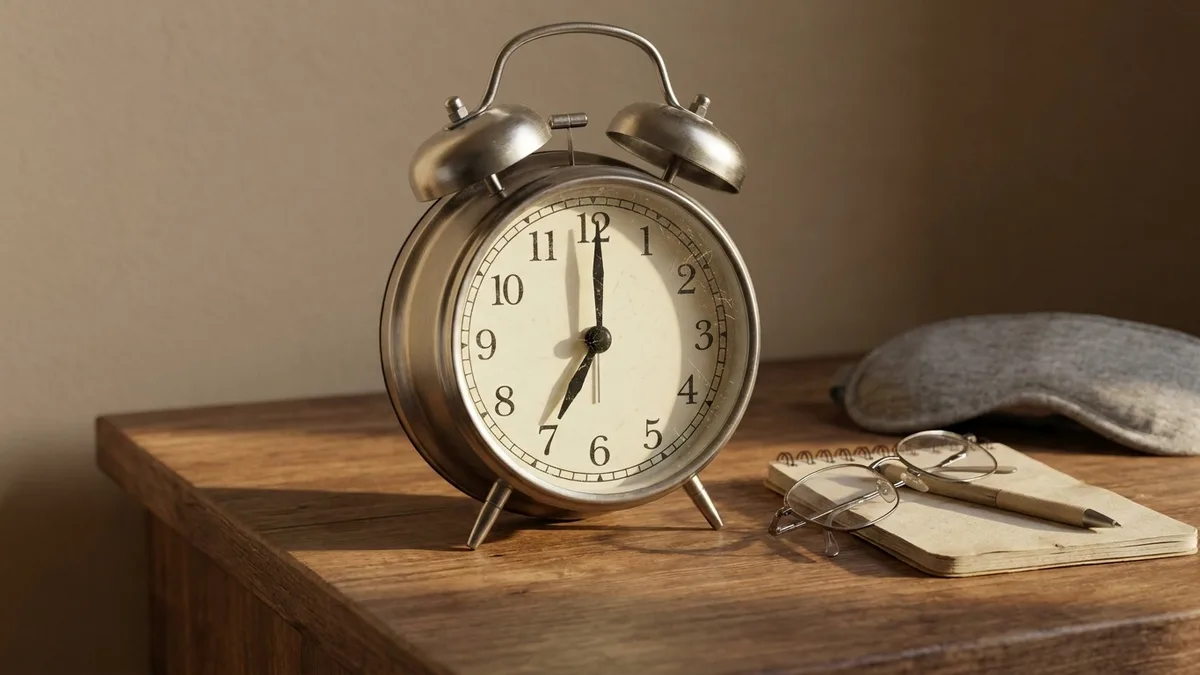
The habit that keeps the healthiest people over 60 going is not a workout or a supplement. It is a wake time they refuse to move. That single fixed hour, 7:00 seven days a week, propping up everything else in the day, is the thing almost nobody protects.
You have likely arrived with a pile of advice that contradicts itself, and the quiet assumption that keeping well at this age takes a gym membership, a shelf of bottles or a full overhaul. The routines that survive are plainer than that. A 7:00 alarm. A one-mile walk before breakfast. A ten-minute call at 17:00.
So this is twelve small daily habits, each sized to fit an ordinary day, copyable a handful at a time. Start with the wake time alone if you like. Hold the other eleven on a written list for two weeks, and you will know which fit, which to skip on a full day, and which questions belong with your doctor.
Quick Tips Before You Start
Anchor the hour first
Pick a wake time and keep it seven days a week before adding anything else – every other habit borrows its timing from it.
Bolt onto a cue
Attach the new habit to something already happening – the kettle boiling, the counter in reach, the lamp going on.
Use real furniture
A firm dining chair and a kitchen countertop cover most of this list. Nothing needs to be bought but shoes.
Size it for a bad day
Every habit needs a two-minute version. One sit-to-stand still counts; a skipped day is the only failure.
Write the list down
Keep the eleven habits you have not started on paper for two weeks. Adding them all at once is how routines collapse.
1. A Wake Time That Never Moves
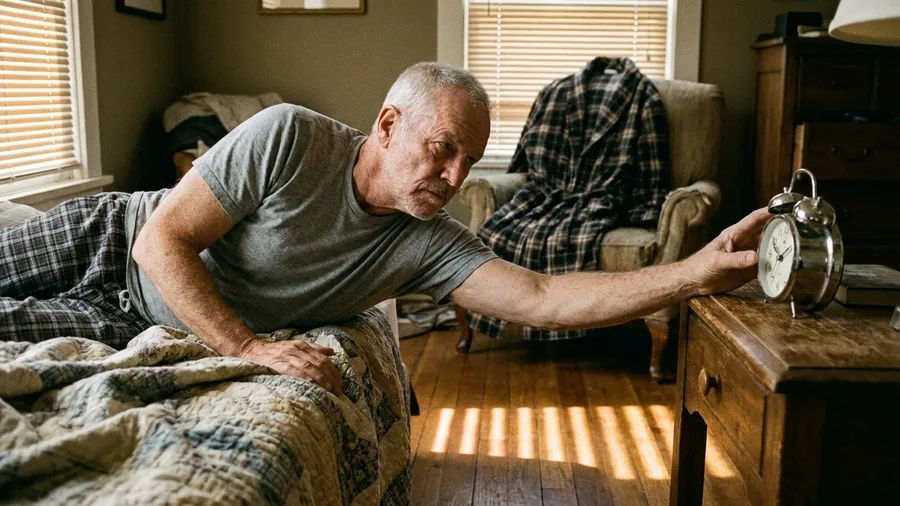
Sleep length gets all the attention. The hour you climb out of bed is what your body actually sets its clock by, and it is the reason this is the one habit to protect before any other.
Set the alarm for 7:00, seven days a week. Sunday included, because Sunday is where the whole thing quietly falls apart.
30, and the 20-minute walk that was meant to happen before breakfast now happens after it. Breakfast slides. So does the 21:30 lights-down, and the 22:30 bedtime slips with it, and by Monday morning the 7:00 alarm is fighting a body that thinks it lives an hour and a half later.
None of this requires willpower so much as setup. Set the alarm the night before. Put the clock on the far side of the room so getting up is the only way to silence it. And open the curtains on your way past, so the morning starts with daylight on your face and one small reason to be standing.
If you are up twice in the night, anchor the 7:00 wake time first and treat the sleep itself as a separate question worth raising with your doctor. The wake hour is the first fixed cue, and every habit after it borrows its timing from that one point on the clock. Get it steady and the rest of the day has something to hang on.
💡 Tip: If the alarm lands at 7:00 and you feel wrecked, do not move the alarm. Move the bedtime fifteen minutes earlier for a week instead.
2. Ten Minutes Outside Before Breakfast

Once 7:00 is fixed, the hour after rising is free real estate, and the best use of it is a walk you can talk through.
Twenty minutes outdoors before breakfast, about a mile, on the same route past two houses and back. That is the whole workout. No pace target, no heart-rate target, no intervals.
You should be able to hold a conversation the entire way. If you are too winded to talk, you are going too hard for what this habit is doing.
Outdoors earns its place over the treadmill for a reason beyond step count. Morning light and a change of scene do work that the same distance indoors does not, and the point of the walk is when and where it happens, not how hard it pushes you.
Bad weather does not cancel it. A coat and the porch will do, or the same walk straight after breakfast instead of before. The route itself needs no equipment beyond a pair of walking shoes, at about $90, and nothing else.
It is deliberately unimpressive. That is what lets it survive an ordinary morning, a stiff knee, and the version of you that does not feel like exercising.
💡 Tip: Choose the route once and never vary it. Decision-free is what makes a walk survive a low-motivation morning.
💡 PRO TIP
Two-Minute Fallback, Every Time
For each habit on this list, decide the bad-day version now, while you are reading. Porch instead of the mile. One sit-to-stand instead of ten. The fallback is not a failure – it is the part that keeps the cue alive until the full version comes back.
3. Protein at Breakfast, Not Just Toast

The morning walk should end at a chair, not a counter.
Breakfast is the meal that gets hollowed out first. Toast and a second cup of coffee take four minutes standing at the counter, and by eleven the morning feels thin – not hungry exactly, just thin – and lunch turns into something to get through rather than something to sit down to.
The version worth copying takes six minutes and a plate: two eggs cooked any way you like, a cup of plain Greek yogurt, and near 25 grams of protein before eight.
Research on older adults keeps pointing to roughly that amount as the level where a meal starts doing muscle work instead of just filling you up. That matters more each decade, because the body gets less efficient at using the protein it takes in.
How much more you need is a question for your doctor or your country's nutrition guidance; kidney conditions in particular change the answer.
Sitting down is the part people skip.
Eaten standing at the counter, breakfast is a graze – something done while reaching for the car keys – and a graze is the first thing dropped on a rushed morning. Eaten at a table, it is a routine with a beginning and an end, and routines survive bad days. The trade is six minutes and one dirty pan.
4. Balance Drills at the Kitchen Counter
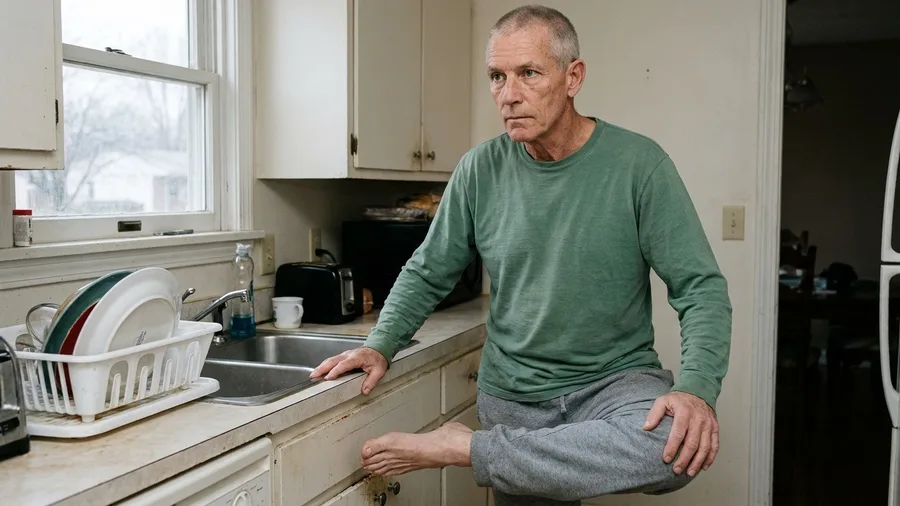
Breakfast ends at the table, and the counter is already there, so the balance work lives where you already stand. Three times a morning, one foot up, fingertips resting on the countertop, twenty seconds each. Do it again before dinner and the whole thing comes in under two minutes.
Balance is not a fixed trait you were issued at birth.
It is a skill, and like any skill it is built in installments. The wobble you feel in the first week is the thing you are training, not a sign you should stop. Physical therapists say the same: practice the unsteady moment on purpose, with a handhold, and the body learns to catch itself.
The kitchen is the point. The counter sits within arm's reach the entire time, which is the whole safety plan. No mat to unroll, no class to drive to, no equipment to buy. You hold on, you lift a foot, you count to twenty, you put it down.
Progression is slow and deliberately unimpressive. Start on fingertips. When twenty seconds pass steady, drop to one finger. When that holds, try nothing at all, but keep the counter a hand's width away. Most people take weeks at each stage, and that is fine.
What makes it stick is that the cue already exists.
You are standing at that counter every morning and every evening anyway, waiting on coffee or watching a pot. The drill borrows a moment you were going to spend regardless, which is why it survives a busy Tuesday when a balance class would not.
💡 Tip: Do the before-dinner set while the oven is on. The oven warming up is a cue you cannot miss.
Kitchen Strength and Balance — At a Glance
🪑 Chair Work
10 sit-to-stands, twice daily
🦵 Balance
3 × 20 seconds, twice daily
⏱️ Total Time
Under 4 minutes a day
🧰 Equipment
Dining chair and countertop
💵 Optional Extra
$15 resistance band, after month one
Why It Works
Both habits are pinned to things already in the kitchen – the kettle and the counter – so the cue fires whether or not you remembered.
5. Sit-to-Stands While the Kettle Boils

The same counter that steadies a one-foot stand holds the kettle, and the kettle supplies the timing for the next thing. Kettle on, chair pulled out, ten stands up and down from a firm dining chair, then ten more before the water goes over the tea.
That is the whole session, twice in a morning, roughly ten seconds a burst.
No gym membership, no class to book, no slot in the calendar. What it costs is a chair with a solid seat that does not rock, and two minutes you were already standing around waiting through. The habit earns its place on when it happens, not on how hard it looks.
The reason to bolt it to a wait rather than schedule it is that a plan needs defending and a kettle does not. Research on leg strength in older adults keeps pointing the same way: muscle responds to short, repeated loading, and a set of stands every morning keeps the pattern alive far better than one ambitious session that gets postponed on a busy Tuesday.
Put it on a wait you already stand through and it survives the week you would have skipped.
One optional extra, and not yet. A resistance band runs about $15 and adds load once the plain stands feel easy, so hold off a month before buying one.
One more thing, and it comes before the first stand rather than after: if you have had surgery recently, or you feel unsteady the first time you push up out of the chair, run it past your doctor before making it daily.
The stands are not a workout to be proud of. They are ten seconds of loading hooked to a kettle, which is exactly why they are still happening in March.
The Same Week, Two Ways
6. One Scheduled Phone Call, Same Time Daily

From the kitchen the day's fixed points reach outward, and the next one is a call at 17:00. Ten minutes, the same hour daily, working through three names kept on a card by the phone. The slot is fixed; the person rotates. That is the whole system.
How do you keep up with people without it turning into a chore?
By giving contact an appointment and an end. A call has both: it starts at five, it finishes at ten past, and you are done. A text chain has neither, so it gets deferred, then drifts, and a month passes. The call does a different job than messaging, and the fixed slot is why it happens.
When nobody answers, go to the next name on the card and try again at the same time tomorrow. No makeup calls, no guilt about the one you missed. The rhythm matters more than any single conversation, and a missed day does not break it if the hour stays put.
The counterweight is worth naming plainly. If you already see people every day, this slot is wasted on you; you need one person you never call, not more calls. Contact survives on a fixed hour and a short list, not on good intentions.
Three names is enough to start. Write them on a card, prop it by the phone, and let the clock do the remembering.
💡 Tip: Keep the three names on a card next to the phone. A list on your phone is a list you scroll past.
7. A Ten-Minute Worry Window With a Pen

Worry responds to the same trick as a phone call: give it an hour and a place, and it stops spreading across the whole day. A ten-minute window at 16:00, with a $4 paper notebook and a pen, does the same job facing inward that a scheduled call does facing out.
The setup takes one minute. Draw three lines on a fresh page: what I am worried about, what I can do, when. That is the whole apparatus.
The point is postponement, not solving. You are not fixing the worry at 16:00 you are moving it there, out of the other twenty-three hours. Most worries survive the wait; some shrink on the page.
When a worry arrives at 09:00, write one word on a scrap of paper and go back to what you were doing. The scrap goes in the notebook at 16:00. That is the entire response, and it works because it gives the worry an appointment instead of an argument.
This suits ordinary fretting, the kind that circles a bill, a name, a conversation not yet had. Relentless anxiety or low mood that does not lift belongs with a clinician, not a notebook.
A fixed appointment and a page are what let the rest of the day go quiet. Sit down at 16:00, write, close the book, and the day belongs to you again.
Cue-Fixed vs. Willpower-Fixed
Fixed to a cue
- Sit-to-stands happen because the kettle is on
- The call happens at 17:00 because it always does
- Water is refilled at 8:00, 12:00 and 16:00 because the bottle sits by the kettle
- Balance drills happen because the counter is right there
- A bad day has a two-minute version already decided
Fixed to intention
- Exercise planned for 'sometime this morning'
- Call a friend 'soon'
- Drink more water 'when I remember'
- Start balance work 'after the holidays'
- A bad day becomes a skipped week
8. Lights Down an Hour Before Bed

Worry parked on a page at four in the afternoon leaves the rest of the day free of it. The evening can then go to a second fixed sequence: closing the house down before sleep.
At 21:30 the overheads go off and the lamps come on. The phone goes to a charger in another room, not the nightstand. By 22:30 the reader is in bed with a paper book for twenty minutes.
No single step in that hour carries the whole effect on its own. What repeats is the order: overheads off, lamps on, phone out, book open, the same order every night.
Repetition is the active ingredient.
After a rough night, the 7:00 wake time stands and the evening sequence is dropped for that one evening. Dim, phone away and paper book make a repeated hour, not a pile of separate tips.
The container is the point: one hour, three moves, in order.
💡 Tip: Put the phone charger in the hallway. Willpower at 22:00 is not a plan; distance is.
⚠️ COMMON MISTAKE
Adding All Twelve at Once
The standard failure with a list like this is starting five on Monday. By Thursday two are gone and by Sunday you have decided the whole thing does not work. Start with the wake time alone for two weeks. Keep the other eleven on paper and add one only when the last one has run a full fortnight without negotiation.
9. The Water Bottle Refilled at the Same Cue

A dimmed house is one kind of cue. The next habit protects a signal that gets quieter with age: thirst.
A 24-ounce bottle lives on the counter beside the kettle and gets filled three times a day, at 8:00, at 12:00 and at 16:00. It costs about twenty dollars, and the bottle is the entire kit.
With age, waiting to feel thirsty stops working, so the drink happens at set moments whether or not the signal shows up.
It sits in sight and in the way, filled at mealtimes rather than carried around and set down somewhere forgotten.
A heart or kidney condition changes the picture; ask the treating clinician about fluid limits. This entry states no number for any reader.
Drinking stays with one bottle in one place and three fixed times. Memory and tracking are not asked to do it.
🕖 The Fixed Day, From 7:00 to 22:30
7:00 — Wake
Alarm across the room, curtains opened on the way past, same hour every day including Sunday.
7:15 — Out the door
Twenty minutes, about a mile, past two houses and back, easy enough to hold a conversation.
7:45 — Hardest task
The one thing named on last night's index card, started before email, phone or news.
8:00 — Breakfast and the bottle
Two eggs and Greek yogurt at the table, water bottle refilled beside the kettle.
16:00 — Worry window
Ten minutes with the notebook: what I am worried about, what I can do, when.
17:00 — The call
Ten minutes, one name from the card by the phone, next name tomorrow if there is no answer.
21:30 — Lights down
Lamps go low, phone charges in another room, paper book in bed at 22:30.
10. The Hardest Task Before the Inbox

A body cue kept in one place handles thirst. The first work cue needs the same treatment, because the hardest task of the day will not name itself while the inbox is open. It gets a name the night before and a fixed moment to start.
The night before, take an index card and write one thing on it: the task that would make tomorrow easier if it were done. Give it 30 seconds, no more. If you sit there weighing five candidates, you have already spent longer choosing than the habit costs.
At 7:45 the next morning, the card is on the desk before email, before the phone, before the news. Not after the first cup of coffee and the headlines. The order is the habit.
The same task saved for 15:00 sits behind a whole day of small decisions. By then it takes longer to start, and it is far easier to set aside for tomorrow. A tired mind finds reasons an alert one would not have offered.
The 7:45 slot does not fit a morning already given over to caregiving, an early appointment or a school run. Use the first free 20 minutes instead, whatever the clock reads. The fixed cue is the card and the desk, not the hour.
This is the trade-off, plainly: one task gets done, and the inbox waits its turn. Some mornings that means a reply goes out an hour later than someone hoped. That is what the habit costs, and it is the reason it works.
Your inbox will always set an agenda if you let it. A named task on a card, started at a fixed moment, gets finished before anyone else gets to decide what your morning is for.
11. Three Specific Good Things, Named Out Loud

A card on the desk gets the hard thing done. The evening needs something just as fixed: a page, written at the same hour every night, holding three good things named so precisely that a stranger could picture them.
Picture the difference on paper. 'Family' fits almost any day and tells you nothing; 'the 08:10 call with my sister' pins down an hour, a person and an event, and the moment comes back to you when you read it. Turn the page and see which kind of line you actually wrote.
That gap is the whole mechanism. A vague entry asks the mind to agree that things are fine, and minds are good at shrugging that off. A dated, particular one makes you go back through the actual hours and find what happened.
Practise it once. Instead of 'a nice walk,' write 'the dog on the corner, the one with the crooked ear, out at 7:40 in the drizzle.' Costs nothing; it just needs the detail, not the mood.
The page is not a mood log and not a remedy. It is a small repeating habit with a fixed slot, the same way the morning's habits have theirs – write it down, not the thought, and never the word 'good' on its own.
Be honest about what it can do. For ordinary fretting at the end of an ordinary day, this helps. For acute grief or a low mood that has settled in and stayed, three lines on a page are not the answer, and that conversation belongs with a clinician.
The writing is what separates it from a passing thought. Say it plainly, in pencil, at the same point tonight.
💡 Tip: If you cannot remember anything specific, look at your phone's photos from that day. The detail is usually there.
The Whole List, by the Numbers
Small enough to fit an ordinary day
12. The Two-Minute Counter Reset at Night
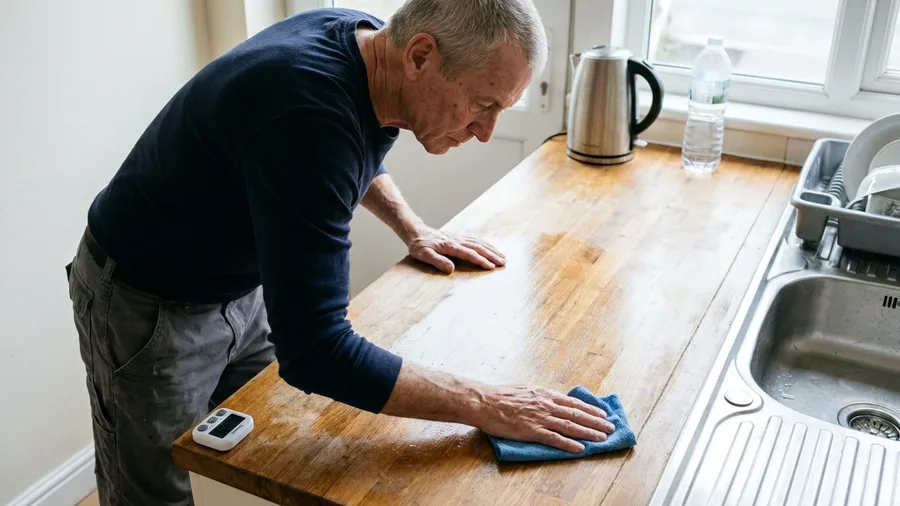
The evening page closes the day. The last habit in the same evening loop hands tomorrow morning a clear surface – two minutes at 20:30, one counter, timer set.
Set the timer first, before you touch a plate. Two minutes, and the target is the single stretch of counter where tomorrow's breakfast gets made, not the kitchen, not the floor, not the cupboard nobody opens.
That one surface will do more across twelve months than a spring clean every season. An annual blitz feels satisfying and gets undone by Wednesday; a nightly two-minute pass on the same three feet of worktop is short enough that you never argue with it.
The payoff shows up at 7:40 the next morning. Eggs onto a clear board, the yogurt out of the fridge, the 24-oz bottle filled at its 8:00 mark without moving a pile of post to reach the tap. Nothing stalled at the first step.
The stopping rule matters as much as the start. When the timer goes off, stop – even with a stack still sitting there. Two minutes repeated is the point; twenty minutes once a week is a different, heavier job that tends to get postponed.
It stays on the list for one reason only: small daily friction removed, not housekeeping done. Skip it on a full day without guilt, and let the morning be slightly cluttered.
Frequently Asked Questions
Why does the wake time matter more than the number of hours I sleep?
A fixed hour stabilises your internal clock, and a stable clock is what makes falling asleep at a predictable time possible. Seven hours on a fixed schedule usually beats eight hours on a moving one. If you are up twice a night, anchor the wake time first and treat the broken sleep as its own problem with your doctor.
Do I have to buy anything to start these habits?
Almost nothing. A firm dining chair and a kitchen countertop cover the strength and balance work. The full kit across all twelve habits comes to roughly $129 – walking shoes around $90, a water bottle $20, an optional $15 resistance band and a $4 notebook. Skip the band until you have done a month of chair work.
What is the two-minute version of the daily walk?
Coat and porch on the same schedule, or the same twenty minutes straight after breakfast if the weather is foul. A moved walk keeps the cue alive; a cancelled one is how the habit disappears. Apply the same logic to everything else on the list – one sit-to-stand instead of ten still counts.
Does the worry notebook work if my worries are serious?
The 16:00 window suits ordinary fretting about money, family and appointments – postponement is the mechanism, not solution. Relentless anxiety or a low mood lasting more than a couple of weeks belongs with a clinician. A notebook is a useful tool and a poor substitute for treatment.
How long before these habits feel automatic?
Expect about two weeks for a cue to start firing on its own, and six to eight weeks before a habit feels strange to skip. That is why the advice is one habit at a time – twelve new routines started together never reach the automatic stage at all.
Can I do these if I am a caregiver or still working?
Yes, with the timing moved rather than the content. The hardest-task slot goes in your first free twenty minutes instead of 7:45, and the walk can follow breakfast. What has to stay fixed is the sequence, not the clock time on every item.
Start With 7:00 and Leave the Other Eleven on Paper
Start with 7:00 and nothing else. Set the alarm for the same hour every morning, put the clock across the room, and run it two weeks before you add a single thing, because every other habit here is timed off that hour.
If a day arrives already full, drop the $15 resistance band and the counter reset outright. Neither holds the day together. Write the other eleven down, keep the list where you will see it, and at the two-week mark test them one at a time against your own week rather than a stranger's. Protein amounts, fluid limits, anxiety that will not settle: those go to your clinician.
None of this is impressive, and the conflicting advice you started with was never the problem. A fixed hour nobody moves, repeated, is what carries the day. The workout, the supplement, the overhaul – set them down and protect 7:00 instead.
Set Tomorrow's Alarm Tonight
Pick the hour, put the clock across the room, and write the other eleven habits on one sheet of paper. That is the whole first week.