

Is cozy cardio actually exercise, or just standing in your living room in soft pants? Here is what this settles: whether it counts, why it fits a midlife body in particular, and where it quietly stops being enough.
The pull is obvious. A video promises walking or light dance at home in comfortable clothes, no gym, no class, no mirror – and it lands on someone who has restarted fitness four times and quit four times. That history is the real obstacle, not the workout.
The turn is that the format is ordinary movement, usually 15 to 30 minutes at home, not a hidden method. What the low bar changes is whether you show up, not what your heart and muscles get out of it.
So treat it as a useful on-ramp rather than a full plan. It can be real exercise and still not replace progressive strength or sustained cardio, and the thing to judge it by is repeatability – can you do it again Thursday? – not the identity it seems to promise.
The test that follows costs nothing: three sessions of 10 to 15 minutes in week one, before any gear, any subscription, or any announcement to your family.
At a Glance
Cozy cardio is low-pressure movement at home
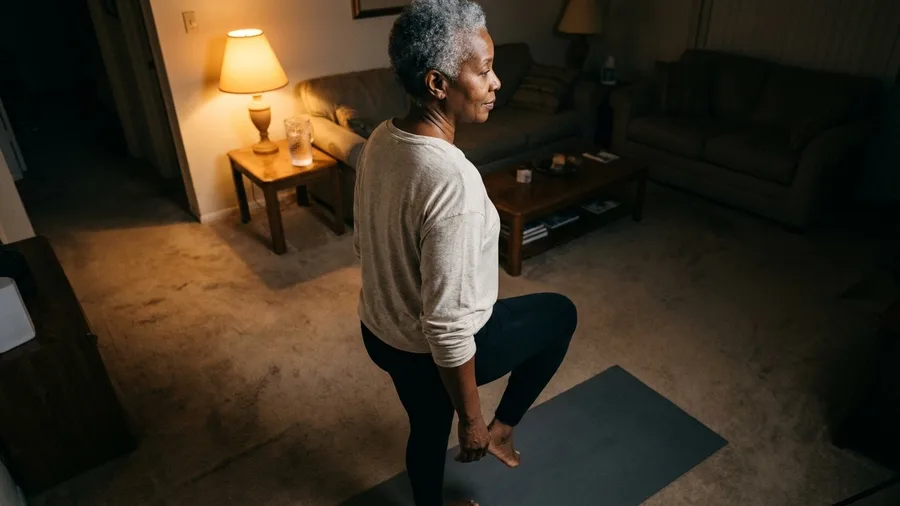
Cozy cardio is 15 to 30 minutes of walking, marching, light dance, or gentle mobility done at home – in the living room, the backyard, or out the front door for a short walk. No gym, no class, no start time.
The setup is deliberately plain. Comfortable clothes, bare feet or sneakers, a stretch of floor, and that is the whole list. There is no special outfit to buy, no mirror to stand in front of, no instructor waiting on a schedule. For a 48-year-old desk worker who has gone two years without regular exercise, 15 minutes of marching in place followed by a few slow hip and shoulder circles is a complete session that fits the definition exactly.
What it is not: medical treatment. Nothing about the cozy setting cures, rehabilitates, or diagnoses anything, and any claim that it does should make you skeptical of the source.
Here is the distinction that matters. Whether a session counts as real exercise is settled by your pace and your load, not by the comfort of the room. Marching slowly while you watch television is movement; the same march at a brisker clip for 15 unbroken minutes is exercise.
The lower barrier buys you a repeatable start. It does not buy fitness on its own.
It borrows the gym's basics without the gym
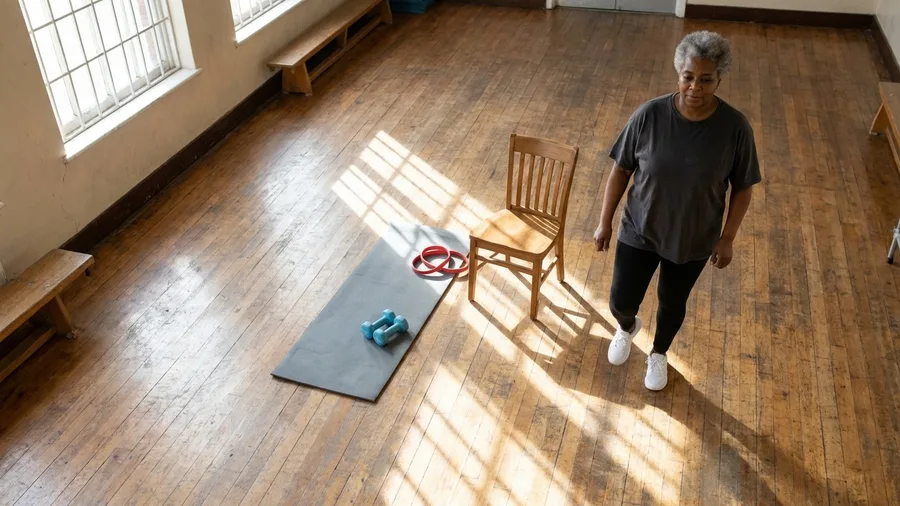
The movements are the ones a gym class would give you: walking, marching, squats, a light pair of dumbbells, a resistance band. What got stripped out is the room, not the exercises.
You can do every one of these with bodyweight alone, so no equipment is required to complete a session. A band or a light set of dumbbells adds resistance later if you want it, but the bodyweight version stays valid at any point.
Compare it with the class you keep not signing up for. No membership, no wall of mirrors, no audience of regulars who already know where the mats go, no 6 p.m. start time to rearrange your day around. The social and logistical pressure is removed. The squat is identical.
Effort sits on a continuum and you set the dial. A slow march and a brisk walk with a band looped around your thighs are both cozy cardio by format, and they are not the same workout. That gap is the honest catch: the stripped-down setup lowers the entry barrier, then leaves progression entirely to you.
Choose pace and load on purpose. Pick a pace where you can still speak in full sentences – if you are breathless, ease off or shorten the session.
The Cost of Finding Out
The low bar is the feature, not a flaw
Because a lower bar attacks the rule that sinks most midlife restarts: if it is not long and hard, it does not count.
That rule is brutal in practice. One missed session becomes a failed week, the failed week becomes proof you cannot do this, and the shame quietly ends the whole attempt – often before the third week. A set of small mental habits can shift that story, and mindset shifts for feeling young offers first steps you can take this week.
A ten-minute session breaks that chain because it still counts as a rep. It keeps the cue and the routine intact, so you are maintaining a habit instead of restarting from zero every time life interferes. Kept faithfully, three short sessions a week leave the routine stronger than one heroic session followed by a fortnight of nothing.
The honest counterweight: if you need structured progression and external load, this loose format will feel like it is going nowhere. There is no built-in rule telling you when to add weight or minutes.
For the people it suits, the recipe is unglamorous – a fixed time, repeated sessions, no performance standard, scheduled like a dental appointment rather than squeezed in when you feel motivated.
The low bar reduces shame and makes repetition likelier. The evidence is sessions you actually completed, not sessions you meant to do.
⚠️ COMMON MISTAKE
Don't Wait to Feel Ready
The most common midlife mistake is spending three weeks researching which mat, which app, which shoes — and zero minutes moving. Do the first session in socks on a bare floor. Buy nothing until you have completed six.
Midlife bodies often want joint-friendly movement first
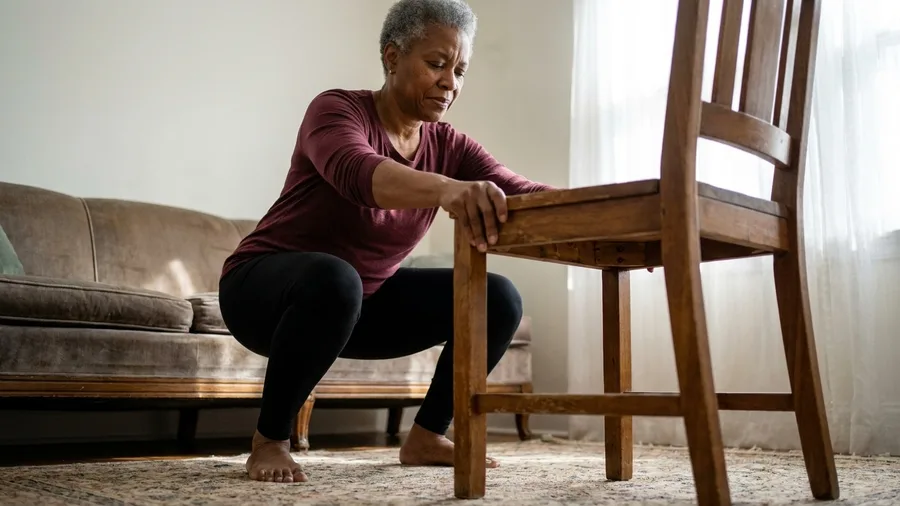
Joint-friendly movement first is the right order, and cozy cardio happens to sit almost entirely inside that menu. Walking, marching, chair squats, gentle mobility, a light resistance band – none of it requires a jump, a pivot, or a landing.
That matters more after 40 because cartilage, tendons, and the small stabilizing muscles around the knee and shoulder recover more slowly than they did at 25. A high-impact class that felt fine two decades ago can leave a 48-year-old limping for three days. The cozy format skips the pounding.
Picture the 48-year-old desk worker who has not exercised regularly in two years. What that person wants is not a race plan – it is to move without paying for it tomorrow. Chair squats and a walk around the living room fit. The intensity check is simple: you should be able to speak in full sentences. If you are breathless, slow down or shorten the session.
Every move scales. You modify by range of motion, by how high or low the chair is, by how much tension is in the band. A shallow squat to a tall seat is still a squat.
Here is the boundary, and it is a firm one. A real injury, a diagnosed condition, or pain that does not settle needs a clinician or a physical therapist, not a video. Cozy cardio is not a rehab plan and it is not a substitute for diagnosis – and if you are working around an old injury, get it looked at before you build a routine on top of it.
Tolerable range and pace are the test. The lower joint stress buys you participation, which is the whole point of an on-ramp. It does not buy treatment, and it does not buy strength progression. That stays ahead of you.
No audience means less self-consciousness
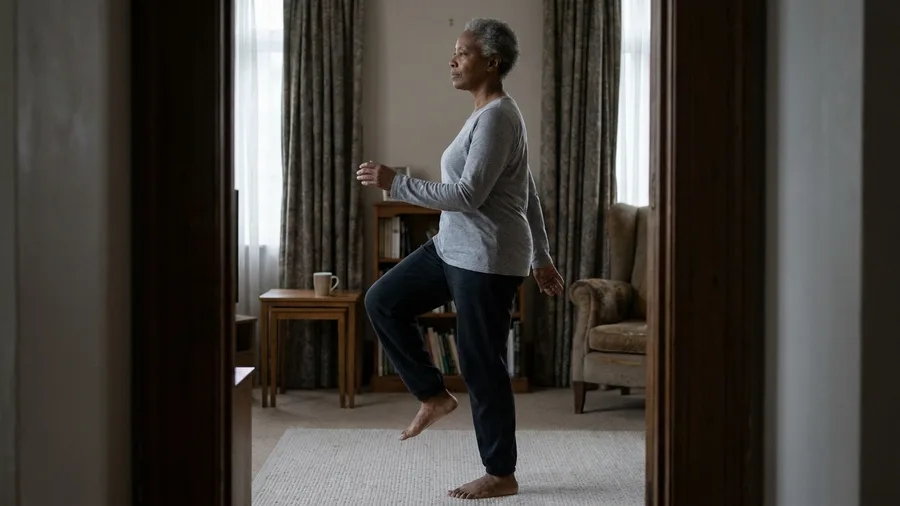
People who hate gyms like this because the gym asks them to perform before they have done anything – and the living room asks nothing. Joint comfort is one barrier down. The audience is the other one.
Walk into a gym after two years off and the load starts before the first rep: the mirror wall, the crowd on the machines, the quiet math of comparing your body to everyone else's, the machine you cannot figure out how to adjust. Physical therapists hear a version of this constantly – the social and mental cost of showing up outweighs the exercise itself.
The living room strips all of it. No one watches your form. No outfit competition. No wait for the squat rack. You are barefoot on the rug with a ten-minute video, and nobody sees the first clumsy week.
The counterweight is real, though. Some people need a class time or a trainer's expectation to show up at all, and for them solitude quietly turns into avoidance – the mat stays rolled in the corner for a month.
If you know that is you, give the home session supports that behave like an audience: a set time on the calendar, a short video you press play on, and no performance target at all. Less self-consciousness lowers the barrier to repeating. It does not supply accountability for everyone, and it is worth being honest with yourself about which one you are.
💡 PRO TIP
The Talk Test Does the Work
You should be able to speak in full sentences the whole session. Not a gasping word, not a song — a sentence. If you cannot finish one out loud, slow the pace or cut three minutes off the clock. That single check replaces a heart-rate monitor.
It fits a tired adult's schedule, not an athlete's
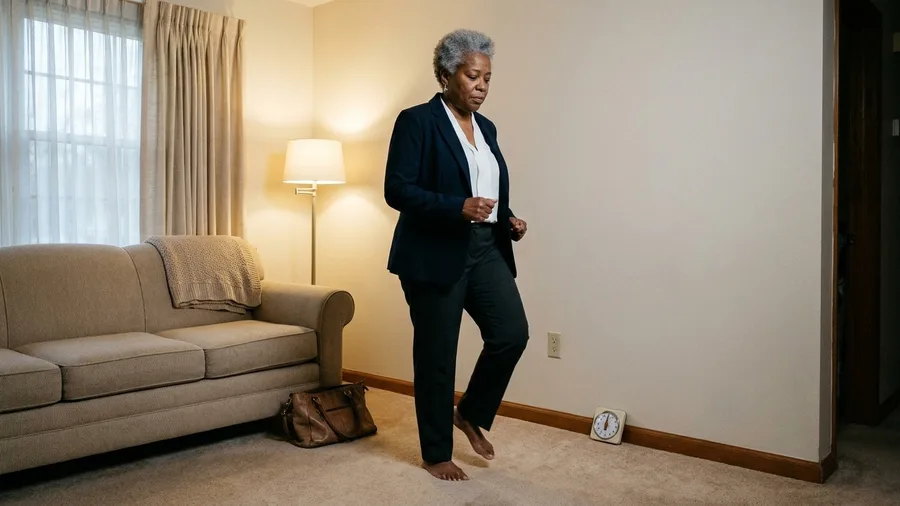
– because on a bad day the session shrinks instead of dying. A 15-to-30-minute block can drop to 10 or 20, or split into two 10-minute pieces, one before work and one after dinner.
The midlife calendar is the real obstacle. Work, caregiving, a commute that eats an hour each way, sleep that is already thinner than it was at 35. Notice what the session is competing with: not a leisure block, but recovery time. That is why the no-commute, no-packing-bag advantage is bigger than it sounds. You change nothing, drive nowhere, and movement starts in the living room or the backyard.
The limit is equally clear. This will not build event-specific fitness or serious strength. If you are training for a half marathon or trying to add real weight to a bar, you need a different plan with progression written into it, and cozy cardio is a fill-in on the days that plan falls apart.
Schedule fit makes repeatability possible. It does not make fitness complete – and mistaking one for the other is how the busy week becomes the whole year.
✅ The Two-Week Test, Step by Step
Clear a patch of floor
Push the coffee table back, lay a towel or mat down, and pick the same spot each time.
Book three slots in week one
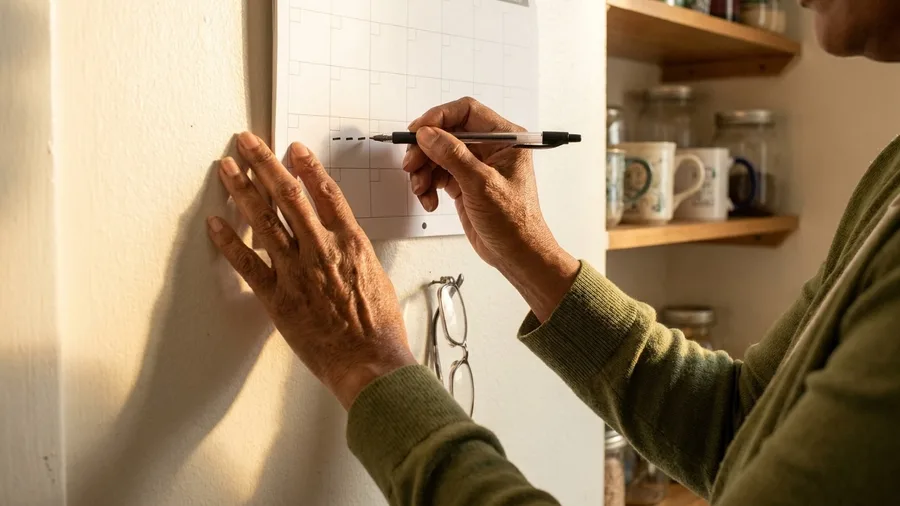
Pick fixed times and put them on a paper calendar — 10 to 15 minutes each, no exceptions made up later.
Keep the first session boring
March, walk, do a few chair squats and gentle mobility; stay at a pace where you can speak in full sentences.
Track done or not done
Mark an X for completed sessions only — skip intensity, calories, and how you felt about it.
Add five minutes only if it felt easy
If the session was still comfortable afterward, add five minutes; if you were wiped out, hold the duration where it was.
Finish six sessions, then decide
Six completed sessions in two weeks is your evidence — buy gear, add load, or stop without shame.
The real payoff is a sense of control

Picking the time, the music, and the pace yourself is what makes it feel unlike a membership you never use.
A gym membership is a transaction that keeps running whether or not you show up: the monthly charge, the class schedule, the bag you packed and did not carry. Cancelling costs a phone call and sometimes a fee. Guilt arrives by mail.
A session in the living room has no such invoice. You stop halfway through, nobody bills you, and nothing to cancel. That absence of consequence is a real motivator at 48, when a failed resolution has already cost you once.
Ten minutes of marching in front of a kitchen chair is evidence you can do this, and evidence is what confidence is actually made of. A 48-year-old desk worker who finishes three of those in the first week has a small, useful fact: the session happened before dinner, in the clothes already on.
That fact, repeated, is different from a plan on paper. Autonomy is the reward that keeps you coming back to a format you chose.
The catch is that the reward fades once the novelty does. Without a standing time on the calendar and a way to add five minutes when a session still feels easy, freedom quietly becomes a decision you keep postponing. Control gets you in the door; a repeatable slot and a progression rule are what keep you inside.
Reading Your Own Two Weeks
- ✅ Six sessions done, still speaking in sentences — Real data. Add five minutes or light dumbbells next.
- ✅ Tired but not wrecked the next morning — The dose is right; keep the schedule steady.
- ⚠️ Four or five sessions out of six — Fit is close. Shrink to 10 minutes rather than quitting.
- ⚠️ Breathless and unable to finish a sentence — Slow the pace or shorten the session — no heroics.
- 🛑 Joint pain that outlasts the session — Shorten the range and check with a clinician before continuing.
- 🛑 Two sessions in fourteen days — The format is not the problem — the schedule is. Change the slot.
What cozy cardio is not enough for
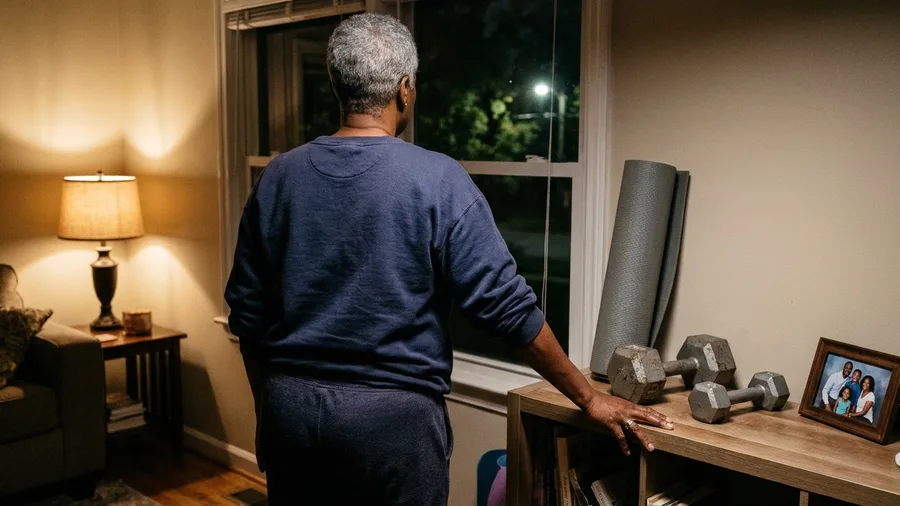
It is not enough for strength, because strength needs progressive load, not movement.
Ten minutes of marching and chair squats with bodyweight builds the habit of moving. It does not build the load that tells a muscle to get stronger. For that, the resistance has to rise over time: heavier dumbbells, thicker band, more reps or more range, session after session. Light dumbbells at 15 to 30 dollars can be the start, but they are a start, not a program.
Cardio fitness asks something else again: sustained effort across time.
A comfortable 15-minute walk in the living room is real movement and it builds recovery and habit. It does not build endurance the way a brisk walk where your breathing is steady and hard for 30 minutes does, repeated through the week. The intensity check is simple: if you can speak in full sentences, it is a good starting pace, and it is not yet a conditioning pace.
So what is it enough for? Starting, building the habit, recovering on a busy day, and acting as a gateway to a fuller plan.
The honest line: real exercise, yes; enough fitness, no.
Buy Nothing vs. Build a Kit
Buy Nothing First
- Shoes you already own and a sturdy chair
- A towel on the floor instead of a mat
- Two weeks of sessions before any purchase
- The test costs $0 and tells you the truth
Build a Kit Later
- Mat $20–$40, dumbbells $15–$30, band $10–$20
- Full basic kit stays under $75
- Optional app or video series $10–$15 a month
- Buy in that order — band and dumbbells before the mat
Costs are small; unused gear is the real waste

For the first two weeks, you need nothing you cannot already find at home.
Sturdy shoes, a chair, a towel, and the floor and wall around you are enough for three sessions a week at 10 to 15 minutes. That costs zero, and no subscription is required for the test. An optional app or video series typically runs 10 to 15 dollars a month, which can also wait.
If the habit survives the test, the basic kit is small: a mat at 20 to 40 dollars, light dumbbells at 15 to 30 dollars, a resistance band at 10 to 20 dollars. The whole thing can stay under 75 dollars, and none of it is a substitute for a session that happens.
The real waste is not the mat. It is the mat that arrives, unrolls once, and leans against the wall in its packaging, echoing exactly the gym membership you never used. Money spent before there is behavior to respond to is the actual loss.
Spend after the habit, not before it.
Gear is a response to repeatability. Buy the band once three sessions a week have already become routine, not because a video promised you the missing piece.
A two-week test beats a full lifestyle overhaul
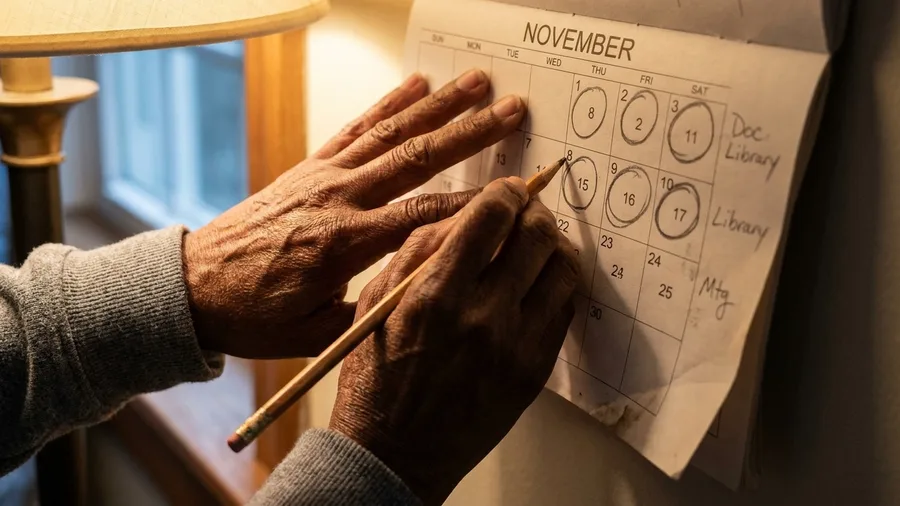
Three sessions a week for two weeks, 10 to 15 minutes each, is a buy decision disguised as a workout schedule. No mat, no band, nothing on your card until the calendar says you showed up six times.
Put the three sessions on the calendar like dentist appointments, not like intentions. Wednesday at 7:15 before the shower, Saturday morning before the house wakes up. Fixed slots remove the daily negotiation over whether today counts.
Track done or not done. That is the whole column.
Intensity, calories burned, mood scores, the number on the watch – none of it belongs in the log. What you are testing is whether a 48-year-old body with two years off will actually turn up three times a week, and that question has a yes-or-no answer.
The intensity check inside each session is whether you can speak in full sentences. If you are breathless mid-march, slow down or cut the session short rather than grinding through it. On progression, add 5 minutes only when the current length still feels easy at the end. Otherwise hold the duration where it is for the full two weeks.
If something hurts or you get dizzy, stop, and have a clinician look at it before the next session. That is the line, and it does not move because a calendar says week two.
Six completed sessions is data. So is four. Either number tells you something a new mat cannot, and you can keep the habit, add load, or drop it without shame – no sunk cost forcing you to keep going.
This is the fastest win in the whole experiment, and it costs nothing but two weeks. The purchase decision comes after the evidence, never before.
Frequently Asked Questions
Do I need an app to do cozy cardio?
No. Every session in this article can be done with a clock, a chair, and a patch of floor. An optional app or video series typically runs $10 to $15 a month, and it is worth paying for only after you have finished six sessions without one.
How many minutes count as a session?
Ten minutes is a legitimate session, especially in week one. The typical range is 15 to 30 minutes, but a ten-minute march keeps the habit alive on a busy day far better than a skipped 40-minute plan.
Can cozy cardio help with knee or shoulder pain?
It offers a low-impact menu — chair squats, marching, gentle mobility — that stays inside a comfortable range, which is why it suits cranky joints at the start. It is not a rehab plan. If pain outlasts the session or you are working around an injury, see a clinician or physical therapist first.
Is this enough exercise to get fit?
It is enough to start, keep a habit, and recover between harder sessions. It is not enough to build substantial strength or endurance, because those need progressive load and sustained effort. Treat cozy cardio as the on-ramp, not the whole road.
What should I buy first?
Nothing, for the first two weeks. After that, the resistance band ($10 to $20) earns its place first because it adds load without taking up room, followed by light dumbbells ($15 to $30), then a mat ($20 to $40) if your floor is hard.
What if I miss a week entirely?
Restart at the same short duration rather than trying to make up the missed sessions. The two-week test measures your schedule, not your willpower — a missed week usually means the time slot is wrong, so move it before you change anything else.
Three Ten-Minute Sessions, No Purchases, No Announcement
The verdict depends on which person you are. Need a gentle on-ramp, or a way to move on the days midlife flattens you? Start with three 10-minute sessions this week and buy nothing. Already lifting or training for an event? Treat it as recovery or a fallback for wrecked days, not the main plan.
What settles the cozy cardio question is not a before-and-after photo or a new label in your head. It is behavior: a calendar with sessions you actually finished on it, no gear required.
Give it two weeks and then decide with evidence in hand. Keep the habit, add load or a fuller plan, or drop it with no shame attached. The test makes the call, not the trend.
And that soft-pants question from the first line finally answers itself: some weeks it is exercise, some weeks it is standing in your living room, and you will know which by what you did.
Book the First Three Slots Now
Open your calendar and put three 10-minute sessions on it this week — same time, same spot, no gear. Six completed sessions is the only test that matters.