

By the end of this piece you will be able to run a four-pillar routine on a normal, overloaded week: one move, one food change, one rest habit, one connection habit, each with the psychological lever that makes it stick. First, the starting point. A typical week at 54 – a marketing manager working about 45 hours, married, two teenagers at home – reads like this: one 15-minute dog walk most days, two strength sessions a month, lunch at the desk four days out of five, one social evening every two weeks, and 6.5 hours of sleep on a 7.5-hour night in bed.
Nothing there is lazy. It is fragmented, because the advice has split into too many rules to hold at once.
So the missing piece is not another rule. It is a framework – move, eat, rest, connect – with one copyable practice per pillar and the reason each one repeats. Choose one from each pillar, run them two weeks, and keep the total near 4 hours a week and the cost between $0 and about $80 one-time, plus an optional $25 a month for a gym drop-in.
Then you can name your biggest bottleneck – sleep debt, low energy, or isolation – pick the matching pillar, and walk out with one exact action for tomorrow morning. Small cues, answered often, beat a complete overhaul you cannot keep.
Quick Tips Before You Start
Shrink it to ten minutes
If a practice needs more than ten minutes to start, it competes with the day's other decisions and loses.
Book it, don't intend it
Put the practice on your calendar with a start time, not just a reminder, so you stop deciding in the moment.
Anchor to a cue you already have
Attach the new habit to something stable: the first bathroom visit, the after-dinner dishes, the 10 p.m. phone charge.
Cap the spend
You can add strength for $80 of adjustable dumbbells or $0 with bodyweight; keep the takeout night under $30.
Run two weeks before adding
One practice per pillar for fourteen days. Add nothing new until the first one holds without negotiation.
1. The 10-minute morning mobility reset

The first ten minutes of a weekday morning are not a fitness opportunity. They are a traffic jam of stiffness, a full bladder, a teenager who cannot find a shoe, and a workday already loading itself into your head.
So the reset is ten minutes, and it is not a workout. Call it a loosening. The order of operations matters more than the moves: bathroom first, then the floor or the hallway, and only after that the coffee and the phone.
That sequence is the whole trick. The first bathroom visit happens whether you feel motivated or not, which makes it a reliable trigger rather than a daily negotiation about whether you have it in you.
The six moves take about ninety seconds each, and none of them require getting down on the floor. Standing neck rolls. Shoulder circles. Hip hinges, pushing the seat back like you are closing a car door. Standing calf raises. Thoracic twists. And a thirty-second doorway chest stretch, forearms on the frame, to finish.
Ten minutes is the right number for a reason. It fits inside the window between a 6:45 a.m. wake time and the moment two teenagers and a 45-hour workweek start spending your attention, and it is short enough that skipping it feels like nothing you would notice.
That is the point of keeping it small. A twenty-minute routine competes with breakfast, email, and the shoe hunt. A ten-minute one slides into the gap before any of those decisions land.
What you get is not a workout high. Hips, shoulders, and calves come out of the shape sleep left them in, joining the quiet habits that fit existing routines, and the first hour of the day costs less to get through. On a stiff morning, that difference is the whole return.
Skip a day and nothing bad happens. Skip a week and the ritual is gone, because a cue that goes unanswered stops feeling like a cue at all.
💡 Tip: Leave the bathroom door open and put a sticky note on the mirror with the six moves in order.
| Pillar | Weekly time | Typical cost | Psychological lever | First move |
|---|---|---|---|---|
| Move | 10 min mornings + 2 × 25 min strength + 20 min walks 3× | $0 to $80 plus $25/month gym drop-in | Implementation intentions and habit stacking | Do the 10-minute mobility reset after the first bathroom visit |
| Eat | 30 g protein breakfast daily + 2 × 20 min lunch escapes + one planned takeout | $0 to $15 extra groceries; $30 takeout cap | Front-loading satiety and pre-commitment | Make the 30 g breakfast before you sit down |
| Rest | 10 p.m. phone curfew + fixed 6:45 a.m. wake + 20 min wind-down | $0 to $15 for an alarm clock | Cue removal and consistent light anchors | Charge the phone in the kitchen at 10 p.m. |
| Connect | 30 min Thursday walk + one monthly dinner + one text a week | $25 per person monthly dinner | Low-effort relatedness and repeated small-group ritual | Send the Thursday invite before you close this tab |
2. Two 25-minute strength sessions booked like meetings

A repeatable morning cue is the platform. Once the 6:45 slot is established, the same slot can hold a full-body plan, which is what turns a small daily start into actual strength work.
The plan needs no gym, no trainer, and no long program. Two 25-minute full-body sessions, Tuesday and Friday at 7 a.m., two sets of 8 to 12 reps each, run through five movement patterns: squat, hinge, push, row, carry.
The gap this closes is real. The current pattern of two strength sessions a month is enough to slow loss but not enough to build, and building is what protects bone density and joint health going into the next decade.
Equipment runs $80 for a set of adjustable dumbbells, or $0 for the bodyweight version, with a $25 monthly gym drop-in if the heavier rows and carries feel better there.
The lever here is implementation intentions, which is the psychology term for writing down when and where, not just what.
Tuesday and Friday at 7 a.m. on the calendar is not a reminder. It is a decision already made, so 6:55 on a Tuesday does not reopen the question of whether to train. Which is how strength becomes an appointment instead of an intention.
💡 Tip: Put the dumbbells next to the coffee maker so the sight of them is the first cue you get.
Strength Sessions — At a Glance
🔁 Tap-Out Reps
Stop at 12 if form breaks before rep 8
⚖️ Weight Jump
Add load only after 2 sets of 12 clean, not before
🚪 Missed Session
Skip, don't stack — next slot is Friday, never Saturday
🛑 Skip If
Sharp joint pain during carry — get it checked before loading again
📉 Regression
Bodyweight squat to a chair, band rows, 5-second carry holds
Why It Works
Rows and carries are where posture and grip show up first, so never cut them to save time.
3. The after-dinner walk that closes the workday

Cardio does not need a gym trip or another commute. It needs a cue that already happens every day, and in most households that cue is the dishes.
Twenty minutes, three evenings a week, starting immediately after the last plate is set in the rack. Shoes go by the door before dinner, not hunted for after.
on those three days the walk replaces the usual 15-minute dog walk rather than adding to it. The week does not get longer, it gets reorganized.
Pair it with something you want anyway, a podcast or a phone call to a sibling, and the walk stops being exercise you owe and becomes the part of the evening you look forward to.
The mechanism is habit stacking plus a transition ritual. Work ends at the sink, the walk marks the boundary between the 45-hour week and the evening, and the brain gets a clean break instead of carrying the inbox to the couch.
That break is worth naming for this decade specifically. The mental load of a job and two teenagers does not switch off on its own, and a walk that closes the workday does more for evening mood and sleep pressure than the same 20 minutes done in a rushed morning.
🏃 A Week of Movement, Stacked
Monday
10-minute morning mobility reset after the first bathroom visit; 20-minute after-dinner walk.
Tuesday
Strength session 7–7:25 a.m.; mobility reset beforehand. Walk optional.
Wednesday
Mobility reset in the morning; 20-minute after-dinner walk.
Thursday
Mobility reset; 30-minute standing walk with a friend at 6 p.m.
Friday
Strength session 7–7:25 a.m.; mobility reset before.
Saturday
30-minute walk or bodyweight session, whichever feels easier.
Sunday
Mobility reset; plan the week's two strength sessions and takeout night.
4. The 30-gram protein breakfast

A walk that closes the workday leaves one decision still open, and it lands before you have finished your first cup of coffee.
Breakfast is where the food day actually begins: whatever you eat by 8 a.m. sets how hungry you are at 11, and how many times you drift toward the kitchen or the vending machine before lunch.
The target that matters here is 30 grams of protein, and the prep ceiling is five minutes. That number is not a slogan. It is roughly the amount research on adults over 50 points to as the practical threshold for a single meal, because protein handling gets less efficient with age and a small morning dose does not go as far as it used to.
Three versions, all under five minutes. Greek yogurt with a handful of nuts. Two eggs on toast with a half-cup of cottage cheese on the side. Cottage cheese with fruit. That is the whole menu, and it is meant to be the whole menu for a while.
For the 54-year-old marketing manager who eats lunch at the desk four days out of five, this changes the shape of the afternoon. A 30-gram breakfast tends to mean fewer unplanned snacks in the gap between meetings, which also means the desk lunch stops being the first real meal since 7 p.m.
The lever is decision removal, not discipline. Make the breakfast decision once, on Sunday, and the daily negotiation disappears.
Front-loading protein at the first meal is one of the more reliable ways to knock down grazing later, because satiety set early in the day carries forward in a way that a large dinner does not undo. It will not feel dramatic. Give it a week before you judge it.
The trade-off is real: a morning that currently runs on coffee and a granola bar now needs three minutes of assembly, and on the worst mornings you will skip it. Keep one no-prep option in the fridge so the skip stays rare.
💡 Tip: Portion the yogurt and nuts into a container the night before so the morning requires zero measuring.
⚠️ COMMON MISTAKE
Don't turn breakfast into a project
The goal is 30 grams of protein, not a perfect meal. If you're chopping vegetables and cooking three pans at 6:30 a.m., you've built a barrier, not a habit. Pick one of the three under-five-minute options and repeat it for two weeks before you vary anything.
5. The desk-lunch escape twice a week

The middle of the workday is the same problem as breakfast, repeated at a worse hour. One food decision was enough before 8 a.m.; by noon you are making it again, and the desk makes it easy to never stop working while you do it.
The fix is not a longer lunch. It is 20 minutes, twice a week, in a place that is not your desk. Pick the two days in advance, and pick the spot: the break room, a bench in the park, the front steps of the building. Name the place specifically, because a vague plan to eat somewhere else quietly turns back into eating at the desk.
Pack lunch the night before, and keep it boring enough that the escape does not itself become a decision about where to buy food. Twenty minutes on a bench with a sandwich is not a restaurant outing, and it is not supposed to be.
Run the arithmetic on the example week: four desk lunches out of five become two escaped lunches and three unchanged ones. Two days out of five is the whole change, and it is small enough to survive a week that goes sideways.
The mechanism is attention restoration plus a physical boundary. Leaving the desk at noon tells the brain that the workday has a seam in it, and that boundary tends to carry into the afternoon instead of dissolving into one continuous blur of screen and keyboard. The point is not calorie counting. It is that the desk stops being the only place your day happens.
If two days a week feels like too much of a stretch, do one. The pattern holds either way.
6. The one planned takeout night
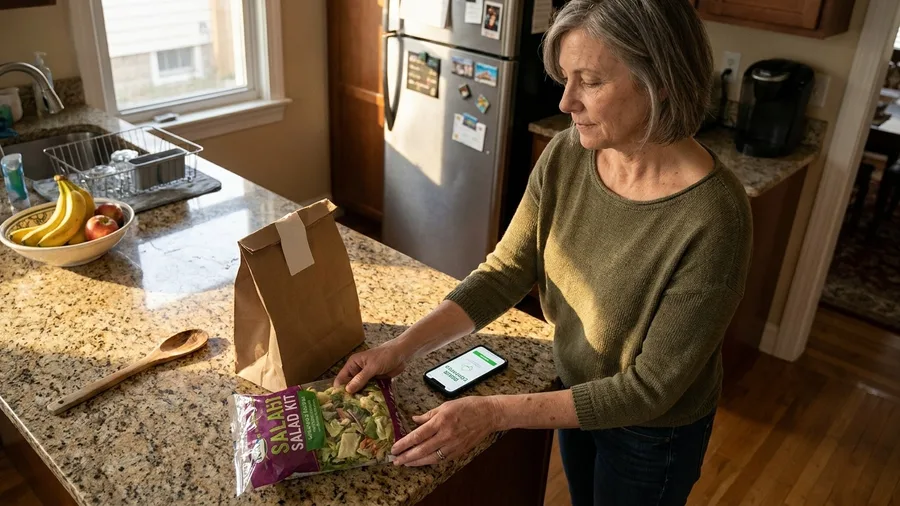
The last food decision of the day is the one made at 7 p.m., when you are tired, the teenagers have scattered, and the delivery app is two taps away. A planned lunch boundary handles noon twice a week; the evening needs a boundary of its own, and the way to draw it is to decide before you are tired.
Pick one night a week as the takeout night. Put it on the calendar. Order ahead by 4 p.m., before the workday winds down and before hunger starts making decisions, and cap the order at $30.
One rule keeps the meal from being just delivery: add something green or something frozen. A bagged salad or a bag of frozen vegetables that goes in the microwave counts. The meal then has a vegetable in it and the order stays a treat rather than the whole dinner.
In the example week, one planned takeout dinner replaces three unplanned ones. That is the entire change. The delivery spiral, where a tired 7 p.m. turns into a $50 order that nobody really wanted, gets one fixed slot instead of three open ones.
This is pre-commitment, and it works because the decision is made while you still have energy to make it. By the evening, the choice has already been made at 4 p.m., and the app does not have to be negotiated with at all.
Give it a couple of weeks before you decide whether the cap is realistic for your household. It may take one round of adjusting to find out what $30 actually buys in your city.
7. The 10 p.m. phone curfew

Every evening decision you can move earlier in the day buys back a decision at 10 p.m., when your judgment is at its weakest. Planning the takeout order by 4 p.m. is the warmup. The phone is the main event, because that scroll is what most directly eats the hour before sleep.
Here is the setup. At 10 p.m. the phone goes on the charger in the kitchen, and the charger lives there now, not on the nightstand. That is the entire rule.
Consider the math on a typical midlife week: 7.5 hours in bed but 6.5 hours of actual sleep. That missing hour is usually the phone, and it drags the whole next day down with it.
Cue removal beats willpower. You cannot reach for what is in another room, and at 10 p.m. you are relying on habit, not resolve. This is why the curfew works where a promise to 'scroll less' doesn't.
The phone leaves a hole, so fill that exact spot on the nightstand. A paper book, an episode of a podcast with the screen face-down, a printed crossword. Same chair, same lamp, something to do with your hands.
Expect the first week to feel wrong. You will be restless, and your hand will reach for a phone that isn't there two or three times before you laugh at yourself. Put a cheap backup alarm clock in the bedroom so you don't need the phone to wake up.
The payoff is the protected hour before lights out at 10:45 p.m. Most of the work of feeling rested tomorrow happens in that wind-down, not in the sleep itself.
Give it two weeks before you judge it. By then your hand stops reaching, and the 10 p.m. boundaary starts feeling less like a restriction and more like the end of the workday.
💡 Tip: Set a 9:50 p.m. alarm on the phone as a warning, then plug it in the kitchen the moment it goes off.
Nightstand vs. Kitchen Charger: What Actually Changes
Phone within arm's reach
- Sleep onset pushes past 11 p.m. even on an early night
- The last thing you see is a feed, not a wind-down cue
- A 6:45 a.m. wake time slips as snooze absorbs the margin
- The wind-down gets skipped because the screen is the activity
Charger stays in the kitchen
- The 10 p.m. cutoff is a location, not a promise to keep
- Sleep pressure builds because the hour before bed stays quiet
- One cheap clock replaces the phone for alarms and the time
- The wind-down has a fixed slot to fill: 10 to 10:45
8. The fixed 6:45 a.m. wake time

If you can only fix one end of your night, fix the morning. A fixed wake time is easier to control than a fixed bedtime, and it pulls sleep into line more reliably than lying in bed willing yourself to drift off earlier.
The number is 6:45 a.m., every day. Weekends drift no more than 30 minutes later, which means 7:15 a.m. on Saturday is fine and 9 a.m. undoes the week.
Then get light within 20 minutes of waking. Step outside, or sit at the brightest window in the house. Morning light is the signal that sets your body clock for the day and, by evening, makes sleep come at a sane hour.
Run the arithmetic for a 45-hour week with two teenagers. A 6:45 a.m. wake puts lights-out at 10:45 p.m. for an eight-hour window in bed. That is a real jump from 7.5 hours in bed and 6.5 hours of sleep.
Consistency is the lever, not perfection. You are not chasing a flawless night; you are anchoring the day so the night has somewhere to land. One late Saturday is survivable. A late Saturday and Sunday is a reset back to where you started.
The first mornings are the hard part. The alarm at 6:45 will feel early, and the pull to sleep in on the weekend will be strong. Get up anyway, get the light, and let the evening take care of itself.
After two weeks the wake time stops being a fight and starts being the thing your day is built around. That is the anchor working from the morning end.
9. The 20-minute low-light wind-down

A fixed wake time sets one edge of your sleep window; the last 20 minutes before bed set the other. Anchor the morning and you still need a closing ritual at night, because the two ends work on the same window from opposite directions.
20 p.m. once the phone is already out of the room. Dim the lights, take a warm shower, do a few minutes of stretching, then write one line about the day in a notebook by the bed.
That is 20 minutes, give or take, and it ends with lights out at 10:45 p.m.
The order matters more than the content. Dim light, warm water, slow movement, one written line. Each one tells your body the day is closing, and repeating the same order each night turns it into a signal rather than a decision.
The one written line does more than it looks like it does. It puts the loose ends of the day on paper so your mind stops rehearsing them at 11 p.m.
If the full sequence is too much on a given night, pick one low-effort stand-in. A paper book. Five minutes of gentle yoga on the bedroom floor. A quick tidy of the kitchen so tomorrow starts cleaner.
The point is not a perfect wind-down. It is a repeatable one that lowers arousal and removes the bedtime question of what to do now.
Give it two weeks and the ritual starts doing the work for you. Lights dim, shower runs, one line goes down, and your brain reads the sequence as the end of the day.
10. The standing Thursday walk with a friend

A closing ritual tells your body the day is over. Relationships run on the same cue-and-repeat logic, which is why connection needs a fixed slot on the calendar, not a vague intention to call someone.
The slot: Thursday at 6 p.m., 30 minutes, one friend, a recurring invite that renews itself whether or not either of you thinks about it. The standing appointment beats a monthly dinner because it asks almost nothing of either calendar.
Walking side by side also lowers the pressure. No table, no bill, no need to sustain eye contact, and a natural exit at the end of the block. Conversation moves easier when you are both looking forward.
Rain plan, decided once: the mall loop, a covered track, or the same 30 minutes by phone at 6 p.m. sharp.
This is where relatedness meets low effort. The research on social connection keeps pointing the same direction: frequency and predictability matter more than the size of the event. A standing walk delivers both. Connection stops being something you owe yourself and becomes something already booked on a Thursday.
💡 Tip: Send the recurring calendar invite before you close this article. It takes 30 seconds and makes the walk real.
💡 PRO TIP
Make the first invitation tiny
Don't open with 'we should get together sometime.' Text a specific day and time: 'Thursday at 6, walk around the park?' A concrete invitation is easier to answer than an open-ended one, and it protects you from the endless back-and-forth that kills plans.
11. The monthly two-friend dinner

A weekly walk keeps a friendship warm. A small dinner with the same two people is what turns warm into close, and it adds depth rather than frequency.
One Saturday a month, same two friends, rotating hosts or a cheap restaurant nobody has to dress for. Cap it at $25 a person and put the phones in a basket at the door.
The group size is deliberate. Three people means one conversation, not two side chats, and nobody gets stuck at the quiet end of a long table.
Set a shared calendar invite that repeats, and send one plain text three days out. That reminder does more for attendance than enthusiasm ever will.
The lever here is repetition in a small group. Familiarity builds through the same faces around the same table, and reciprocity follows: next month someone else hosts. You get closeness without hosting a crowd.
12. The five-minute 'thinking of you' text

It is maintenance that keeps a friendship warm between the dinners and the walks. It is also the answer for the reader tired of being the one who always reaches out.
The practice: one text a week to one person, naming a specific memory or detail. Not "we should catch up" but the diner with the bad coffee, the song from the drive to the shore in 2009.
Keep three names on a list and cycle through them. No reply expected, which is the part that ends the scorekeeping.
A Sunday evening reminder covers it. Five minutes, one thumb, done.
The lever is low-cost maintenance, and the confidence that comes with it: connection does not need a big block of time. It needs a small, specific signal that someone is still in your thoughts.
Frequently Asked Questions
I'm exhausted by 8 p.m. Can I still do the after-dinner walk?
Put the walk right after the dishes, before you sit down. Once you sit, the decision is lost. If you're truly depleted, do 10 minutes instead of 20 and count it. The cue matters more than the duration.
What if I miss a strength session?
Don't reschedule it. Just show up to the next scheduled time. Adding a makeup session turns the plan into a debt, and that's how most people quit by week three.
Is 30 grams of protein at breakfast too much for my kidneys?
For most people with healthy kidneys, 30 grams is fine. If you have known kidney disease or are on a protein-restricted diet, ask your doctor before increasing protein—that's a conversation for your own medical team, not a general article.
What if my partner watches TV in bed and won't do the 10 p.m. curfew?
Start with your own phone and your own wind-down. You can't control the TV, but you can control where your phone charges. A backup alarm clock and a paper book make your side of the room a low-light zone even if the TV stays on.
How long before these practices feel automatic?
Most people notice the cue feeling more natural after about two weeks, and the whole routine starts to run without negotiation after four to six. The first week is the hardest because the old cues are still winning.
The One Pillar You Start With Tomorrow
Start with the pillar that matches your bottleneck. If you are carrying sleep debt – 6.5 hours on a 7.5-hour night – begin with the 10 p.m. phone curfew. If low energy is the problem, start with the 30 g protein breakfast and the 10-minute morning mobility reset. If isolation has crept in, start with the Thursday 6 p.m. walk and send the invite tonight.
Whichever you choose, run one practice per pillar for two weeks before adding anything else. This is four pillars and a dozen copyable practices, not a full overhaul; the honest time cost is about 4 hours a week, with the wind-down and desk lunch mostly swapped from existing screen and desk time.
And here is the point the fragmented version missed: a 45-hour week, two teenagers, a 15-minute dog walk most days, two strength sessions a month, four desk lunches out of five, one social evening every two weeks, and 6.5 hours of sleep on a 7.5-hour night do not need twelve simultaneous fixes. Tomorrow, at 6:45 a.m., after the first bathroom visit and before coffee or the phone, do the 10-minute mobility reset – neck rolls, shoulder circles, hip hinges, standing calf raises, thoracic twists, and a 30-second doorway chest stretch. That is the whole assignment, and the dog walk happens after.
Start With Tomorrow Morning
After your first bathroom visit, do the 10-minute mobility reset before you touch your phone. One cue, six moves, and the framework is underway.