

The obstacle to eating well at 55 is not cooking skill — it is decision fatigue, and it lands hardest right when you have the least to give. Walk into the average kitchen at 5:40 on a Tuesday and you will find a competent adult standing in front of an open fridge, unable to answer a question they have answered a thousand times, with a lunch bag still to fill for tomorrow.
The belief most people carry in is that a good dinner requires a fresh decision every night: which protein, which vegetable, what is already in the fridge, what has to go into a container by morning. But cooking does not exhaust people in their fifties the way deciding does. That is the wrong job to do at the end of a workday.
So here is the way out: seven default dinners, each on a fixed night, 15 to 20 minutes of active time each, about $96 for the full week and roughly $3.43 a serving. Every meal makes 4 servings, so two go into containers, and the shopping list stops being a negotiation with yourself. By the end you will know which two to start with, and which single night wins on least cooking versus best leftovers.
Seven meals, seven nights, one formula of protein plus vegetable plus starch, one known cost and active time per plate, and one named plan for what happens to the rest. That is what replaces the daily question with a weekly rotation, and dinner still covers everything worth eating.
Quick Tips Before You Start
Assign Nights First
Write Monday through Sunday on the fridge and pencil in each default before you shop. The calendar does the deciding.
Shop the Same List
Stick to the anchors: chicken thighs, frozen salmon, ground turkey, sausage, tofu, eggs, canned beans and lentils, rice, tortillas, pasta, frozen vegetables, broccoli, kale, cucumber, spinach, onion, broth.
Cap Active Time
Every meal here takes 15–20 minutes of hands-on work. If a recipe needs more, it does not belong in the rotation.
Pack Two Lunches
Each dinner yields two lunch portions. Store components separately where texture matters — tortillas, noodles, rice — and label by day.
No New Recipes
Repeat the same seven for four weeks before you swap anything. The point is to stop reading recipes, not to keep exploring.
1. Sheet-Pan Chicken Thighs and Broccoli
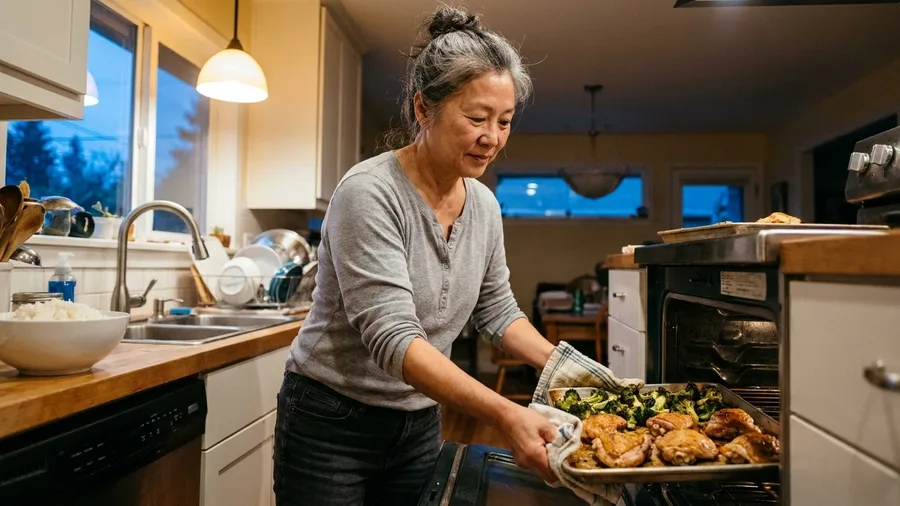
Chicken thighs are forgiving in a way breasts are not. Dark meat stays moist through a 40-minute roast and again through a reheat, which is why it can carry Monday and still taste like Monday on Tuesday at noon.
The formula is one protein, one vegetable, one starch, all on one sheet pan: 2 lb of thighs, two crowns of broccoli cut into florets, and rice cooked alongside. Fifteen minutes of active work, 40 minutes in the oven, four servings at about $3.50 each. The only thing left open is the seasoning, and a spice blend answered once takes the side-dish question off the table.
That is the trade. Two decisions gone – what protein, what vegetable – for a quarter hour of hands-on time, at the middle of the week's price range.
The cook itself belongs on Sunday. A 75-minute block roasts the thighs and cooks 4 cups of rice in one go, so Monday is a reheat in portions rather than a start from raw. The largest cooking effort lands on the day with the most slack in it, which is the whole reason a weekday night can stay short.
Two servings go into containers for Tuesday lunches. Roasted broccoli is the reason: it holds its texture through a night in the fridge, where steamed florets go limp and watery by the next afternoon.
What this night buys the reader is the next one – the biggest effort banked early, two lunches already packed. Eat the chicken Monday and the week is already running.
💡 Tip: Season the thighs on Sunday before roasting, then reheat Monday without adding anything. The flavor is already in the pan.
| Default meal | Night | Main protein | Active time | Cost per serving | Leftover move |
|---|---|---|---|---|---|
| Sheet-pan chicken thighs and broccoli | Monday | Chicken thighs | 15 min | $3.50 | Pack two lunches with roasted broccoli |
| Egg and bean taco night | Tuesday | Eggs + black beans | 15 min | $2.50 | Fill tortillas at lunch, not before |
| Tofu stir-fry with frozen vegetables | Wednesday | Tofu | 20 min | $3.00 | Keep noodles separate from sauce |
| Red lentil tomato soup with toast | Thursday | Red lentils | 15 min | $2.25 | Freeze half; toast fresh |
| Turkey and white bean chili | Friday | Ground turkey + white beans | 15 min | $3.75 | Better on day two — pack for Saturday |
| Salmon rice bowls with edamame | Saturday | Frozen salmon | 15 min | $5.50 | Flake into rice for Sunday lunch |
| Pasta with sausage, kale, and beans | Sunday | Sausage + white beans | 15 min | $3.50 | Reheat with a splash of water; pack for Monday |
2. Egg and Bean Taco Night
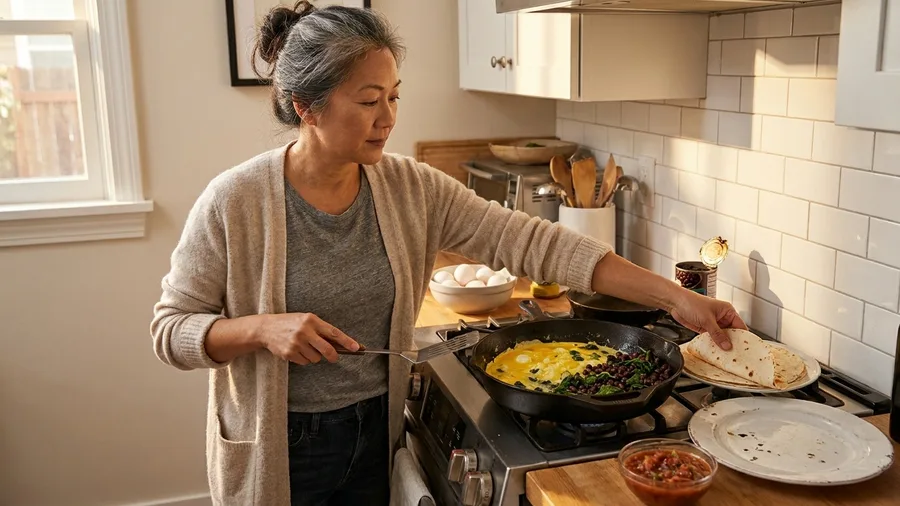
Bank the week's biggest cooking on the day with the most time in it, and a night is freed up later to be nothing more than a skillet. That is the bargain this one keeps: 20 minutes, one pan, and no trip to the store.
Eight eggs, a can of black beans, eight tortillas, a handful of spinach, salsa. Fifteen minutes of active time, 20 minutes total, four servings at about $2.50 each – the cheapest plate in the week.
Protein and vegetable were decided in advance. Eggs, beans and spinach are all pantry or fridge stock, so a night that falls apart needs no planning, only the fridge door.
One skillet does the eggs and beans while the tortillas warm. Nothing waits on anything else, which matters more than it sounds when everyone is hungry at the same moment.
Pack the filling separately from the tortillas for the next day's lunches. A soft tortilla packed against a wet filling is a soggy tortilla by noon; kept apart, it is a taco again at lunch.
For the reader with the least patience left by evening, this is the entry point. Fifteen active minutes, one pan to wash, $2.50 a serving – a real dinner with the fewest steps in the rotation.
💡 PRO TIP
The One-Pan Rule
If a default meal needs more than one cooking vessel on a weeknight, it does not belong in the rotation. Save the two-pan meals for weekends. The point is to reduce cleanup, not just cooking time.
3. Tofu Stir-Fry with Frozen Vegetables
Somebody still has to open a bag of spinach, rinse it, and pick out the stems that went slimy. That is the next decision to take off the table, and it comes off in the freezer aisle. The same logic applies to the shelf itself, which is why a pantry reset pays for itself in fewer weeknight choices.
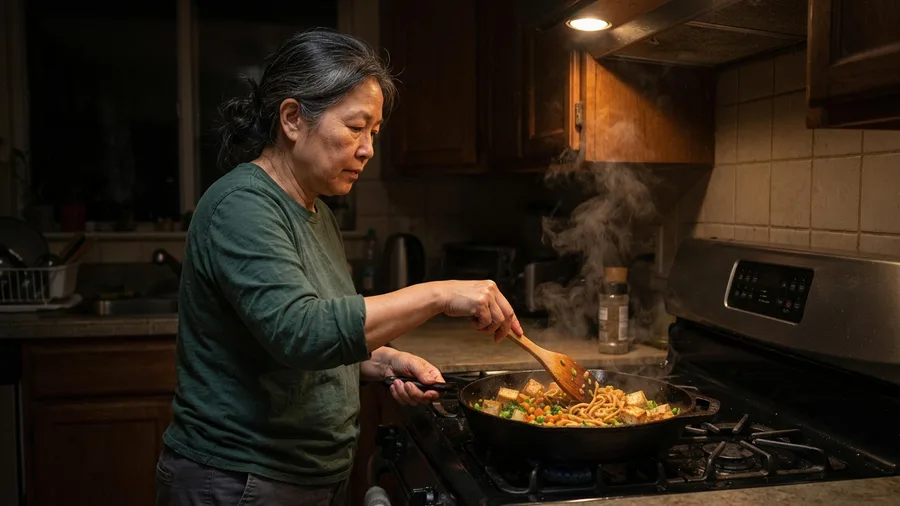
Wednesday's meal is a block of firm tofu, a bag of frozen stir-fry vegetables, noodles, and a soy-ginger sauce you mix once and never rethink. Fourteen ounces of tofu, twelve of vegetables, eight of noodles, four generous bowls for about $3.00 a serving.
Twenty minutes of hands-on work, twenty-five start to finish, and the equipment is one skillet and one pot – the pot for noodles, the skillet for everything else.
The vegetables get chosen a single time, standing in front of the freezer case, and then they are simply the vegetables. No weeknight trip through produce, no half bag going soft in the crisper drawer by Friday.
Press the tofu, cube it, and that is the only knife work that matters. The sauce stays identical week to week, so the pan starts to feel familiar and nothing needs tasting or adjusting – no recipe open on the counter, no small decisions hiding inside the cooking.
Here is the honest part. This night asks for five more active minutes than the quickest meal in the rotation, and what those minutes buy is the disappearance of the fresh-vegetable question entirely. For anyone who has thrown out a wilted bunch of something they bought with good intentions, that is a fair trade.
Come Thursday, the noodles go into their own container, sauce kept off until lunch. Noodles that sit overnight in sauce drink it up and arrive as one dense clump; stored apart, they loosen with a stir.
💡 Tip: Press tofu for 15 minutes with a heavy pan while you chop. It firms up and browns better, with no extra attention.
Which Default Meal Fits Your Energy Tonight?
- Egg and bean tacos — 15 active minutes, one skillet, pantry stock. Go here when you have nothing left.
- Red lentil soup — One pot, 15 minutes active, then it simmers without you. Good for a low-attention night.
- Pasta with sausage and kale — One pasta pot, pantry anchors, 15 minutes active. The easiest Sunday cook.
- Tofu stir-fry — 20 active minutes and two vessels. Fine on a normal night, not on a late one.
- Turkey chili — 15 minutes active but 40 total. Start it early or you will eat at nine.
- Salmon rice bowls — Assembly only if the Sunday rice is done. Otherwise add 20 minutes for rice.
- Sheet-pan chicken — 40 minutes total. Do not attempt on a night you get home after seven.
Active time and total time from the rotation plan.
4. Red Lentil Tomato Soup with Toast

By Thursday evening, the constraint has stopped being the clock and started being the will. Two fast skillet nights can carry you on momentum, but a person can only wash so many pans before dinner starts to feel like one more task on a list that never gets shorter. What the fourth night needs is a meal that makes a second dinner while it simmers, so Thursday's effort buys Friday some slack.
Red lentil tomato soup is that meal. One cup of red lentils, a 28-ounce can of crushed tomatoes, 4 cups of broth, and one onion go into a single pot; 15 minutes of active work and 35 minutes of total time produce 4 servings at about $2.25 each.
That is the lowest cost per serving in the entire seven-meal rotation.
The starch is toast, and it is fixed. Nobody stands at the stove at 6:40 deciding whether tonight is rice or potatoes, because Thursday is toast and always will be. Once the pot comes to a simmer, nothing needs stirring, salting, or watching – the lentils collapse on their own while you do something else.
Half the pot goes into the freezer in two portions. On the cheapest night of the week, you are also putting a spare dinner away for the week when the schedule falls apart – the one you will be glad exists on a Tuesday in March.
For Friday's lunch, reheat the soup and make the toast fresh. Toast is the single component here that does not survive storage; pack it separately or, better, keep a loaf at work and toast it there. The soup itself is better on day two anyway.
The honest trade is total time, not active time. Thirty-five minutes from pot to bowl is longer than most nights in this rotation ask, and you spend the back half of it waiting rather than cooking. What those minutes buy is a freezer with two dinners already in it – cooking for a night that has not arrived yet.
Do This, Not That: Weeknight Defaults
Do This
- Assign each meal a fixed night and stick to the calendar.
- Use the same spice blend every week so seasoning is decided once.
- Pack lunch portions before you sit down to eat.
- Store components separately when texture matters.
- Repeat the rotation for four weeks before changing anything.
Not That
- Deciding at 5 p.m. what to cook based on mood.
- Trying a new recipe on a weeknight.
- Packing tortillas and filling together.
- Leaving noodles in sauce overnight.
- Swapping meals before the seven are routine.
5. Turkey and White Bean Chili
Freezing half a pot only pays off if some later meal in the week can hold the back half on its own. That means a batch that improves with a night in the fridge, not one that merely survives reheating. Friday's chili is built for exactly that: it is better on Saturday than it was on Friday, and the rotation counts on it.
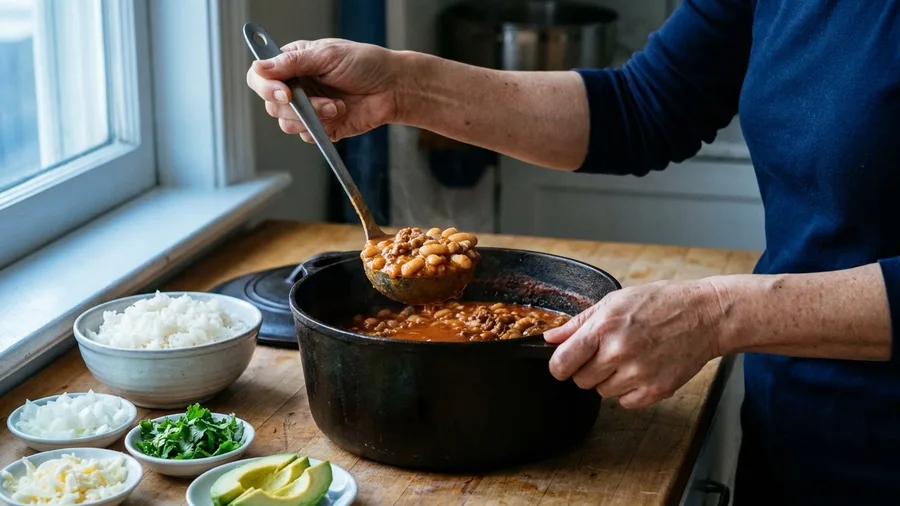
One pound of ground turkey, 2 cans of white beans, a 28-ounce can of diced tomatoes, an onion, and chili spices. Fifteen minutes active, 40 minutes total, one pot, 4 servings at about $3.75 each.
The spice blend is the same every week. That is the whole point: the seasoning decision was settled once, months ago, so Friday dinner needs no recipe open on the counter and no measuring spoons out. You brown the turkey, add everything else, and walk away.
Overnight, the chili thickens. The beans give up starch, the tomatoes concentrate, and by Saturday lunch it has body that Friday's version did not have. Two portions go into containers as lunch bowls – not as a consolation prize for eating the same thing twice, but because day two is the better bowl.
If the pot needs to stretch further, spoon it over rice left from the Sunday prep. That is a five-minute addition, not a new meal.
This is the night where leftovers stop being something you tolerate. A rotation that has to reach the weekend cannot rely on meals that only reheat well; it needs at least one that rewards the wait. The trade is simple: 40 minutes on Friday, and Saturday's lunch is already decided and already better.
💡 Tip: Make the spice blend in a jar on Sunday: 2 tbsp chili powder, 1 tbsp cumin, 1 tsp smoked paprika, 1 tsp oregano. Scoop and go.
6. Salmon Rice Bowls with Edamame
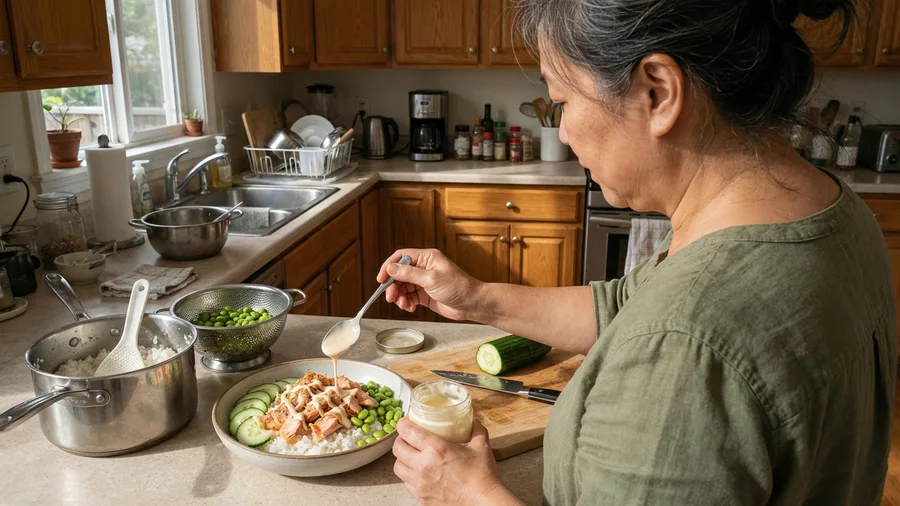
Five nights of chicken, eggs, tofu, lentils, and turkey leave one category untouched, and most home rotations drop fish for the same two reasons: the fresh counter is a decision, and the fillet has to be cooked today. The freezer removes both. Frozen salmon means no counter conversation and no use-it-by-tonight deadline, and that is what keeps fish in the week instead of falling off after one attempt.
Saturday's bowl is 4 frozen 5-ounce salmon fillets, 2 cups of rice, cucumber, 1 cup of edamame, and a mayo-soy drizzle. Fifteen minutes active, 30 minutes total, 4 servings at about $5.50 each – the highest cost per serving in the rotation, and the only fish in the week.
The rice is already cooked. It came out of the Sunday prep block, so Saturday's bowl is assembly rather than cooking, which matters on the night with the least kitchen time left in you. The fillets go in the oven from frozen; the edamame boils in three minutes; the cucumber gets sliced.
The formula does not change: salmon, rice, cucumber, edamame, drizzle. No variation to weigh, no sauce to invent, no wondering whether this week calls for something different.
Flake whatever salmon is left into the remaining rice for Sunday lunch. The fish night still produces a lunch portion, which is the rule every meal in the rotation has to meet.
The trade is the price. At $5.50 a serving, this is the night that costs the most, and it buys the only fish you will eat all week. Frozen stock is what keeps it repeatable – buy the bag, keep it in the freezer, and the meal stays on the schedule instead of becoming a good intention.
7. Pasta with Sausage, Kale, and Beans
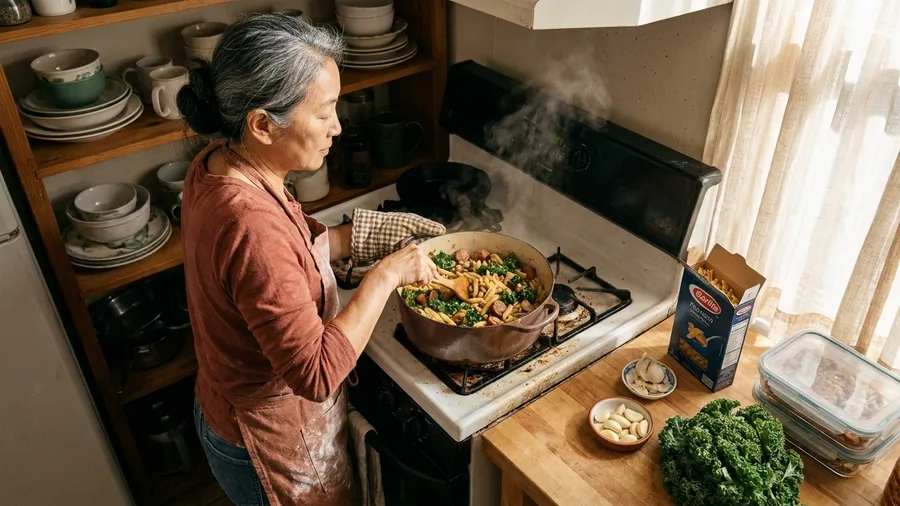
A bowl assembled from rice cooked on Sunday and edamame pulled from the freezer needs nothing from a store, and that is the reason the week can close on pasta built out of pantry stock. Sunday night should not send anyone back out to shop.
12 ounces of pasta, 12 ounces of sausage, a bunch of kale, a can of white beans, and garlic. Fifteen minutes of hands-on work, 30 minutes total, four servings at about $3.50 each.
The formula has not changed since the week began, and that is the point. Kale stands in as the vegetable, white beans as the plant protein, and both run on the same greens-and-beans logic that carried every other night, so the Sunday trip adds nothing unfamiliar to the cart.
Sausage, pasta, white beans, and garlic were already on the list from the start of the week. The kale, the onion, the spinach, and the cucumber came in the same haul, which means Sunday cooking begins without a detour.
One pot, and every ingredient came in through the pantry door. That is the cheapest kind of cooking there is: no counter full of prep bowls, no second pan, no last-minute run.
Reheat what is left with a splash of water in the pot so the pasta loosens instead of sitting in a clump. Two portions go into containers for Monday lunch.
Those two containers are the first lunch of the next rotation, which is how the system feeds itself without anyone deciding to keep it going. The week ends by stocking the day after it starts.
Frequently Asked Questions
Do I have to cook all seven meals in the first week?
No. Start with two that fit this week's schedule, shop only for those, and add one new default each week until all seven are in rotation. The calendar fills itself over a month.
What if I don't eat meat or fish?
Swap the chicken, turkey, sausage, and salmon for extra tofu, tempeh, or additional beans. Keep the protein-vegetable-starch formula intact. The taco night and lentil soup are already meatless.
How much does the full week cost?
About $96 for four servings per meal across seven dinners, or roughly $3.43 a serving. Costs range from $2.25 for lentil soup to $5.50 for salmon bowls.
Can I prep everything on Sunday?
A 75-minute block covers the biggest tasks: cook four cups of rice, roast the chicken thighs, chop cucumber and kale, drain beans, portion edamame. The rest is quick weeknight assembly.
What about breakfast and lunch?
Each dinner makes four servings. For a two-person household, that is dinner plus two packed lunches. Breakfast stays simple and separate — eggs, yogurt, or toast — so the rotation only solves dinner.
How long before the rotation feels automatic?
Four weeks. The first two weeks you will still check the list. By week three the nights are memorized, and by week four you are shopping without the list. Do not change the meals until then.
Pick Two Nights and Shop for Those
Pick the two nights that fit this week's schedule and shop only for those two. Add one new default each week until all seven are in rotation; the other five stay undecided until their week arrives, and nothing is lost by that.
If you want the least cooking, start with Tuesday egg-and-bean tacos: 15 minutes active, 20 total, one skillet, $2.50 a serving. If you want the best leftovers, start with Friday turkey chili, which thickens overnight and packs into Saturday lunch bowls – better on day two than day one.
That 5:40 fridge stare now has an answer before the day begins, at roughly $96 for the week and about $3.43 a serving. For a bigger bank of no-recipe defaults like these, see the lazy cook's defaults built for eating well after fifty. The rotation is not a restriction on trying something new; it is what buys you the room to.
Print the Rotation, Stick It on the Fridge
Write Monday through Sunday on a sheet of paper, pencil in the seven defaults, and shop the same list every week. The decision disappears the moment the calendar takes over.