
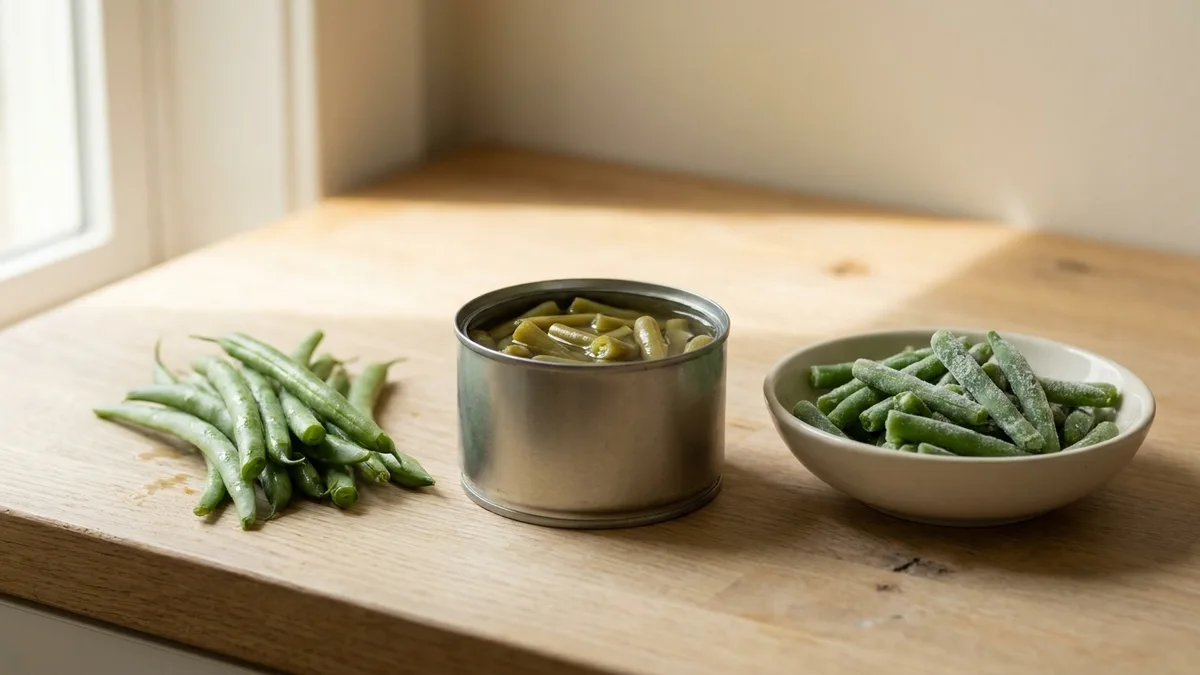
Most shoppers treat the fresh bin as the healthy choice and the freezer aisle as the place you settle. Then a pound of off-season green beans rings up at $4.99, half of it goes soft in the crisper by Thursday, and the eaten portion costs $9.98 a pound.
Frozen cut green beans hold at $1.64 for a 12-ounce bag and canned at $1.15 for 14.5 ounces all year, with calories and fiber close enough that the label, not the aisle, decides what you get.
The better buy comes down to three things: whether the vegetable is in season, what the dish needs from it, and what the label actually says.
Choose fresh in season for anything served raw and crisp, plain frozen as the cooking default the rest of the year, and no-salt-added canned for the pantry. Check one label before you assume fresh wins.
💡 PRO TIP
The label trap costs more than the format
Plain frozen green beans run $1.64 per 12 ounces; the seasoned version runs $2.79 for the same vegetable with a sauce packet. No-salt-added canned runs $1.45 against $1.15 regular. Pre-trimmed fresh bags run $3.99/lb against $2.49 loose. Same produce, different price — the label, not the aisle, decides.
Out of season, frozen and canned cost less
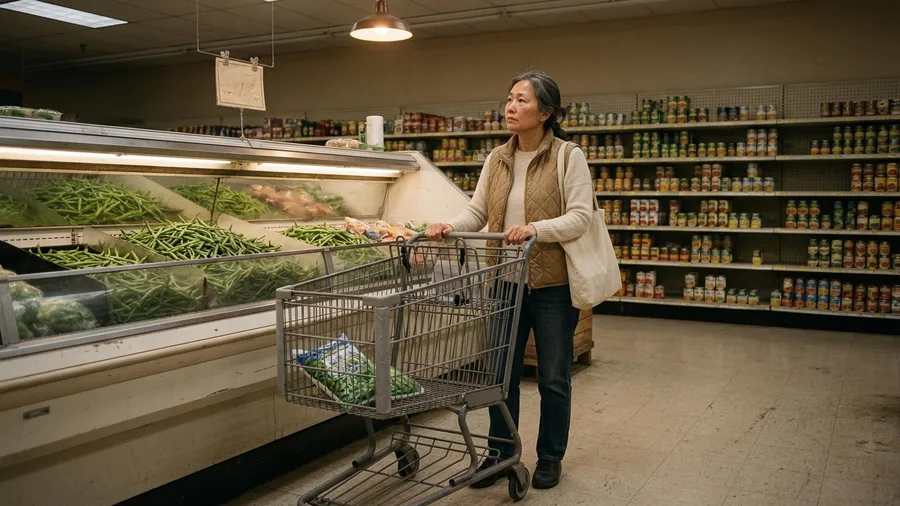
Frozen and canned undercut fresh whenever green beans are out of season, and the gap is not small. At peak, fresh beans run about $2.49 a pound. Off-season, the same pound sits at $4.99 while frozen cut green beans hold at $1.64 per 12-ounce bag and canned hold at $1.15 per 14.5-ounce can, all year.
The sticker only tells half the story.
Fresh beans carry about 10% waste to trim ends and any soft spots, so the real cost per eaten pound runs above what you paid at the register. Frozen and canned arrive already trimmed and ready to use, which quietly closes the gap further. So the cheap-looking fresh pound is not so cheap once the paring knife is done.
That trim math is the seed of a bigger number. Half of a $4.99 off-season pound tossed in the crisper drawer turns the eaten portion into $9.98 a pound. The waste does not just trim margins; it doubles them.
The comparison flips at peak season. When beans are $2.49 a pound in June, fresh beats frozen and canned on price and on flavor, and buying frozen then is paying for shelf life you do not need.
Who the gap matters to: off-season shoppers and large families buying volume, where the per-pound difference compounds across a week of meals. It matters less to gardeners and farmers-market regulars who already have cheap fresh supply and a plan to eat it.
Check the unit price once on your next trip and the seasonal pattern shows itself without any guesswork.
At a Glance
Frozen and canned are close, not automatically worse
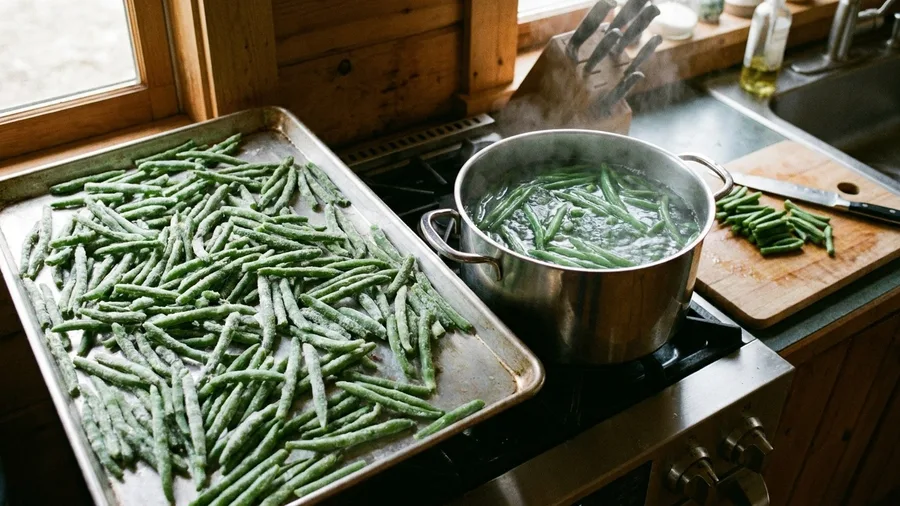
The cheaper bag is not the lesser bag. Most frozen and canned vegetables are processed within hours of picking, at the peak of their sugar and vitamin content, while fresh beans can sit in a truck, a distribution center and your crisper drawer for the better part of a week before they hit the pan.
That transit matters because produce is still breathing after harvest. Vitamin C in particular declines steadily with time and warmth, so a bean that traveled six days to a winter shelf may arrive with less of it than one blanched and frozen in July.
Now line up the label on a cup of cooked green beans. Fresh comes in around 44 calories and 4 grams of fiber, frozen about 42 and 4, canned roughly 36 and 3. Three nearly identical columns.
The catch is that canning uses heat, and heat-sensitive vitamins like C and some B vitamins take a hit in the process. Frozen, blanched briefly and then locked at 0 degrees, tends to hold them better.
Exact numbers swing by vegetable, brand and how long the can sat in your pantry, so the honest check is USDA FoodData Central rather than a general winner claim. For the everyday job of getting vegetables onto the plate in January, frozen and canned hold their own.
| Factor | Fresh | Frozen | Canned | Best for |
|---|---|---|---|---|
| Cost | $2.49/lb in season, $4.99 off-season | $1.64 per 12 oz, year-round | $1.15 per 14.5 oz, year-round | Fresh in season; frozen and canned off-season |
| Edible loss | ~10% trim plus fridge spoilage | Almost none | Almost none | Anyone who tosses leftovers |
| Calories & fiber (1 cup cooked) | 44 cal, 4 g fiber | 42 cal, 4 g fiber | 36 cal, 3 g fiber | All reasonable; check USDA FoodData Central |
| Added sodium | 0 mg | 0 mg | ~380 mg per 1/2 cup regular; ~5 mg no-salt-added | Plain frozen or no-salt-added canned |
| Texture | Snaps raw, stays crisp | Thaws watery, holds shape roasted | Soft | Fresh for raw; frozen for high heat; canned for soups |
| Prep time | ~8 min trim plus 5 min cook | ~1 min open plus 5 min cook | ~2 min drain plus 3 min heat | Weeknights without time to trim |
| Peak season | June–September | Year-round | Year-round | Fresh at peak; either staple otherwise |
| Shelf life | 5–7 days in fridge | 8 months at 0°F | 2 years in pantry | Planning around an unpredictable week |
| Label check | Loose $2.49/lb vs pre-trimmed $3.99/lb | Plain $1.64 vs seasoned $2.79 | Regular $1.15 vs no-salt-added $1.45 | Read the label once, then decide |
Canned sodium and sugar are the real catch

The salt is not in the vegetable; it is in the liquid you are about to pour off. That is the whole distinction, and it is why two cans of the same green beans can land 375 milligrams apart.
Look at the numbers per half cup. Fresh and plain frozen green beans carry no added sodium at all. A regular can runs about 380 milligrams, a meaningful slice of a day's limit if you are watching blood pressure. The no-salt-added version sits near 5 milligrams and costs roughly 30 cents more per can. Thirty cents against a third of your daily sodium is a trade most people make once and then stop thinking about.
If you only have the regular can, drain it into the sink and rinse the beans under cold water for a few seconds. That washes away a good share of the surface sodium, the same trick that works on canned beans.
Sugar hides on the fruit side. Syrup-packed peaches and pears list it plainly on the label, while fruit canned in its own juice does not. Read the line before the price.
Anyone managing sodium or blood sugar should keep plain frozen in the freezer as the default and treat regular canned as the backup.
⚠️ COMMON MISTAKE
Rinsing helps — reading the label helps more
Rinsing cuts surface sodium, but it cannot undo a syrup pack or a seasoned sauce frozen into the bag. Flip the can or bag over once in the store. If the ingredient list runs past beans, water and salt, you are paying for sodium and sugar you did not ask for.
Fresh wins raw; frozen holds up in cooking
A crisp snap is the one thing frozen and canned cannot give you, which is why fresh still owns the raw plate. Green beans pulled from the fridge and eaten cold, or scattered through a salad, depend entirely on cell walls that hold their shape under your teeth. Thaw a frozen bean and it goes limp and watery in the bowl. Open a can and you get soft. If the dish is built on crunch, fresh is not a splurge, it is the ingredient that makes the dish work at all.
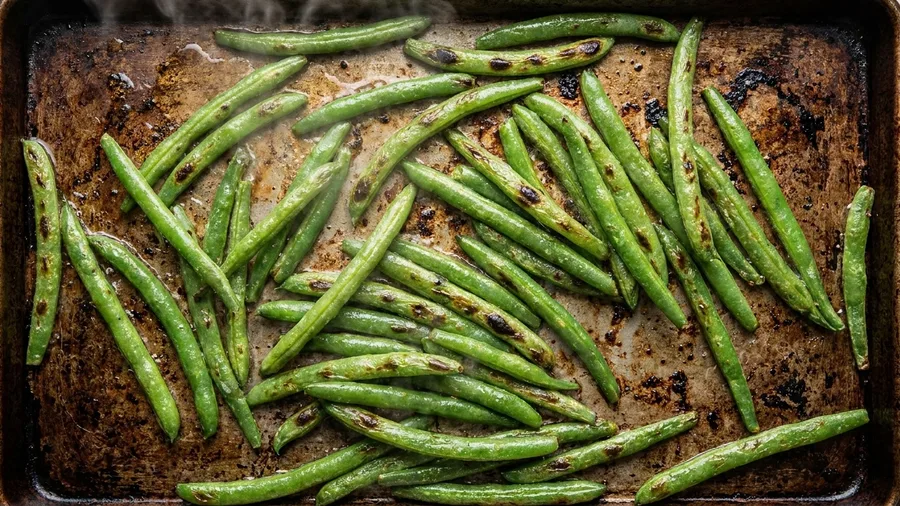
Heat flips the ranking almost completely. Frozen green beans come out of the bag watery but firm up and keep their shape under a hot oven or a screaming skillet, blistering at the edges rather than collapsing into mush. That makes them the practical pick for sheet-pan roasting and stir-fries where you want some bite left.
Canned beans are soft, and for two jobs that is exactly right. They break down into soups and stews, thicken a casserole, and disappear into the body of a braise instead of sitting in it as separate pieces.
The detail worth holding onto: texture only decides the choice when texture is the point. In a long simmer or a puree, softness stops mattering, and the cheapest format on the shelf does the job. A bowl of green bean soup does not know the difference.
Frozen and canned cut prep; fresh costs minutes
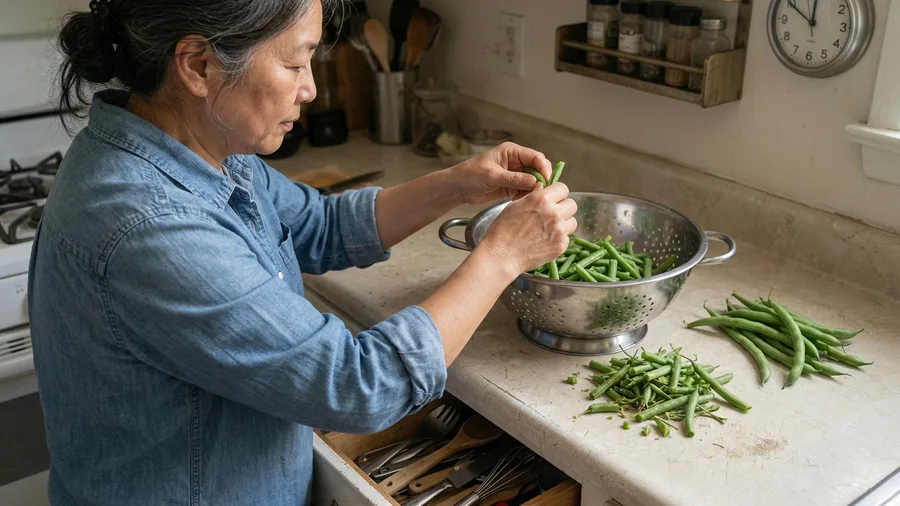
Texture decides which format belongs in the pan, and the clock decides whether dinner happens at all. Frozen and canned cut the prep; fresh asks for minutes up front.
Picture the counter at 6:15 on a Tuesday. Fresh green beans take about 8 minutes to top, tail and snap, then 5 minutes to cook. Frozen: about 1 minute to open the bag, 5 minutes to cook. Canned: 2 minutes to drain, 3 minutes to heat.
Those totals look closer than the fridge shelf suggests.
Stove time barely moves between formats. What frozen and canned remove is the washing, trimming and chopping that happens before the burner is even on, which is why the gap lands hardest at the end of a workday.
Add children at the counter and the 8 minutes stretches, since small hands snap slowly and the trimming becomes a project rather than a step. A bag of frozen cut beans skips that entirely.
Fresh still fits when prep is part of the plan, like a weekend cook or a kid learning to trim. On a rushed weeknight, the 8 minutes is the difference between a vegetable and no vegetable.
What Seven Extra Minutes Buys You
Prep minutes are hands-on; cooking minutes overlap with everything else on the stove.
In season fresh wins; otherwise frozen is steadier
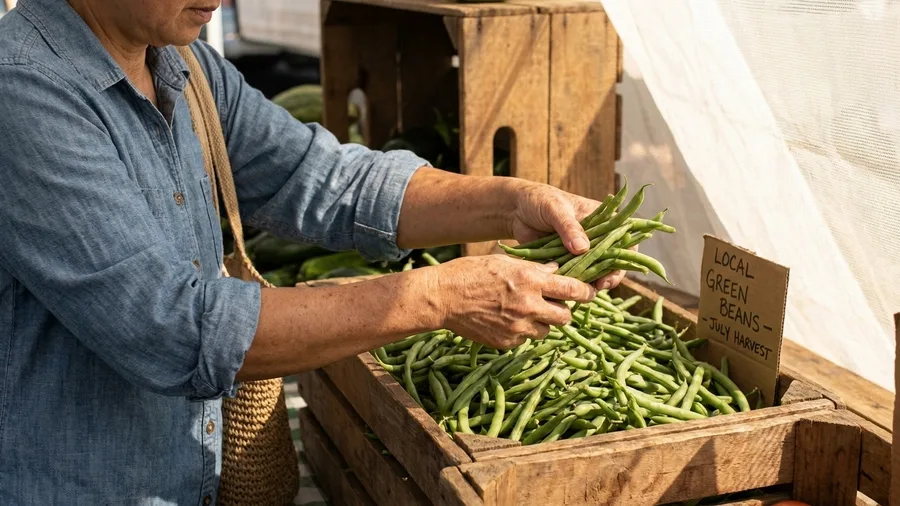
Fresh earns its premium for about four months a year, when green beans peak from June through September at $2.49 a pound. That is when they taste sweetest, snap cleanest, and cost the least. Off-season the same beans climb to $4.99 a pound after a longer trip to the shelf, and the flavor rarely justifies the climb.
Frozen and canned barely move. Frozen cut green beans hold at $1.64 for a 12-ounce bag and canned at $1.15 for a 14.5-ounce can, month in and month out, like the cheap staples nutritionists keep buying. The product inside is the same in January as in July, because it was packed at harvest and held at a steady temperature since.
So the season sets the rule. Buy fresh in summer at peak price for the flavor, and keep plain frozen and canned for the rest of the calendar.
Cold-climate shoppers and anyone buying off-season feel this most, since fresh is at its priciest exactly when the local supply is gone. Gardeners and farmers-market regulars feel it least. For them, fresh is cheap and close to the vine most of the year.
Buy Fresh vs Buy Frozen or Canned
Buy fresh when…
- It is June through September and priced near $2.49/lb
- You will cook it within 5 to 7 days
- The dish is served raw — salad, snack plate, crudité
- You shop twice a week with a plan in hand
Buy frozen or canned when…
- It is off-season and fresh is $4.99/lb or higher
- The week's schedule is unpredictable
- The dish roasts, stir-fries or simmers for a while
- You want a staple that waits 8 months to 2 years
Fresh spoils fast; frozen and canned wait

A short fridge life is the format's real deadline, and it decides whether any of that fresh quality reaches your plate. Fresh green beans keep 5 to 7 days in the crisper; frozen holds 8 months at 0°F; canned sits 2 years in the pantry.
Which purchase survives your actual week?
That gap changes the math. Half an off-season fresh pound at $4.99 goes soft and gets tossed, and the eaten portion costs $9.98 a pound. The green beans you never cooked cost more than the ones you did, because the bin keeps its own ledger.
Buying fresh feels virtuous in the moment, even when the calendar says Wednesday is takeout and Thursday runs past eight. The intention is honest. The bin records the difference between intention and use, and the bin does not grade on effort.
Busy households and spontaneous cooks feel this most, the ones whose plans shift by six o'clock. Fresh earns its place for shoppers who go twice a week with meals mapped out, who pick up a pound and have it on the plate by Thursday. Everyone else buys a deadline along with the produce.
🛒 One Week, Decided Before You Shop
Check the calendar
Count how many nights you will actually cook at home this week.
Check the season
If green beans are near $2.49/lb and look crisp, fresh is the buy.
Match the dish
Raw or crisp salads get fresh; roasting and stir-fry get frozen; soups get canned.
Read one label
Compare plain against seasoned, and regular canned against no-salt-added.
Buy for the days you have
One fresh pound for the first three nights, frozen and canned for the rest.
Fresh bias makes you pay for virtue
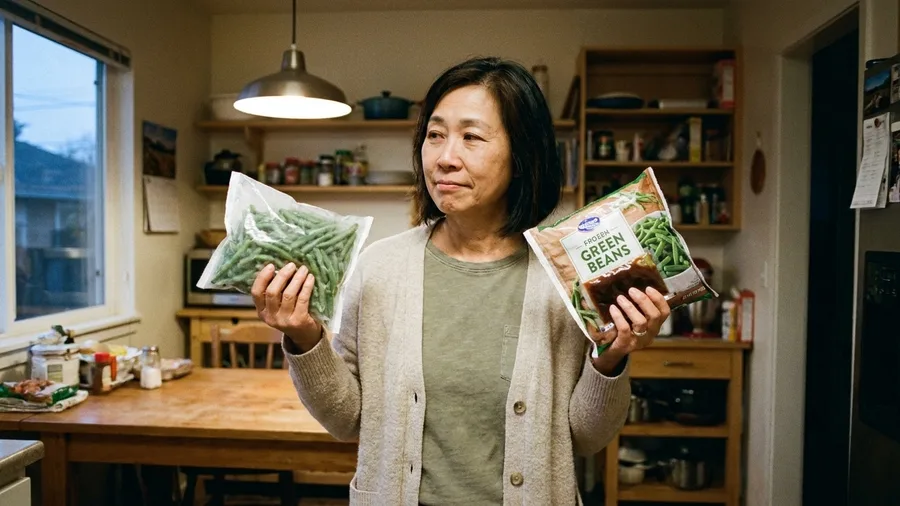
Fresh reads as healthy and frozen or canned reads as compromise, so the assumption sets the price before you have checked anything. It is a shortcut, not a rule, and the sticker does not always back it up.
Read the label and the trap shows up in two places. Plain frozen green beans run $1.64 per 12 oz, while the seasoned bag beside them is $2.79 for the same vegetable plus a sauce packet. No-salt-added canned is $1.45 versus $1.15 regular, so the cheaper can is the one carrying about 380 mg of sodium per half cup.
The price trap sits on the fresh side. A bag of pre-trimmed green beans at $3.99 a pound costs more than loose beans at $2.49 for the same vegetable, the $1.50 paying for someone else's knife work while the clock in your kitchen stays the same — the same logic behind the swaps dietitians choose instead.
That is money spent without better nutrition, only more convenience on one end and more salt on the other.
The bias costs shoppers who reach for fresh as the superior choice before reading a thing. It costs little for anyone who already cooks fresh before it spoils, because the habit is doing its job.
Where the Money Actually Goes
Green beans, priced per edible pound in this example
Exact figures vary by store, brand and storage — verify against current prices and USDA FoodData Central.
Frequently Asked Questions
Is frozen produce less healthy than fresh?
Not automatically. Frozen vegetables are blanched and frozen within hours of harvest, while fresh produce can spend days in transit and in your fridge. Label values for one cup of cooked green beans land within a few calories and a gram of fiber across fresh, frozen and canned. Check USDA FoodData Central for the exact product you buy.
Does rinsing canned vegetables really reduce sodium?
Yes, it removes a meaningful share of the sodium carried in the packing liquid on the surface of the food. It does not turn a regular can into a no-salt-added can — regular canned green beans still carry roughly 380 mg per half cup before draining. If sodium is a concern, buy no-salt-added at about $1.45 a can.
When is fresh produce actually cheaper than frozen?
At peak season and local supply. Fresh green beans near $2.49 a pound with about 10% trim beat frozen at $1.64 per 12 ounces and canned at $1.15 per 14.5 ounces on cost per edible pound. Off-season at $4.99 a pound, fresh loses on price and often on quality.
How long does each format actually keep?
Fresh green beans keep 5 to 7 days in the fridge. Frozen keeps about 8 months at 0°F, and quality declines if the bag sits through freezer burn. Canned keeps about 2 years in the pantry. Buy the format that matches the week you actually have, not the week you planned.
Which format should I use for soup versus salad?
Canned for soup, stew and casserole — it is soft going in and softness is the destination. Fresh for salads, snack plates and anything served raw, where the snap is the point. Frozen for high-heat roasting and stir-fries, where surface water cooks off before the vegetable collapses.
Do seasoned or sauce-packed frozen vegetables cost more?
Usually yes, and you are paying for salt and sauce rather than vegetables. Plain frozen green beans run $1.64 per 12 ounces; the seasoned version runs about $2.79. If you want seasoning, buy plain and season it yourself — you control the sodium and spend less.
Fresh when it is June, frozen when it is Tuesday, canned for the pantry
Here is the rule to carry into the store. Buy fresh when the vegetable is in season and certain to be eaten within a few days. Make plain frozen the default for cooking the rest of the year, especially off-season and on weeknights with no trim time. Keep no-salt-added canned on the shelf for soups, stews and the nights the plan falls apart.
Then do one comparison before you assume anything. Check plain against seasoned frozen, and no-salt-added against regular canned, which usually runs about $0.30 more. If the plain version delivers the same fiber and calories for less money and less waste, that is not settling. That is buying well.
Go back to that $4.99 off-season pound and the $9.98 you actually paid per pound eaten. The fresh halo is expensive when the produce was never going to make it to the plate. Decide by season, use and label, and the choice stops being guilt and becomes a trade-off you planned.
Read One Label Before You Assume Fresh Wins
Pick the vegetable you buy most and compare the loose price, the plain frozen bag and the no-salt-added can side by side. One trip tells you where fresh earns its price and where it quietly does not.