
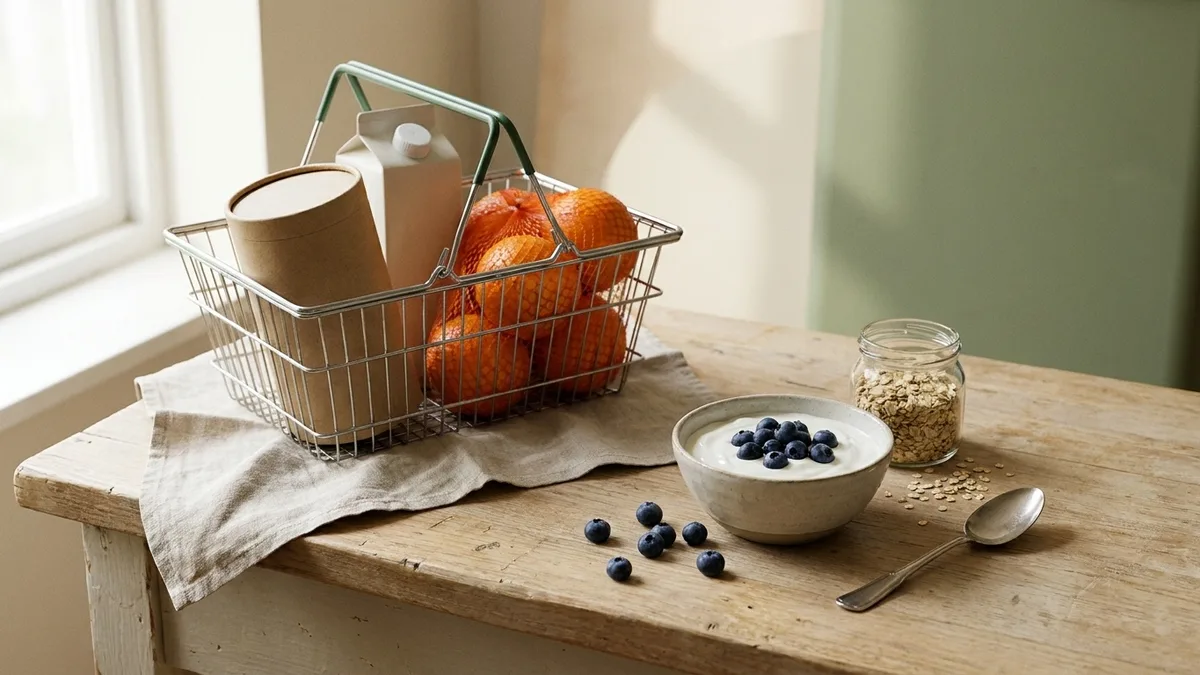
The surprise is not that the cart changes after 50. It is how little of it has to. The $0.90 flavored yogurt cup, deli turkey at $9 to $11 a pound, the $2 can of condensed soup: the cart at 47 looks almost exactly like the cart at 37, even with a general instruction to eat differently ringing in your ears that names no product on any shelf.
What actually changes is narrower than that instruction sounds. Nobody is removing a category of food. What moves is a single item, replaced by its neighbor a few feet away: the sweetened cup for a scoop from a plain tub, the flavored packet for a canister of oats.
You can price each one before you commit. About $0.90 against about $1.00 a serving at the dairy case. Roughly 17 cents a serving against 40 cents a packet at the cereal aisle. Five dollars a pound against $9 to $11 for the sandwich filling.
By the end you will have a short list, know which swaps cost nothing extra, which one saves money outright, and which one carries a premium, and whether you are the shopper who should take the numbers to a clinician first.
Quick Tips Before You Start
Flip the package
Compare protein, added sugar, sodium, and fiber per serving on the back panel, not the front claims.
Price per serving
Divide the package price by the number of servings you will actually get — a $6 tub often beats a $0.90 cup.
Count the minutes
Rolled oats and barley take 5 to 40 minutes; figure out when you will cook them before you buy.
Swap one item
Change the yogurt or the bread this week, not the whole cart — one swap at a time sticks.
Why the cart changes at 50
After 50, the question at the shelf shifts from how many calories to what those calories carry. Muscle protein synthesis responds less efficiently to smaller doses of protein, and fiber intake tends to drop as appetites and routines change. The two numbers that start organizing the list are grams of protein and grams of fiber per serving.
That does not mean cutting whole categories. It means looking at the item inside the meal — the yogurt in the bowl, the oats in the pot, the slices on the sandwich — and asking what one dollar and one serving deliver.
1. Protein and fiber start driving the list

The change after 50 is not a subtraction. It is a shift in what a meal is built around – protein and fiber per bite instead of a number of calories removed.
That is the whole reason the list exists, and it is why calorie arithmetic stops organizing the cart somewhere around the mid-forties. The question at the shelf becomes what a serving gives back, not what it costs you in calories.
Take the breakfast most people already eat. A 5.3 oz flavored yogurt cup runs about $0.90 and carries roughly 5 g of protein against about 12 g of sugar. A scoop from a $6, 32 oz tub of plain 2% Greek yogurt lands at about $1.00 for the same 5.3 oz serving, with about 15 g of protein and no added sugar. Three times the protein, a dime more.
The meal itself does not change. The toast stays toast. The sandwich stays a sandwich. The oatmeal stays oatmeal, spooned from the same bowl at the same kitchen table.
What changes is the item inside the meal. That is a rebuild, not a removal, and it is the pattern the rest of the cart follows once you see it.
No daily gram target is set here, and it should not be. A personal protein or fiber number comes from the Dietary Guidelines for Americans or from a registered dietitian who knows your history, not from a shopping list.
The only measure this list applies to any item is what one dollar and one serving deliver. A trade, always – never a prohibition.
💡 Tip: Read the protein and added-sugar lines on the back panel before you look at the front-of-pack fruit pictures.
| Bought less often | Bought instead | Why the swap | Price check |
|---|---|---|---|
| Flavored yogurt cup (5.3 oz) | Plain 2% Greek yogurt tub (32 oz) | About 15 g protein vs 5 g; no added sugar | ~$0.90 per cup vs ~$1.00 per serving |
| Sweetened instant oatmeal (10 packets) | Plain rolled oats (42 oz) | No added sugar; about 17 cents a serving | ~$4 per box vs ~$5 per canister (30 servings) |
| Deli turkey or ham (per lb) | Whole rotisserie chicken or canned salmon | Lower sodium per serving; more protein per dollar | ~$9–11/lb vs ~$5/lb (chicken) |
| White sandwich bread | Whole-grain bread | 3–4 g fiber per slice vs 1 g | ~$3.50 vs ~$4.50 per loaf |
| Condensed soup (10.5 oz) | Low-sodium carton soup (32 oz) | About half the sodium per cup | ~$2 per can vs ~$4 per carton |
| 100% juice (64 oz) | Whole oranges | Fiber in the fruit, none in the juice | ~$4 per bottle vs ~$1.30/lb oranges |
2. Dietitians trade up rather than cut out
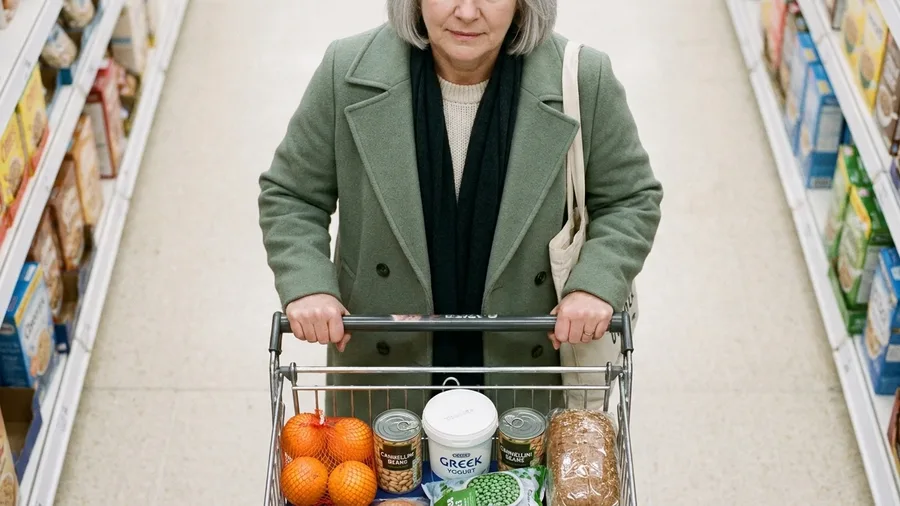
Nothing on this list asks you to stop buying a category of food. The same cue-based approach fits a broader four-pillar wellness framework for movement, food, sleep and connection. Almost every item bought less often has a replacement sitting in the same aisle, keeping the meal it belongs to intact.
Yogurt for yogurt. Oats for oats. Bread for bread. Soup for soup. The shelf does not empty out; one package trades places with its neighbor.
Plenty stays in the cart untouched. Whole oranges and canned beans have no trade worth making – they already deliver what the list is asking for. Frozen vegetables go in exactly as they always did, bag by bag.
The changed list is short, and it is named one item at a time: the flavored cup, the sweetened packet, the deli slices, the white loaf, the box of instant rice, the condensed can, the juice, the soda.
Read that back and notice what is missing – no dairy case struck off, no bread aisle abandoned, no grain banished. Eight items, not eight departments.
No number describes what dietitians buy as a group, and none is offered here. The pattern is visible one shelf at a time, which is how the aisles that follow walk it.
The swaps, aisle by aisle
Six aisles, walked in the order a shopper moves through them: yogurt, cereal, deli, bread and grain, soup, drinks. Each entry names the item going back on the shelf, the replacement going in the cart, and the price difference per serving.
Read the numbers off the back panel as you go. The front of the package is designed to sell the swap or hide the cost of it.
3. Flavored yogurt cups give way to plain Greek yogurt

The dairy case makes the trade easy to see, because the cup and the tub sit a few feet apart and the gap between them comes down to about a dime.
A 5.3 ounce flavored cup runs about 90 cents and gives you 5 grams of protein with roughly 12 grams of sugar folded in. The 32 ounce plain 2% Greek tub costs around $6 and portions out to about $1.00 per 5.3 ounce serving, at close to 15 grams of protein and no added sugar. Three times the protein, ten cents apart, same aisle.
So you are not giving up yogurt. You are holding a different package of it.
The decision lives on the back panel, and it takes about four seconds. Read two lines: protein and added sugar. The fruit pictured on the front and the word light tell you nothing you can use.
Where this does not fit: if plain yogurt is a food you will not eat, stirring chopped fruit or a spoon of jam into the tub gets you most of the gain without abandoning the switch. And an occasional flavored cup is not the problem this list was written to solve.
💡 Tip: Mix a spoonful of jam or honey into the plain tub at first, then cut back over two weeks — the palate adjusts faster than you expect.
⚠️ COMMON MISTAKE
The front-of-pack trap
The words made with real fruit or light on a yogurt cup say nothing about added sugar or protein. Flip to the back panel and compare the two numbers that matter for this swap: grams of protein and grams of added sugar per serving, not per container.
4. Sweetened instant packets become plain oats you flavor

The yogurt trade at the dairy case keeps the two prices a dime apart, so the register barely notices. Down the cereal aisle the same swap pays a dividend instead of costing one.
Ten flavored instant oatmeal packets run about $4, which works out to 40 cents a bowl, and each packet carries about 12 grams of sugar before you taste anything. A 42-ounce canister of plain rolled oats costs around $5 and holds roughly 30 servings, landing near 17 cents a serving. That is less than half the per-bowl cost.
Time is the trade, and it is the honest part.
💡 Tip: Soak 1/3 cup oats in 2/3 cup milk overnight, add cinnamon and berries in the morning — no stove, no packet.
Oats vs Packets — At a Glance
📆 First two weeks
Blander than you expect — the sugar habit fades by day 10
🍌 What to add
Half a banana, berries, cinnamon, a spoon of peanut butter
🌾 Fiber per bowl
~4 g plain vs ~2 g flavored packet
⚠️ Skip the swap if
You truly won't cook — 40 cents and 12 g sugar beats no breakfast
The honest catch
You are trading four minutes of stove time and a sweeter first bite for fiber that actually keeps you full until lunch.
5. Deli slices shrink; rotisserie chicken and canned fish grow

Eggs and tuna are fine, but the question most people actually ask is what to do about the sandwich filling, and that is where the price gap in the store runs widest. Deli turkey or ham runs $9 to $11 a pound, and a two-ounce serving of it carries roughly 600 to 800 milligrams of sodium.
A whole rotisserie chicken costs about $5 a pound by comparison, and there is no mystery cut: what you peel off the bones and shred or slice becomes sandwich filling for the week.
The shelf-stable backup is a 14.75-ounce can of salmon at about $4.50, ready for a mixed-salmon sandwich or a patty with no cooking required. Mind the salt: canned salmon is salted too, so the panel gets read the same way it was read across the rest of this list.
The convenience cost is real, so budget for it. Shredding and portioning a chicken takes about 20 minutes on a Sunday, and the meat holds three to four days in the fridge or gets frozen in individual bags.
💡 Tip: Buy the rotisserie chicken plain, not seasoned or glazed — the seasoning is where the sodium climbs back up.
The sandwich, rebuilt
What to reach for first when the deli slices come out
6. White bread and instant rice become whole grains

The bread under the better filling is the next line on the list. One extra dollar a loaf is a fair price for a lot more fiber.
White sandwich bread runs about $3.50 a loaf with roughly a gram of fiber a slice. Whole-grain bread at about $4.50 a loaf delivers 3 to 4 grams, three to four times what the white loaf gives. An extra dollar buys the whole loaf, not the slice.
The front label cannot be trusted by itself, because every loaf claims something. Turn it over and read the first ingredient. Whole wheat is the whole grain; wheat flour is white flour wearing a sensible name, and made with whole grains means it is mostly white flour with a sprinkle of the real thing.
The grain swap works the same way on the rice shelf. Instant white rice runs about $2 a box; pearl barley runs about $1.80 a pound, cheaper by the pound and higher in fiber. The trade is time, 25 to 40 minutes at the stove, and the fix is to cook a batch ahead on a weekend so the grains are ready in the fridge.
💡 Tip: Cook barley in low-sodium broth instead of water — it absorbs flavor and needs no sauce later.
White vs whole grain: what the label says
White bread & instant rice
- Bread: 30% of daily fiber if you eat 3 slices
- Rice: 'enriched' = B vitamins added back, fiber is gone
- 5-minute rice: read sodium; some seasoned boxes hit 600 mg
- Barley swap: check hulled vs pearled; pearled cooks faster, less fiber
Whole-grain bread & barley
- Bread: 3 slices = 9-12 g fiber (women 50+ aim 21 g/day)
- Barley: 1 cup cooked = 6 g fiber, plus beta-glucan for cholesterol
- Batch trick: cook barley in broth, freeze in 1-cup portions
- Label check: '100% whole grain' stamp beats 'made with'
7. Condensed soup and regular broth become low-sodium cartons

Low-sodium soup is not bland soup. It is soup that has not been finished yet.
The premium is real and it lands on every single purchase: a 32 oz carton of low-sodium soup runs about $4 against about $2 for the familiar 10.5 oz condensed can. That is the largest gap in the whole aisle-by-aisle list, and unlike a loaf of bread it does not come once a week as a maybe – soup buyers tend to buy soup often. What the extra money does buy is arithmetic. The condensed can carries roughly 800 mg sodium per half-can; the carton runs about 400 mg per cup. About half, serving for serving.
Broth is the quiet version of the same swap, and the smaller one: a 32 oz regular carton sits near $3, the low-sodium carton near $3.50. Fifty cents to cut the salt backbone out of everything cooked with it.
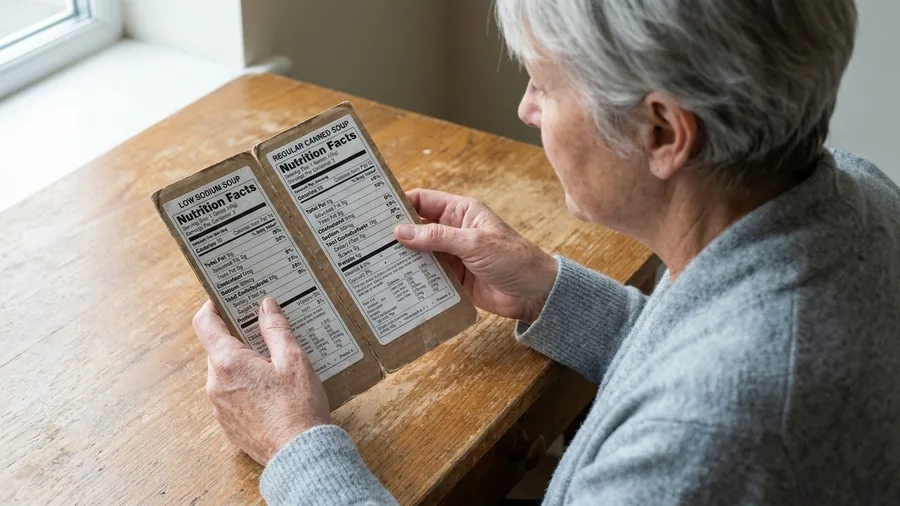
Here is where most readers get misled. Front-of-pack sodium wording shifts by brand and by claim – reduced sodium, lightly salted, less sodium – and those phrases are not the same claim. The number that decides it is on the back panel, in milligrams, next to the serving size. Compare those two numbers, not the words above them.
Then the flavor question, honestly. A low-sodium carton tastes thin straight from the pot, and the fix is not to buy the salty can again – it is to finish the bowl at the table. A pinch of salt, herbs, a squeeze of lemon or a splash of vinegar restores what the can carried in, and you decide how much goes in.
Where it does not apply: a reader who eats canned soup a few times a year has very little to gain for the extra $2. The math only tilts when soup is a regular meal.
💡 Tip: A squeeze of lemon or a splash of vinegar at the table makes low-sodium soup taste salted — try it before you reach for the shaker.
🥣 Your first low-sodium soup: the sequence that avoids a wasted carton
Buy one carton first, not three
Brands differ wildly in how thin low-sodium tastes. Try a single 32 oz carton before committing shelf space.
Date the carton when you open it
Low-sodium cartons often turn sooner than condensed cans once opened. Mark the lid; finish within 4 days or freeze the rest.
Freeze in 2-cup portions, not the whole carton
Freeze the leftover half in 2-cup containers you would actually use for one meal, so nothing thaws twice.
Skip the swap if soup is a rare meal
A few cans a year does not justify the $2 premium or the freezer space. Buy the condensed can and add water plus your own seasoning.
Use low-sodium broth in anything you reduce
If a recipe simmers broth down by half, regular broth concentrates its salt. Low-sodium broth is the one place the $0.50 actually protects the whole dish.
8. Juice and soda become whole fruit and sparkling water

A carton and a bottle present the same delivery problem: sweetness that reaches you in a glass, arriving without the bulk that would have slowed it down. Soup hands you salt that way; juice and soda hand you sugar that way.
Start with the carton. Sixty-four ounces of 100 percent juice runs about $4, and the back panel lists no fiber at all. The word 100 percent is doing real work, since it means no added sugar, but it says nothing about what happens when four oranges' worth of sweetness lands in ten minutes without the pith or the pulp to travel with it.
Then pick up a bag of whole oranges instead, about $1.30 a pound, each one carrying roughly 3 grams of fiber. That fiber is the item you could not buy in the juice aisle, and it is why the fruit takes longer to finish.
The soda case is blunter. A 12-pack of regular soda runs about $6; a 12-pack of plain sparkling water about $5, so the swap actually trims a dollar from the cart.
There is a middle position worth naming, because it is where most people land. A small glass of juice poured alongside a meal, not a tumbler carried around on its own, keeps the vitamin C and lets the food in your stomach slow the delivery.
And there is a group this does not apply to. One glass of juice a week has nothing to fix, and treating it as a problem to solve will just make the rest of the list feel like homework.
💡 Tip: Pour sparkling water over ice in a wine glass with a slice of orange — the ritual survives even when the juice does not.
The cart changes one item at a time, not one category at a time.
— What dietitians keep repeating about shopping after 50
Cost and when to skip the swap
Six swaps in, the money question shows up: will this cost more each week? Some of it will, some of it will not, and the difference is worth pricing before you commit.
The next two entries settle that question and name the reader for whom the original item is still the right buy.
9. Cheaper by the serving, pricier at the register

Six aisles of swaps, each priced alone at the shelf, do not necessarily add up to a bigger weekly bill. Some of them come out ahead per serving, a few cost more, and the total depends on which ones you actually take.
Run the numbers that come out ahead. The oats canister lands at roughly 17 cents a serving against 40 cents for a flavored packet. A rotisserie chicken at about $5 a pound sits well under deli meat at $9 to $11. A pound of pearl barley at $1.80 replaces a $2 box of instant white rice and covers more meals.
Now the ones that cost extra. A low-sodium soup carton at $4 against a $2 can looks like double at the register, and it is. But the carton holds four cups; the can yields two half-can servings. Per bowl the two are close to even, which is the kind of arithmetic the receipt never shows you.
Whole-grain bread adds about a dollar to the loaf, $4.50 against $3.50. The oranges run more than the juice bottle. None of these are back-breaking sums, but they are real, and they land in the same week as the ones that save.
Four things absorb the difference without changing the list: store brands on the plain items where the label matches, frozen fish and frozen vegetables, canned beans, and grains bought in bulk rather than in boxes.
For anyone on a fixed budget, the order matters more than the full list. If the cart still feels off after these swaps, simple resets to try first let you test one change at a time. Start with the three that cut the bill, the oats, the chicken, the barley, and let the premium items wait until the money-saving ones are habits. The swaps only pay off if the cart stays affordable enough to keep filling.
💡 Tip: Check the unit price tag on the shelf edge, not the package price — it is printed per ounce and per serving for a reason.
10. Some shoppers should keep the original item
The shelf arithmetic works for most carts, but not every one.
There is a shopper for whom the original item is the better buy no matter what the price-per-serving comparison says, and the swaps on this list were not drawn for them.
The first is the reader losing weight without meaning to, or the one who sits down to a plate and stops after a few bites. For that person calorie density beats trading down: the fuller-fat yogurt, the saltier soup, the higher-calorie original gets more nutrition into a smaller appetite, and stripping it out can push weight down further when the goal is to hold it steady.
Unintended weight loss after 50 is a conversation with a doctor, not a cart decision, and picking a doctor is the first work for that reader, not changing how one buys food.
The second is anyone on a sodium, potassium or protein limit, as with kidney disease, whose clinician has already written numbers down. The replacements are not automatically safer for that cart.
Cottage cheese, Greek yogurt and canned fish all carry mineral and protein numbers that can sit over a limit just as easily as under one, so a swap made for better numbers can move the wrong figure in the wrong direction.
The third is the occasional eater. Twice a month, the swap buys almost nothing worth the trouble.
A deli sandwich every other Saturday is not the thing a cart needs fixing for, and spending mental energy there crowds out the swaps that would actually pay.
What helps instead is smaller than a new list: ask a registered dietitian or the treating clinician before changing anything, and bring the label numbers from both items to that conversation.
The protein, fiber, sodium and potassium figures off the back of the original and the replacement together give the clinician something concrete to compare, which is more useful than a memory of what the old cart held.
💡 Tip: Photograph the back panels of both items and take the photos to your appointment — easier than remembering the numbers.
Frequently Asked Questions
Do I need to hit a specific protein number after 50?
No single number is set in this article. A personal protein target comes from the Dietary Guidelines for Americans or a registered dietitian who knows your kidney function, medications, and appetite. Bring the label numbers from the foods you actually eat to that conversation.
Is low-sodium soup really worth paying double?
Per bowl, the carton and the can are near even: $4 for four cups against $2 for two half-can servings. At the register it is double. The swap is worth it if sodium is the number your clinician has asked you to watch; if not, buy the can you like and salt it yourself.
Can I still eat deli meat?
Yes — twice a month is not the target of the swap. The change is for readers eating deli slices several times a week, where the sodium adds up. Rotisserie chicken and canned salmon are the replacements, and the canned fish is salted too, so read its back panel.
What if I do not like plain Greek yogurt?
Stir fruit, jam, or honey into the tub rather than abandoning the swap. Start with a spoonful of sweetness and cut back over two weeks — the palate adjusts. An occasional flavored cup is not the problem this list is aimed at.
Will these swaps save me money or cost me more?
Some save, some cost. Oats, rotisserie chicken, and barley save per serving. Low-sodium soup, whole-grain bread, and whole oranges cost more at the register. A reader on a fixed budget starts with the money-saving swaps and leaves the premium items for a month when the total has room.
Two swaps cost nothing extra; one saves money outright
Start with the two that cost nothing extra. A plain oats canister runs about $5 for roughly 30 servings, near 17 cents a bowl against 40 cents a packet. A low-sodium soup carton is $4 for four cups, about $1.00 a bowl against $1.00 for a half-can. Neither asks you to give up a meal you like.
The swap that saves money outright is deli meat to rotisserie chicken, about $5 a pound against $9 to $11, with less sodium in the bargain. If the register total is what worries you, do that one first.
Stop before any of it if you are losing weight without meaning to, if your appetite has shrunk, if you are on a sodium, potassium or protein limit such as kidney disease, or if your clinician has already set targets. Take the label numbers from both items to that clinician or a registered dietitian.
Back at the same supermarket, the $0.90 flavored cup stays on the shelf. The oats canister, the plain Greek tub and the chicken go in the cart, and the rest of the list waits until you know which shopper you are.
Pick one swap for your next shop
Choose the oats or the rotisserie chicken, check the unit price at the shelf, and read the back panel before it goes in the cart.