
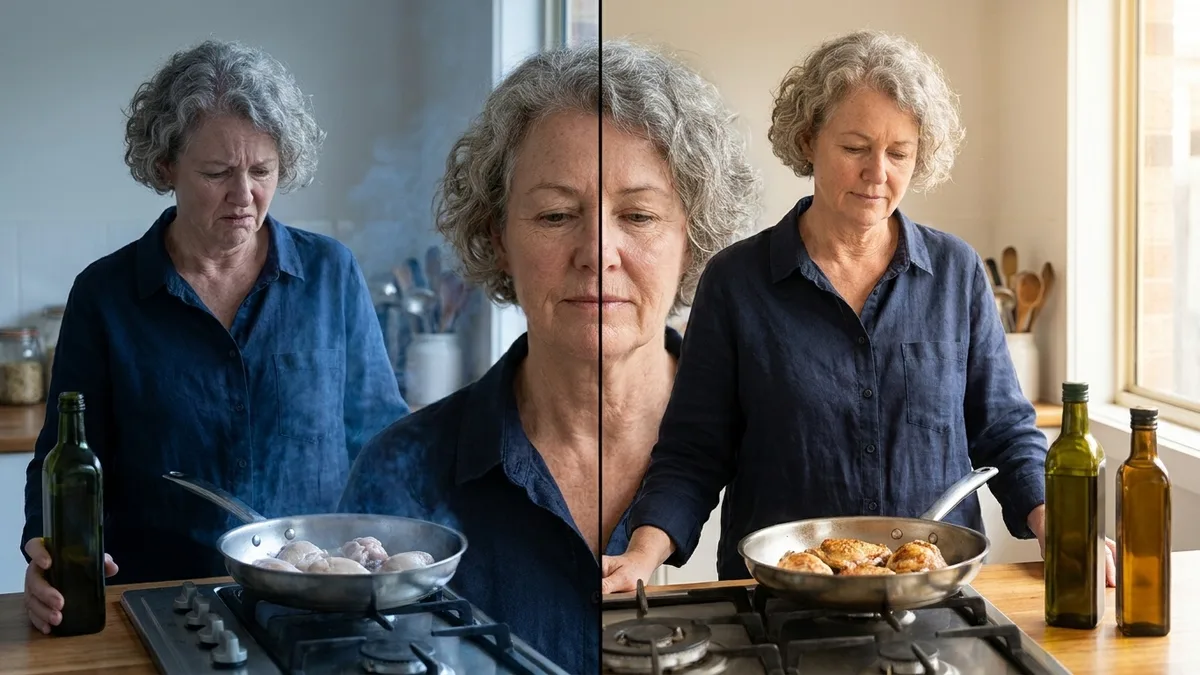
375°F. That is where extra virgin olive oil starts to smoke, and a searing pan runs 400 to 450°F.
So the pan is asking the bottle for something the bottle cannot give. The blue wisp arrives, the chicken sits there pale instead of browning, and the dish picks up a bitterness you taste before you can name it. The label said extra virgin, which sounds like the good one, and it was the wrong one for this job.
Pan temperature picks the oil, not the label. Avocado holds to 500°F and refined peanut to 450°F, so they take a hard sear. Extra virgin olive tops out near 375°F, fine for a gentle sauté and wrong for a screaming pan. Match smoke point to heat first, price per ounce second, flavor third.
Do that and two bottles cover the kitchen: one cheap neutral workhorse and one high-heat bottle that ends the smoking. By the end you will know which to buy first, which unlocks a real sear, and when the expensive bottle is money you do not need to spend.
Quick Tips Before You Start
Check the smoke point first
If the pan will run hotter than the oil's smoke point, pick a different oil. No amount of care fixes a mismatched bottle.
Divide price by ounces
A $14 bottle of avocado oil costs about 83 cents per ounce; a $6 bottle of canola costs about 12 cents. That gap decides big-batch frying.
Smell before you trust
Rancid oil smells like old crayons or putty. If the bottle fails the sniff test, no recipe will rescue it.
Store cool and dark
A cupboard away from the stove keeps refined oils good for about 12 months and olive oil for 18 to 24 months.
Finish off the heat
Delicate olive aroma cooks off in minutes. Add a splash at the end, off the burner, to keep the flavor you paid for.
High heat: searing, frying, roasting
This is where the smoke point earns its keep. A pan above 400°F will punish any oil that cannot take it, and the punishment is a bitter, acrid taste that no sauce hides.
The good news: only two bottles in the whole aisle clear this bar, and one of them is cheaper than the olive oil you already own.
1. Searing wants 400°F, so olive oil is out
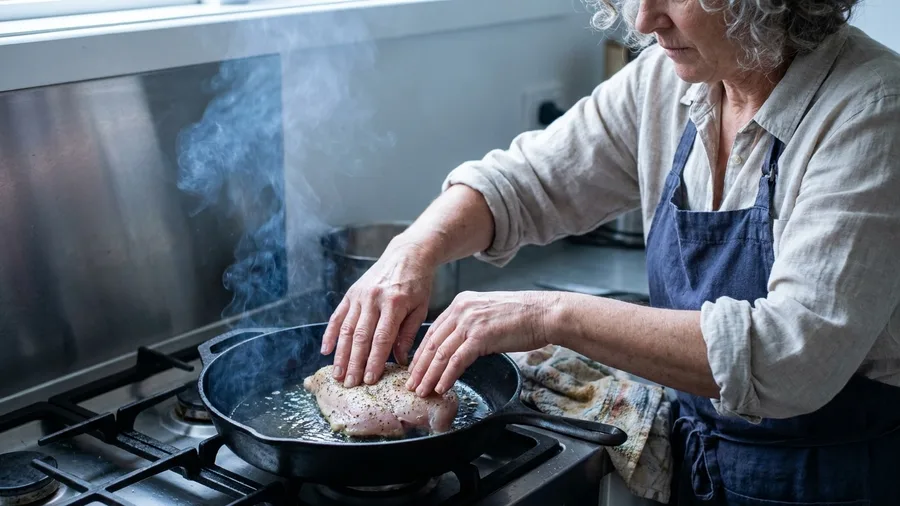
The moment the chicken hits the pan, you want a hard brown crust and no blue haze drifting toward the smoke detector.
A proper sear runs the surface of the pan to 400-450°F, and the oil sitting in it has to hold that heat without breaking down. Extra virgin olive tops out around 375°F, which means it starts smoking and going bitter in the same minutes the meat is still pale and stuck to the steel. You smell it before you see it – that acrid note that gets into the crust and stays there.
Two bottles actually clear the temperature. Avocado stays stable up to 500°F, and refined peanut holds to 450°F. Either one sits quietly under a screaming pan while the surface browns the way you wanted it to.
The cost differs sharply. Avocado runs about $14 for a 16.9-ounce bottle, close to 83 cents an ounce. Refined peanut is around $9 for 24 ounces, roughly 37.5 cents an ounce – barely half the price for a ceiling that clears most searing jobs. If searing is a weekly habit, the peanut bottle earns its spot on the counter; avocado is worth it only if you routinely push the pan past 450°F or finish under the broiler.
None of this means the olive bottle is dead to you. A gentle sauté at 300-350°F sits well below its limit, and that is where most weeknight cooking happens. Buy the high-heat bottle for the hot work, and let the cheaper olive oil handle everything gentler.
Watch for the first thin thread of smoke curling off the surface. That is not a warning to reduce the heat – the oil has already passed the point where it cooks clean, and whatever goes into the pan next will taste of it. Pour it out, wipe the pan, and start again.
💡 Tip: A gentle sauté at 300–350°F is fine in cheap olive oil. Only searing and hard frying need the high-smoke-point bottle.
| Oil | Smoke point | Best for | Typical price |
|---|---|---|---|
| Avocado (refined) | 500°F | Searing, roasting at 425°F | $14 / 16.9 oz |
| Peanut (refined) | 450°F | Deep frying, stir-frying | $9 / 24 oz |
| Ghee | 450°F | High-heat eggs, roasted vegetables | $12 / 13 oz |
| Canola (refined) | 400°F | Baking, sautéing, neutral roasting | $6 / 48 oz |
| Olive (extra virgin) | 375°F | Sautéing, finishing, vinaigrette | $12 / 16.9 oz |
| Coconut (refined) | 350°F | Curry, granola, coconut-flavored bakes | $8 / 14 oz |
| Sesame (toasted) | 350°F | Finishing noodles, rice, cold greens | $7 / 12.7 oz |
| Butter | 300°F | Low-heat eggs, browning, finishing | $5 / lb |
2. Deep frying: refined peanut outlasts olive and costs less
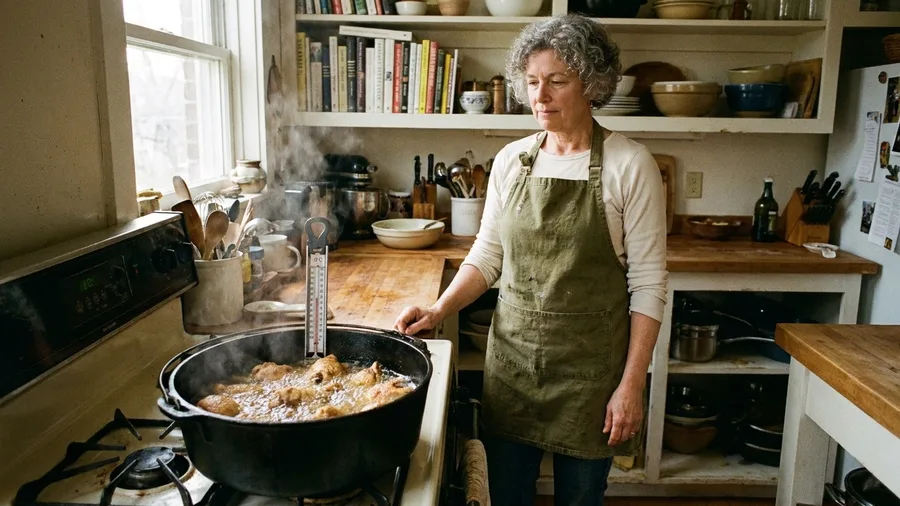
A sear takes a splash, but a full pot of frying takes the whole bottle, and that changes the math. A 3-lb batch of fried chicken absorbs about 6 cups, or 48 oz, so what you pay per bottle starts to outweigh almost everything else on the shelf.
Deep frying sits at 350-375°F. Refined peanut oil, at 450°F and about $9 per 24 oz, clears that range with room to spare and costs less per ounce than extra virgin olive at $12 per 16.9 oz and a 375°F ceiling.
The olive is sitting right at frying temperature with no margin. The peanut is sitting well above it.
Reuse is the second half of the decision. Strain the peanut oil through a fine mesh once it cools, refrigerate it, and it will carry two or three more batches. Olive breaks down faster and picks up the flavor of whatever was fried in it long before peanut does.
If you fry once a year, buy the peanut oil and skip the reuse question entirely. One clean batch is the whole job.
The frame that keeps this simple: at frying temperature the bottle is a consumable, not a finishing oil. Neutral flavor and cost per ounce do the deciding, and the label on the front does not.
Deep Frying — At a Glance
🌡️ Oil temp
350–375°F
🛢️ Oil needed
About 6 cups (48 oz) for 3 lb chicken
💰 Best value
Refined peanut, about 37.5¢/oz
♻️ Reuse
Strain and refrigerate for 2–3 more batches
⚠️ Skip if
You fry once a year — buy fresh and toss
Why It Works
Peanut's 450°F smoke point leaves a 75°F cushion above frying temperature, so the oil stays stable through the whole batch.
3. Roasting at 425°F: avocado and refined canola are interchangeable
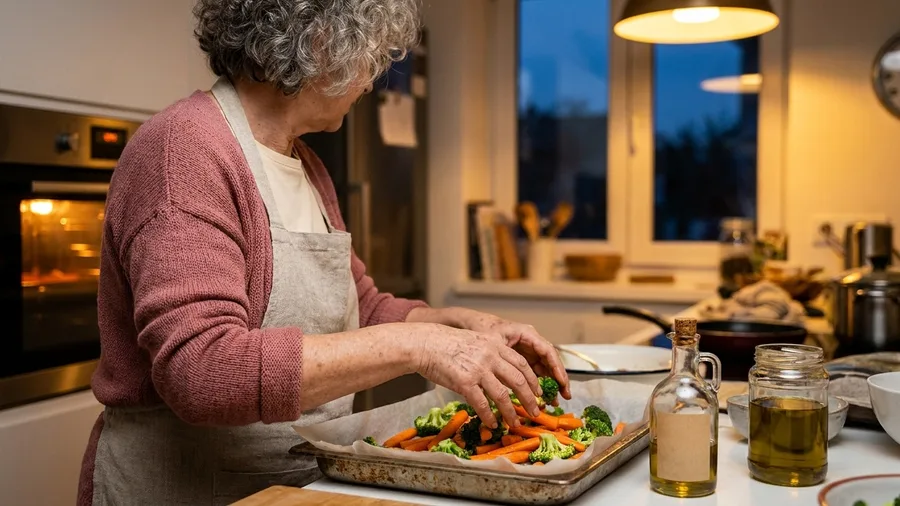
Frying is the greediest use of oil in the kitchen – a single batch of chicken can drink six cups – and that is why heat tolerance dominates the choice there. Move to the oven and the rules soften.
At 425°F, a sheet pan of carrots tossed in refined canola (rated to 400°F) and the same carrots in avocado (rated to 500°F) come out looking and tasting the same. The gap between them only appears if you crank the oven to 450°F or slide the pan under the broiler for a char at the end. For an ordinary roast, either bottle handles the job.
What separates them is price per ounce. Canola is about $6 for 48 ounces – a fraction of the cost of that $9-per-24-ounce peanut bottle, and miles below avocado at $14 per 16.9 ounces. If you roast vegetables four nights a week, the cheap bottle saves real money over a year for no loss in the pan.
The other difference is what the oil tastes like. Canola disappears under the sweetness of roasted carrots and the char of a pepper. Avocado leaves a faint peppery note that some cooks like and others find distracting on a delicate vegetable.
So for a plain sheet pan, the decision comes down to two things: how much you pay per ounce, and whether a mild background flavor bothers you. Canola answers both for most kitchens – neutral, cheap, and steady at 425°F. Avocado is the pick only if you routinely push the oven hotter or finish the vegetables hard at the end.
💡 PRO TIP
The splash you add at the end is the one you taste
Delicate olive oil aroma cooks off within a couple of minutes. Add a teaspoon of your good bottle off the heat, right before serving, and the flavor survives to the plate.
Everyday stove work
Once the pan drops below 350°F, heat tolerance stops being the deciding factor. Flavor and price take over.
4. Sautéing: extra virgin olive for flavor, canola for neutral

An oven running at 425°F is hot enough that the smoke point still rules the choice. Drop the pan to the burner, dial it to medium, and the whole equation changes: a weeknight sauté lands around 300-350°F, comfortably below the 375°F ceiling on extra virgin olive and well under canola's 400°F.
Neither bottle will smoke at that heat.
So the fork in the road is flavor, not temperature. That is the shift worth noticing here, because at this gentler heat the oil no longer has to survive anything.
Reach for the olive when the pan is going to hold something that benefits from it.
Garlic loosening in the pan, a mound of greens collapsing, a pot of white beans with rosemary – a grassy, faintly peppery oil gives those dishes a backbone that neutral oil simply cannot. You pay for it: around $12 for a 16.9-oz bottle, against a couple of dollars more than that for a 48-oz jug of canola that lasts months.
Canola is the answer when the food should taste like itself.
Anything landing in the pan with soy sauce, fresh ginger or a spoon of sugar wants a clean backdrop. A neutral oil lets those flavors run the dish; the peppery olive would sit on top of them like a second conversation.
One trick worth knowing: the aroma compounds in good extra virgin olive are fragile and burn away in two or three minutes of heat.
So cook with a plain oil or a cheaper olive and keep the good bottle for a splash at the end, off the heat, stirred into the pan as it comes off the burner. That final drizzle is where the money actually shows up on the plate.
💡 Tip: Use olive oil for Mediterranean and vegetable cooking. Use canola for anything with soy, ginger or sugar going into the pan.
Clear the smoke point first, check the price per ounce second, and ask about flavor only when the pan is cool enough to deserve it.
— The rule that decides every bottle in this article
5. Baking: neutral oil wins unless you want olive's flavor
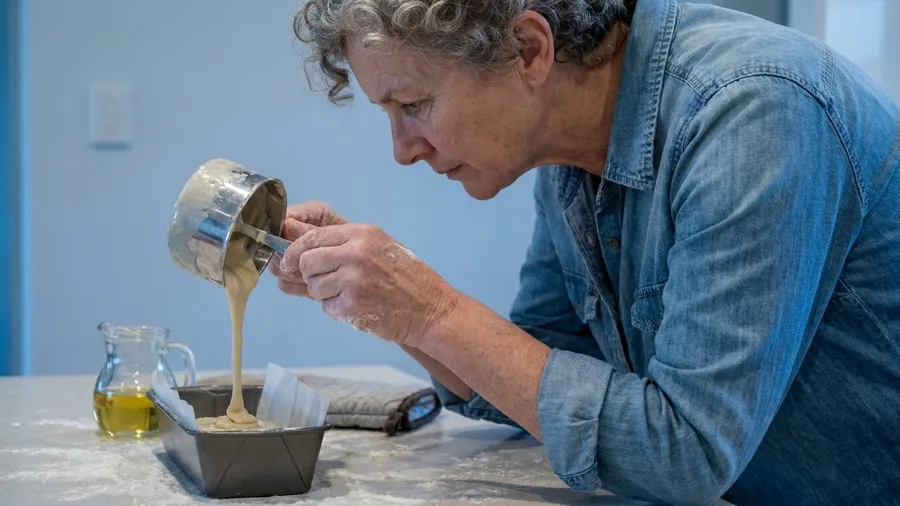
The logic that governs the stove holds in the oven too – but at 350°F, one rung below sauté heat, the whole question inverts: heat tolerance drops out entirely.
A boxed cake or quick bread calls for 1/2 cup oil and bakes at 350°F. That is below every smoke point on this list except butter, so no bottle is going to smoke or turn bitter on you. Which means you could, technically, pour in whatever is already in the cupboard.
Whether you should is another matter.
A neutral oil is the safe default, and it is cheap: a 48-oz jug of canola or vegetable runs around $5-6 and lasts through a year of baking. The crumb stays light. The flavor stays out of the way.
Extra virgin olive, on the other hand, does not disappear.
Bake a vanilla cake with it and you will taste olives in a vanilla cake – an odd, savory note where you wanted sweetness. At $12 per 16.9 oz you have also paid more for that surprise.
There is a place where the expensive bottle belongs.
Olive oil cake, carrot cake, anything with orange zest, lemon or rosemary – in those the olive's peppery edge is part of the recipe, not a mistake. And one texture note worth filing: coconut oil sets firm when a chilled dessert is refrigerated, so a bake made with it will firm up rather than stay soft once it cools.
Butter vs. Ghee: When to Use Which
Butter
- Smoke point around 300°F
- Costs about $5 per lb (≈31¢/oz)
- Best for low-heat eggs and finishing
- The only one that browns properly
Ghee
- Smoke point around 450°F
- Costs about $12 per 13 oz (≈92¢/oz)
- Best for high-heat eggs, dosa, roasted vegetables
- Milk solids removed, so it does not burn early
6. Butter burns at 300°F; ghee keeps going
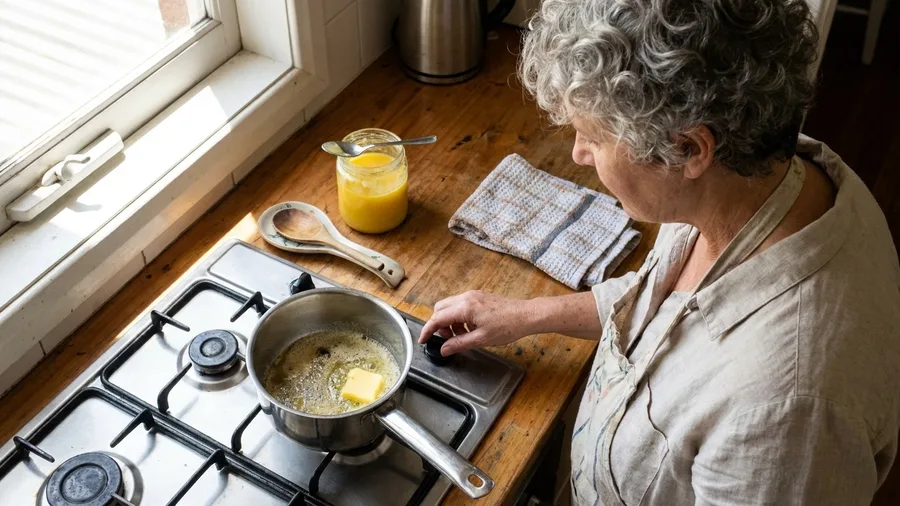
Butter smokes at about 300°F – lower than almost anything else in the kitchen – and costs about $5 per lb. Ghee runs about 450°F at $12 per 13 oz. That gap of 150°F is the whole reason both exist in the same cupboard.
What actually burns is not the fat. It is the milk solids suspended in the butter, the same ones that brown and give butter its flavor. Ghee is butter with those solids removed, so it takes the heat that plain butter cannot.
The split follows from that. Butter for eggs cooked low and slow, and for finishing a pan off the heat. Ghee for eggs at a higher heat, for dosa, and for roasted vegetables that need to go into a hot oven.
There is one job only butter can do. If browning butter is the goal – that nutty, deep flavor – ghee will not get you there, because the solids that brown are the ones removed. Browned butter is a butter-only technique.
On price, butter lands around 31¢ per ounce and ghee around 92¢ per ounce. You are paying roughly triple for the higher smoke point and the shelf stability. If you only ever cook eggs gently, the butter is the better buy.
💡 Tip: Clarified butter and ghee are not identical, but both have had the milk solids removed. Either will outlast whole butter in a hot pan.
Cold and finishing
Off the heat, the rules flip. Flavor is the whole job, and a teaspoon is usually the entire dose. These are the bottles you keep on the counter, not in the cupboard.
Two of them cover most kitchens. Buy the one you will actually eat.
7. Raw finishing: olive is peppery, toasted sesame is loud
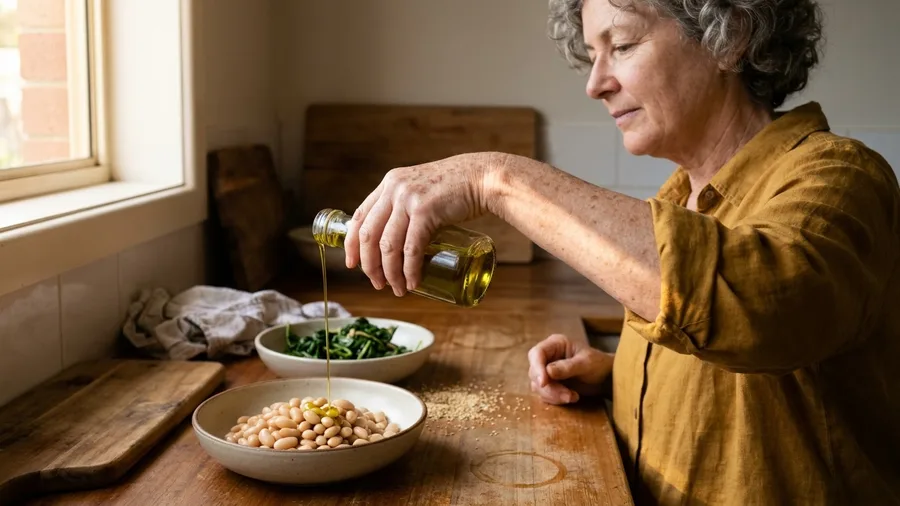
Once a fat's job is heat, flavor takes over. The finish happens off the burner, in a soup pot or a bowl that just came off the stove, and at that point the smoke point stops mattering.
A teaspoon is usually the whole dose, so the oil is a seasoning rather than a cooking medium.
Extra virgin olive at about $12 for 16.9 ounces brings something a neutral oil cannot: a green, peppery edge that sits on top of white beans, a bowl of lentil soup, or a plate of pasta without needing another ingredient to prop it up.
That last flush of olive oil at the end is where its character ends up, because heat drives the aroma off in a couple of minutes.
Toasted sesame runs the other direction entirely. At $7 for 12.7 ounces and a smoke point near 350°F, it is not a frying fat; it is three drips over cold noodles, a bowl of rice, or wilted greens, and the toastiness lands hard enough that anything more overwhelms the dish.
Both oils lose their case on a burner.
Sesame turns harsh and bitter the moment it hits real heat, and olive's aroma is gone before the pan has finished warming.
8. Vinaigrette: olive brings flavor, avocado stays neutral
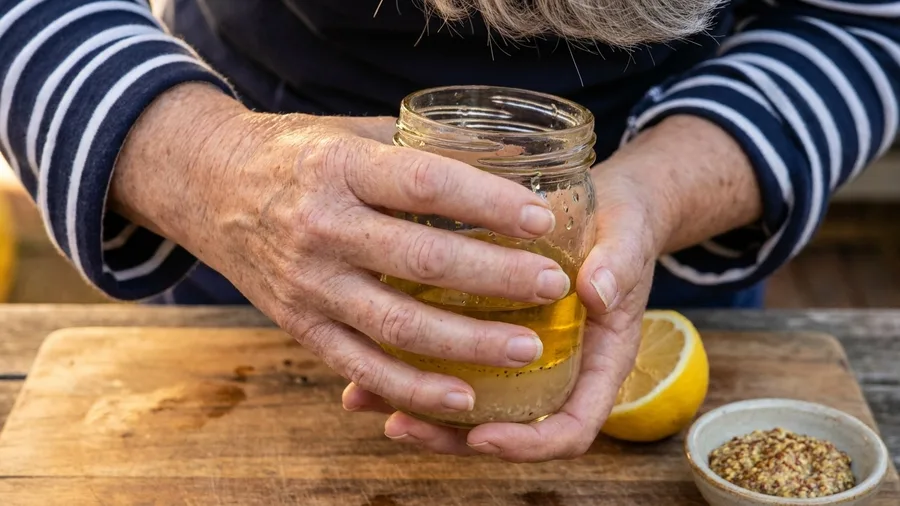
A drizzle is easy to judge, because a teaspoon either smells good or it doesn't. A dressing is harder, because the oil goes from garnish to a main ingredient, often the largest single thing in the bowl.
At the classic three parts oil to one part acid, whatever the oil tastes like is roughly what the dressing tastes like. Vinegar sharpens it, mustard holds it together, garlic and salt push it, and the oil underneath sets the whole tone.
Extra virgin olive, about $12 for 16.9 ounces, gives a vinaigrette a backbone that holds up next to all three, with enough pepper to stand beside mustard and garlic instead of disappearing under them.
Avocado oil, about $14 for 16.9 ounces, brings almost nothing to a cold sauce.
That sounds like a flaw and is sometimes exactly the point: when the salad already runs on sesame, lime, or chili, a neutral oil lets those flavors do the talking without a second voice talking over them.
The deciding test is the bottle, not the recipe. Pour a little olive oil on a spoon and taste it plain.
💡 Tip: Taste the oil on its own before you build the dressing. If it tastes flat or waxy, it will flatten the salad too.
9. Coconut oil only earns its place for the flavor

Flavor can win a tie, but it can't outrun heat and price forever. Refined coconut oil is where that argument gets interesting: just 350°F of smoke point against refined canola's 400°F and ghee's 450°F, at roughly $8 for 14 ounces.
Searing a steak in it means smoke and a scorched, bitter edge on the crust before the meat has browned.
It also fails the neutral test: a cake baked in coconut oil tastes faintly of coconut, which is fine in a granola or a curried loaf and strange in a vanilla layer cake.
What it does well is specific. Curry, dal, and granola benefit from coconut being a signature rather than a substitute.
The price makes the rest of the decision easy.
Frequently Asked Questions
What is the single most useful cooking oil to buy first?
Refined canola at about $6 per 48 oz. It handles baking, sautéing, and 425°F roasting, and it stays neutral so the food tastes like itself. It is the cheapest oil per ounce that covers the widest range of everyday cooking.
Which second bottle unlocks searing and deep frying?
Refined peanut oil at about $9 per 24 oz and a 450°F smoke point. It clears both searing and frying temperatures and costs less per ounce than avocado. Avocado is a fine upgrade if you want the 500°F ceiling, but peanut covers the same jobs for half the price per ounce.
Can I use olive oil for everything?
No. Extra virgin olive at 375°F smokes before a 400°F sear can form a crust, and it breaks down faster in a deep fryer. Use it for sautéing, finishing and vinaigrette, but keep a higher-heat bottle for searing and frying.
How can I tell if my oil has gone bad?
Smell it. Rancid oil smells like old crayons or putty, not like the oil you bought. Refined oils last about 12 months in a cool, dark cupboard; olive oil lasts 18 to 24 months. If it smells off, throw it out.
Is a more expensive oil always better?
No. Avocado at about 83 cents per ounce costs more than six times what canola costs per ounce, and it only pays off above 400°F. For sautéing, baking and 425°F roasting, the cheap neutral bottle performs the same.
Two Bottles, One Decision: Canola First, Peanut for Heat
Buy refined canola first if you are buying only one. At 400°F, neutral in taste and about $6 per 48 oz, roughly 12.5 cents an ounce, it handles sautéing, baking, roasting at 425°F and frying at 350-375°F. Add refined peanut as the second bottle at 450°F and about $9 per 24 oz, around 37.5 cents an ounce: that is the pair for 400-450°F searing and repeated frying, and it strains into two or three more batches.
Skip avocado, at $14 per 16.9 oz and roughly 83 cents an ounce, if your hottest work is 425°F roasting, 350-375°F frying or a sauté. Its 500°F ceiling buys nothing that cheaper canola or peanut does not already cover. It is a searing tool, not a default.
Back at that pan: the blue wisp at 375°F is still the signal. Match the bottle to the heat, not the label, and the smoke does not come.
Check Your Smoke Point Now
Open your cupboard and read the label on every bottle of oil. If the pan runs hotter than the smoke point on that label, move it to the cold drizzle shelf and pick up a neutral bottle for the stove.