
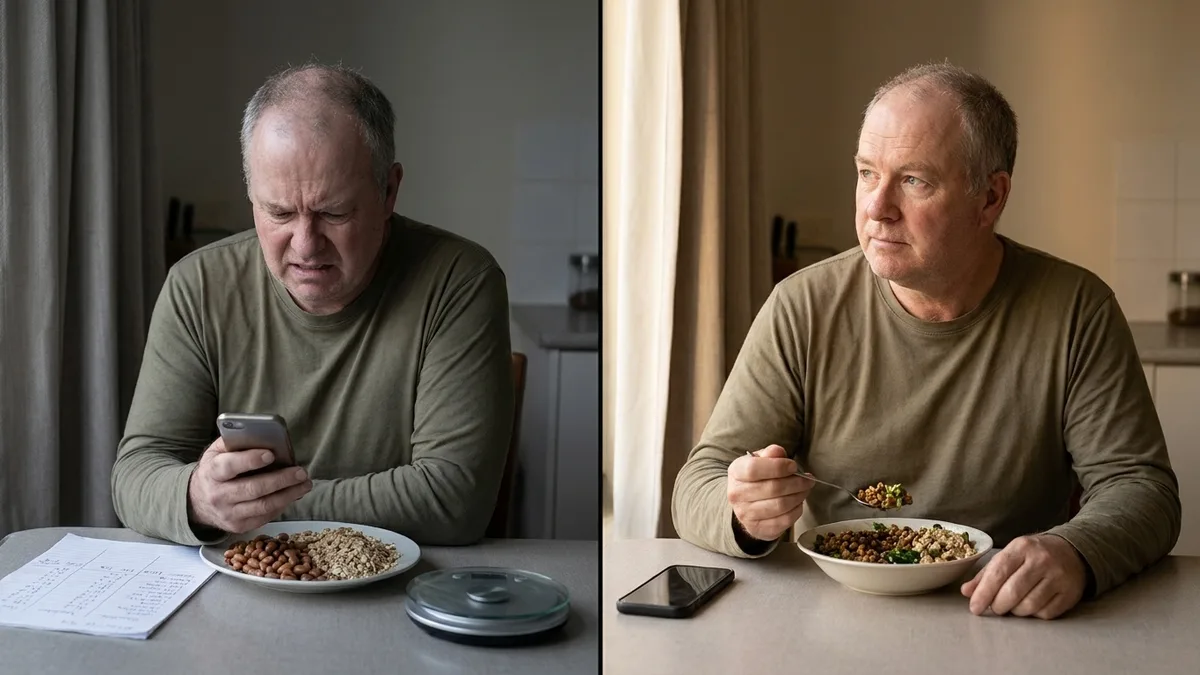
Fourteen days is how long this actually takes to show you something, and that is roughly ten times longer than any of the videos suggest.
The entry point is familiar by now: per-meal gram tallies, fiber-per-calorie rankings, and an $18 twelve-ounce tub of psyllium husk powder that works out to about 60 cents a serving and promises to skip the whole learning curve. Half of you is tempted. Half of you has watched a supplement aisle fill up with things that did not work.
What fibermaxxing actually is, once you strip the branding, is a self-run challenge to push fiber grams as high as possible, meal by meal, mostly from plants and increasingly from powders, gummies and bars. Nobody founded it. Nobody governs it. The target is whatever the person posting decided it should be that morning.
So the split worth carrying into any fibermaxxing advice is three-way: keep the per-meal question and the beans and oats behind it, slow down on the scoreboard and the public comparisons, and hand anything personal to a clinician. Start with one swap at one meal you already eat, hold it two weeks, no app in week one and no new products until week three.
The plant habit is worth copying. The scoreboard around it is worth leaving on the internet.
| Add-on | Typical US price | Cost per serving | Where it fits |
|---|---|---|---|
| Psyllium husk powder | About $18 for a 12-oz tub | Roughly 60 cents (about 30 servings) | A concentrated fiber serving alongside a meal that already exists |
| Canned beans | About $1.30 a can | Roughly 43 cents (about 3 servings) | Fiber plus protein and volume at an actual lunch or dinner |
| High-fiber cereal | About $5 a box | Roughly 63 cents (about 8 servings) | An oat-based breakfast you were going to eat anyway |
| Fiber bars | About $12 for a 12-bar box | $1 a bar | A portable snack, not a replacement for a plate |
| Nutrition-tracking app | About $40 a year | About 11 cents a day | Noticing patterns in the first two weeks, if it stays neutral |
Fibermaxxing is a gram-counting challenge, not a diet

Fibermaxxing is a challenge you set for yourself, not a diet anyone hands you.
The goal is simple on its face: push your fiber grams as high as you can, day by day and meal by meal, mostly from plants, with powders, gummies and bars filling in the gaps. There is no founder, no fixed protocol and no official target. Nobody certified this thing. It grew in short video, where a creator films the plate and a number sits on top of it.
That format is the tell. Clips show grams per meal, grams per dollar, and rankings of fiber per calorie, which turns a lunch into a line you can compare against a stranger's lunch. The comment section keeps the tally going. The shelves have noticed too, with fiber-fortified cereals, snack bars and drink mixes crowding the same aisle as the psyllium.
So the challenge lives in three places: the phone screen, the reply thread, and the supplement shelf. It does not live in a quiet kitchen on a Tuesday.
Here is where the definition already shows its seam. The number is the product, and the plants are just the vehicle that gets you there. Swap the beans for a fortified bar and the grams still post, which tells you what the challenge is really rewarding.
⚠️ COMMON MISTAKE
The Number Is Not the Assignment
Most people who try fibermaxxing spend the first week chasing a target a stranger chose, then quit when the target feels impossible. Pick the meal you are changing and let the grams sort themselves out later – or never.
Why a daily score pulls so hard, and who should walk away from it

A score you can raise every single day is the pull, and it has almost nothing to do with beans.
Fiber grams have the qualities a certain kind of mind finds hard to resist. The number moves fast, it moves daily, and it responds to decisions you make three times a day. Breakfast is at 8, lunch at noon, dinner at 7, and each one hands you a fresh chance to watch the dial turn up. That feeling of control and competence is real, and it is the engine under the whole trend.
Then the psychology of staying curious converts a private habit into a public ranking. People post totals, grams per dollar, fiber-per-calorie tables. A quiet breakfast becomes a score compared against a stranger's score, and the comparison is the point.
The deepest payoff is identity, not fiber. Being someone who optimizes is the reward, and the plate is the evidence you submit.
This is exactly why some readers should walk away from the framing before they start. If scoring food makes you tense, or if you have a history of rigid eating, the same mechanism that hooks everyone else works on you as a trap. The daily dial does not feel like competence there; it feels like a grade you cannot afford to miss.
The honest test is whether the score can come off while the plate habit stays. If it cannot, the score was the thing you wanted all along.
The plant-variety core is sound, unoriginal, and not owned by anyone

Take the score away and what is left is a grocery list you have seen before: a can of beans, a bag of lentils, oats, barley, whole-grain bread, berries, pears, almonds, sunflower seeds.
None of it is new and none of it belongs to anyone.
That is the part worth copying, and it costs about $1.30 a can for beans that stretch across roughly three servings.
What matters is spread, not a hero food. A bean or lentil lunch on Monday and an oat-based breakfast on Tuesday do more than three servings of the same high-fiber product, because your gut meets different plant material at different meals instead of the same branded bar at the same time every day.
Put two plates side by side. One is a bowl of fortified cereal with a fiber claim on the front of the box. The other is a lentil salad at lunch and oatmeal at breakfast, both plain foods that sat in your kitchen before the videos existed.
The second plate is this trend's real content, and you did not need a creator to find it.
No number is attached here. Your own figure, if you want one, comes from your clinician or the federal dietary guidelines, not from a comment section.
The list passes the test because every item on it points back at a plant. It fails the moment a gram tally or a branded tub becomes the point instead.
The useful part is the plate, not the number

It is a rule small enough to hold in your head while the plate is still in front of you, and it asks for attention rather than a number. Not a target, not a daily total, not a rank against anyone else's lunch.
Watch what it does to a default plate. Most of us serve protein, a starch, and something green pushed to the edge as a garnish. The question moves that plant from side to required part, because you have to answer it out loud before you sit down.
The habit and the metric are owned by different people. Per-meal attention belongs to you, in your kitchen, on your schedule. The gram target belongs to a stranger who set it online and will never see your dinner.
That ownership split tells you who this suits. If you like one plain rule with no dashboard, the question fits easily into a lunch that already happens. If you take any rule and turn it into a grade, then a verdict, this one will hand you fresh material for the verdict.
The test is whether it makes the meal visible. The plate question passes. A gram figure bolted onto the same plate fails, because it turns the eater into something auditable rather than the food into something noticed.
Doing it in public holds some people to it and shames others off it

The social side helps a reader who needs a witness and hurts one who already grades hard, and the two are not the same person.
The upside is real. A total you have told someone about is harder to quietly abandon than an intention kept in your own head, and the audience supplies a small external contract for a habit that otherwise has no deadline and no one waiting.
The downside is the same mechanism running backwards. An audience converts one bad day into a public one, and the post that held you to the habit last month can be the reason you stop posting at all. Quitting becomes a thing to be seen doing.
You can get the witness without the leaderboard. One friend who asks about the bean lunch. A paper note on the fridge. A short weekly check-in with yourself or with them. The function you want is being noticed, not being ranked.
Some readers should skip the public version outright: anyone who already compares harshly, anyone who dreads being watched while quitting, anyone with a history of rigid eating.
Public totals pass when they support the next meal and fail when the audience becomes the eater's judge.
Keeping the plate vs keeping the scorecard
Worth copying
- Ask what plant is on this plate
- Rotate beans, lentils, oats, barley, berries
- Change a meal you already eat
- One witness, not an audience
- Treat a rough gut day as pace, not verdict
Worth slowing down on
- Chasing a stranger's gram target
- Posting totals to rank yourself
- Buying the tub before the habit exists
- Ramping hard in week one
- Reading one cake as a ruined week
Ramping up in a week is the mistake almost everyone makes first

The first week went badly because you went fast, and the trend gave you no other option.
Gas, bloating, cramping, looser or harder stools: that cluster is the ordinary result of loading a lot of fiber onto a gut that had not seen much of it. It is a pace problem, not a character problem.
The feed sets you up for it by showing the endpoint. Full bowls, high totals, a counter lined with tubs and bars, and almost never the ramp between where you start and where the video begins. This article will not hand you a ramp schedule or a dose, because that number is not a video fact.
The costly part is the story you tell yourself afterward. One rough week gets read as I can't do this rather than I went too fast, and a pace problem turns into a personal failure you file away.
Symptoms that persist, hurt, or alarm you belong with a clinician, not a comment section. There is no threshold in this article that tells you when to call; that judgment is a person's, made with your history in front of them.
Speed is a scoreboard demand. Your body's response is information about pace, not a verdict on you.
📆 The two-week arrangement, in order
Pick the meal
Choose one meal you already eat every day – usually lunch or breakfast.
Make one swap
Put beans or lentils into that lunch, or oats into that breakfast. Nothing new invented.
Week one, no app
Keep the first seven days free of tracking, so the habit stands without the number.
Expect noise
Some gas or bloating in the first fortnight is possible; it is a pace signal, not a failure.
Week two, still no products
No new powders, gummies or bars until week three at the earliest.
Review and keep or drop
If the plate stayed visible and the score stayed irrelevant, you have something worth keeping.
The supplement aisle is where the cost and the hype pile up together
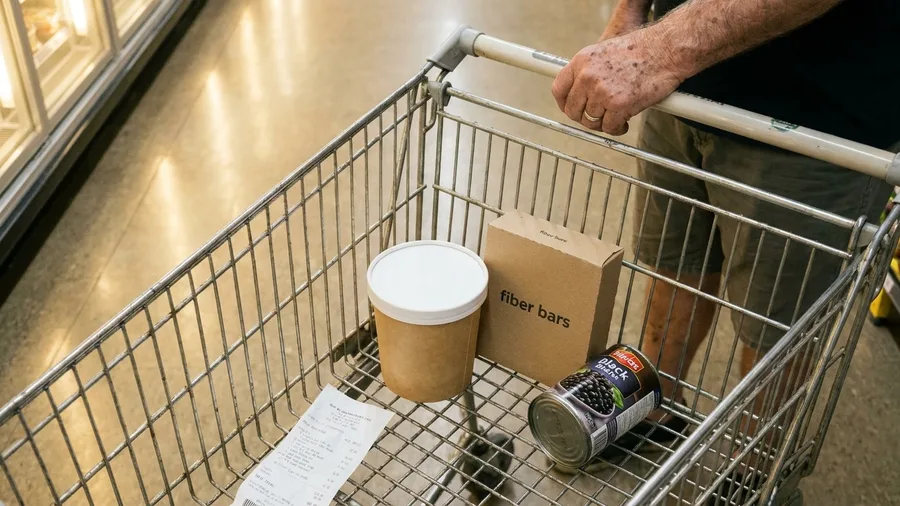
In most cases you do not need the powder or the bars, and the shelf says more about marketing than about your lunch. The prices sort it out fast. A 12-oz tub of psyllium husk runs about $18 and holds around 30 servings, so roughly 60 cents each. A 12-bar box of fiber bars costs about $12, a dollar a bar. High-fiber cereal runs about $5 a box at about 8 servings.
Now the comparison the label doesn't want you to make. A can of beans costs about $1.30, covers about three servings, and delivers fiber plus protein and volume at an actual meal. Psyllium gives you one concentrated fiber serving and nothing else on the plate.
Watch for the tell. Fiber-per-calorie rankings and added-fiber claims stamped on otherwise ordinary products are selling a number, not a plate.
Here is the psychology of the purchase worth naming out loud. Buying the tub, the bar or the cereal satisfies the urge to have started. The receipt becomes a symbol of intent. But a symbol is not the habit, and the habit was always one bean lunch and one oat breakfast a week.
So run the test before you add anything to your cart. A supplement passes only if it supports a meal that already exists. It fails the moment the receipt replaces the swap.
What a week of this actually costs
Typical US prices, illustrative week
Two of these buy a meal. Two of them buy the feeling of having started.
Tracking helps right up until the log becomes a grade

Logging a food is the same gesture as buying the tub: it makes the fiber visible, and it turns on you the moment the total starts scoring the person who ate it. Short-term, a log earns its keep. Underneath, a running diary does something a memory cannot, because it shows a lunch pattern the reader had no idea had quietly dropped the beans four days out of seven.
But then the log flips.
A number below whatever target was picked up online is no longer information. It's a rebuke, and it turns in one direction only: the tally that began as a record of vegetables becomes a running judgment of the person holding the phone.
There is a single question to test this against, and it costs nothing. Put a blank day of low score on paper and see what it does to the mood by evening. If you feel worse about yourself, the log is not neutral. It has stopped observing and started grading.
That verdict is why the answer is not the same for every reader. People with a history of rigid or disordered eating should treat a food diary as off-limits rather than optional, because for them the numbers collect as evidence rather than data.
Then there is the price tag. The subscription to log in and out of every item is about $40 a year, and during the first two weeks each meal takes roughly two minutes to enter. About 14 minutes a day is not a decision anyone makes lightly.
The tool tracks last only if every entry pushes toward the next meal, in the direction of asking which plant is going on the plate at lunch. The moment the diary starts totalling up self-respect, it's time to delete it and ask about the plate instead.
The good-food framing curdles into guilt, and that is the tell

The self-criticism from a screen is a short jump to a moral vocabulary, and once a plate gets described as clean or optimized, a slice of cake stops being food and becomes a small character witness against you.
That is why you feel bad about cake now.
A single low-fiber lunch that a log might have flagged as a miss gets read instead as a day already ruined, and a day already ruined is read as a week, and the abandoned project is the actual outcome. The one dessert was never the problem. The story attached to it was.
Watch the words used in the videos. Good, bad, clean, fail, on track. Each raises an ordinary decision into a judgment of character, and soon the cake is not something you ate, it's something you are.
The people who come out of this well do it the opposite way. They treat the whole thing as a preference, not a standard. They buy beans because they like beans, and when there are none in the fridge, they eat something else and get on with the evening.
There is a sentence worth installing for the moment that internal narrator starts up again: an unmaximized plate is still a plate. The food is food whether or not it earns a score, and the meal counts without the number attached to it.
The tests stay the same. Any framing that turns the eater into the subject and the plate into the verdict always fails. The curious question, the one about what is on the plate, is what you keep. It is a look at lunch, not a judgment of the person eating it.
Pick one meal and one swap, and give it two weeks

Once the scoring and the moral verdict are set aside, what is left is small enough to try in an ordinary week: one meal you already eat, changed once, held for fourteen days. Not a new meal built from scratch, which fails by Thursday because the cue was never in your day to begin with. A swap that rides a routine survives.
Take the lunch you already make. Add beans or lentils to it. Take the breakfast you already make. Make it oat-based. No new slot invented, no recipe hunted down. The structure works because the moment already exists and the change sits inside it rather than alongside it. What you are buying is repetition, not novelty.
The rules are simple. No app in week one. No new product until week three. Two weeks of the habit gets tested before the market gets a vote on it. If the routine is going to break, you want to know before you have spent anything. If it holds, you have earned the right to consider a tool.
For a sample week: one bean or lentil lunch, one oat-based breakfast, one supplement serving, across about seven days. Time cost runs perhaps ten extra minutes a day, mostly chop-and-rinse at lunch. That is the honest number. The first two weeks can bring gas, bloating, cramping, looser stools. That is the gut adjusting, not a verdict on your character.
Do not open the apps or the leaderboards in that stretch. Skip the new powder that launched last Tuesday. The test is whether one meal became visible and stayed visible through two ordinary weeks. If the two weeks turn into a scoreboard with an app and a tub attached, the habit is no longer what is being tested.
Where the trend stops and a clinician starts

If your own body or history is in play, the answer about whether this is safe for you does not come from a video. It comes from your clinician. The swap itself is mild, but the decision about whether it fits your situation is not a stranger's to make.
Some readers should ask before starting. Irritable bowel syndrome or any diagnosed digestive condition. A past or current eating disorder, even one that feels far behind you. Pregnancy. Diabetes. Any condition or medication a clinician is already managing. In each case the swap is a conversation topic, not a private experiment. That sentence covers the whole list, and it is the only medical caveat in the piece.
What this article will not do is supply the numbers you might be looking for. No gram target. No powder dose. No ramp schedule. No threshold at which symptoms become a problem. Those are not facts that exist in a sixty-second video, and no writer who has not examined you should be handing them over as if they were.
Your personal number, if you want one, comes from two places. The federal dietary guidelines, and a clinician or registered dietitian who can see your actual situation. Those two sources know things about your body that no creator does. Trust them before you trust anyone whose number arrives with a product link.
The only decision you need before the two-week swap is which meal you are changing and when this week it happens. Name the meal, name the day. Everything else can wait until the fourteen days are done. That keeps the focus on the eater's safety, not a stranger's number.
Frequently Asked Questions
What is fibermaxxing in plain terms?
It is a self-run challenge to maximize fiber grams per day and per meal, mostly from plants, topped up with powders, gummies and bars. No founder, no protocol and no official target – the number is whatever the person posting it decided.
Do I need to hit a fiber target to get any benefit?
No. Adding one bean or lentil lunch and one oat-based breakfast to a week changes what your meals look like, whatever the total is. Any personal gram target is a question for your clinician or the federal dietary guidelines, not for a video.
Why did the first week feel so bad for me?
Gas, bloating and cramping are the ordinary result of adding a lot of fiber quickly. The trend shows the endpoint and skips the ramp, so people read a rough week as personal failure instead of a pace problem. Persistent or painful symptoms belong with a clinician.
Are the powder and the bars worth buying?
Psyllium runs about 60 cents a serving and fiber bars about a dollar each, while a $1.30 can of beans covers roughly three servings of food. Buy a supplement only to support a meal that already exists – never as a substitute for the swap.
Should I track grams?
Track if it makes meals with no plant visible to you, and stop the moment a low day changes how you feel about yourself. If you have a history of rigid or disordered eating, do not track at all; a food log is not a neutral tool for you.
Is fibermaxxing safe if I have a digestive condition?
That is a question for your clinician, not a comment section. IBS, other digestive diagnoses, pregnancy, diabetes and any managed medication all change the answer, and no dose, ramp schedule or threshold in this article applies to you until a professional says so.
Keep the bean, leave the scoreboard
Keep the per-meal question: where is the plant on this plate? Keep the beans, the lentils, the oats, the barley, the berries. Drop the gram scoreboard, the public ranking and the supplement haul that lets you feel started without changing lunch.
The $18 psyllium tub, the $12 box of fiber bars and the running gram tally can all stay on the shelf. The useful version of this trend is a bean lunch and an oat breakfast, and it costs less than either product.
Then take the one step: one swap, at one meal, for two weeks. No app in week one. No new products until week three. Any personal number you eventually want comes from a clinician or the federal dietary guidelines, not from a video. An unmaximized plate is still a plate, and fourteen days from now you will know more about your own gut than any clip can tell you.
Name the one meal before you close this tab
Pick the lunch or breakfast you are changing this week, decide the swap, and start the fourteen days tonight. Everything else can wait until week three.