

You assume balance means adding the right routine, and that assumption is the thing keeping the day full. Lagom means just right, not too little and not too much, and the habits that carry it mostly decide when enough has already arrived.
Picture the week as it tends to run: boxes stacked edge to edge on the calendar, a shelf with no gap left in it, the phone still in hand at nine at night. The reflex in that moment is always to add one more commitment, one more storage box, one more scroll.
The problem is not a shortage of discipline. It is the reflex to add, and it fires fastest in the second before you decide.
Nine small Swedish-inspired habits follow, each with a smallest version and a way to adjust it as your body, household, and evenings change. You do not need all nine. You need the two that match where life feels overstuffed right now, because lagom is the moment you look at the small version you already have and stop.
Quick Tips Before You Start
Pick two, not nine
Choose the two habits that match your biggest friction and ignore the rest for a month.
Start at the smallest version
Run the smallest version for two weeks before adding any length or frequency.
Set the same time daily
A habit attached to a fixed cue (after lunch, before bed) sticks faster than a floating one.
Keep the pause unproductive
The break is not for catching up on email, listening to a podcast, or optimizing anything.
Note the enough signal
Write down what tells you to stop: the timer, the empty shelf space, the 15-minute mark.
1. The Two-Minute Lagom Check

The reflex to add is quick. A cart button, a second helping at dinner, a yes to another meeting that lands on a Wednesday already full.
Lagom is the Swedish word for just right, and it points in a direction most of us ignore: not too little, not too much, but the amount already sitting in front of you. The check is built around that one idea, and it only works if it happens before the addition, not after the regret.
The smallest version is a card. On it goes a single line asking whether what is already there counts as enough, or whether the hand is moving out of habit. Two minutes is the whole investment, spent standing in a store aisle or hovering over a calendar invite.
Where the card lives makes the difference. By the wallet, on the fridge door, taped next to the computer monitor, wherever the automatic reach keeps happening, so the pause interrupts the reach instead of trailing behind it.
A family can draw theirs. Younger children get a picture card, an image of a full plate or a toy bin, because the question lands better as a picture than a paragraph. For older adults, print it large enough to read without hunting for glasses.
This one suits the overcommitters and the overbuyers. The people whose calendars fill like a shelf with no gap, whose closets have stopped closing easily.
It does not suit someone facing genuine scarcity. When the cupboard is bare or the paycheck does not reach the end of the month, adding is need, not habit, and the pause has nothing to hold back.
it puts the line between enough and more where the eye can see it, in the second before the addition, which is the only moment the choice is still open.
💡 Tip: Keep the card where your hand already goes, not in a drawer. The cue has to be in the path of the reach.
⚠️ COMMON MISTAKE
The check is not a budget
People turn the two-minute pause into a full spending audit and then abandon it in a week. The check is one question at one moment. Do not add tracking, categories, or a spreadsheet. Ask the question, then move on.
2. The Daily Fika Pause

Catching the reflex to add at the counter or the calendar raises a harder question: whether a day can hold a pause that fills nothing at all.
Fika answers that question in fifteen minutes. Mid-morning or mid-afternoon, coffee, tea, or plain water, a small snack on a plate, and nothing else attached to the time.
The Swedish tradition treats fika as the pause itself, not the caffeine or the perfect latte. A mug of instant from the office kitchen and a couple of biscuits count just as much as anything fancier, and that is what makes it repeatable on a Tuesday.
The phone goes face-down. The work task stays closed, the inbox stays shut, and no one is expected to come back from those fifteen minutes with anything produced.
Some days the snack is not there. The smallest version of this habit is the same fixed quarter-hour with whatever drink happens to be within reach, on the same block of the day, so the pause holds even when the extras fall away.
For a child, the milk-and-cookie version lands easily, poured at the table, in the same seat. For an older adult, the quieter shape may be seated with a neighbor over a cup, the conversation itself the small snack.
Desk workers and caregivers get the most from this one. The person who has not stood up since nine and the person whose whole day is someone else's schedule both benefit from a boundary around the middle of the day.
It earns less if a break already happens naturally. Someone with a genuine tea-and-window routine does not need to schedule a second one; the bound is already there.
What matters here is that the rest is set and unproductive. Not lengthened, not refined, not made to earn its keep, just placed on the day like an appointment and respected at the fifteen-minute mark.
3. The One-In, One-Out Shelf
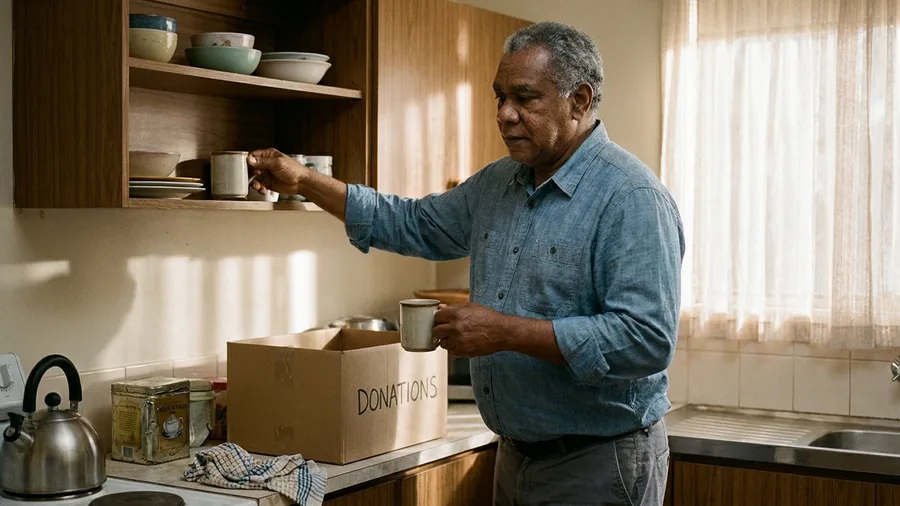
A pause shows that rest can be bounded. Possessions are the other place where more piles up quietly, without anyone deciding to let it happen.
The mistake most purges make is the size of the boundary. A whole garage, a whole closet, a whole house in a weekend, and the effort collapses by Sunday afternoon.
The rule is one shelf, drawer, or category. A mug on the open shelf, a single shirt on the hanger, a toy in the bin, a book on the nightstand.
When one new item comes in, one comparable item goes out. Not the sentimental stuff, not the heirloom, just a like-for-like exchange, so the shelf holds the same count it did before the new thing arrived.
The smallest version is one drawer. Kitchen drawer, sock drawer, a single shelf of overspill books, and the count stays level over weeks rather than a weekend.
A child can pick one toy to give away each time a new one arrives, and the choosing is the practice. Put a small box aside and let the child set the toy in it, one for one.
For an older adult, starting matters. A small drawer of everyday items is easier than a box of letters and photographs, and the sentimental papers stay out of the first round entirely.
It suits people who can see the clutter from where they stand. The counter with no clearance, the closet with the door ajar, the shelf where the stacks lean.
Skip it during a temporary downsizing crisis, a move or a bereavement, when the goal is sorting boxes, not holding a boundary.
The line here is physical: one boundary, one exchange, and the home stays at the amount it already held, which is enough, rather than tipping toward a purge and a fresh start every season.
💡 Tip: Keep a donation bag inside the closet, not in the garage. The out-item has to leave the same day the in-item arrives.
The Shelf Rule — At a Glance
📦 Scope
One shelf or drawer
🔁 Exchange
1 in, 1 comparable out
📅 Check
Once a month
👶 With Kids
They pick the out-item
⏱️ Time
10 minutes per check
Why It Works
A physical limit removes the mental debate, so you decide once instead of at every purchase.
4. The Blank-Hour Calendar Rule

A home with a boundary around the stuff teaches the lesson that time needs the same treatment: somewhere in the week that stays unfilled.
The calendar is the other shelf that never gets a gap. Every hour that could hold a rest has been assigned to an errand, a meeting, or catch-up work, and the white space keeps getting quietly colonized.
The fix is a recurring 60-minute block labeled 'open' or 'lagom time.' No errands in it, no catch-up work, no optimizing.
The hour can be spent doing nothing in particular. That is the point, not a failure to plan it better.
Most people, staring at a packed week, will insist there is nowhere to put sixty minutes. So start with less. One hour a week, protected like a dentist appointment — it appears on the calendar, it does not move for a reschedule request, and you show up to it.
The age adjustment matters here because a calendar looks different depending on who is keeping it.
A young child's day gets a 15-minute open block, because fifteen minutes of unscheduled time for a small kid is a lot and the point is to model the pause early.
For retirees running on medical appointments, the slot works better in the quieter morning hours rather than stacked against a clinic visit. Keep it clean of the appointment itself.
This suits the over-scheduled: workers juggling back-to-back calls, students whose days are carved into obligations, anyone who feels the squeeze of a full week. It is not a substitute for a needed medical appointment or a caregiving commitment. Those stay. The rule is about the gap, not the duty.
💡 PRO TIP
Name it something boring
Label the block 'lagom time' or 'open' rather than 'self-care'. A vague label invites you to fill it. A boring label makes you leave it alone.
5. The Single-Task Timer Window

An open hour creates breathing room around the tasks; the tasks themselves still need a smaller, visible window to hold one thing at a time.
Focus does not come back through willpower. It comes back through a boundary small enough to keep. A 25-minute timer, one task visible on the desk, other tabs and notifications closed.
That is the whole setup. Twenty-five minutes and one thing.
The rule most people miss: stop when the timer goes, even if the task is unfinished. Write down the next small step and leave it. Stopping at the bell is what keeps the window from turning into a contest you lose.
Smallest version is one window a day, or one window when you need it. That is enough to count.
Age adjustments are the same principle scaled to the person holding the timer. Ten minutes for a teenager, whose focus span is shorter and whose resistance to the whole idea is higher. Fifteen minutes for an older adult, where the goal is a clear, gentle stretch rather than a sprint.
And a body-doubling version for anyone who works better with company. Sit near someone else doing their own task and time the window together. The presence is the structure.
This one fits people who scroll or switch tasks without meaning to, who surface at the end of an afternoon unsure where it went. It does not fit jobs that demand constant monitoring — a nurse on a ward, a parent of a toddler, a driver. Those roles need a different rhythm than a closed door.
The measure of enough focus is a window that opens, holds one thing, and closes at the timer. Not a cleaner inbox, not an app full of streaks. Just the bell and the next step.
💡 Tip: Use a physical kitchen timer, not your phone. A phone timer puts the phone back in your hand at the exact moment you finish.
6. The Fredagsmys Shutdown Ritual

A timer can close a single task. It cannot close a week. That end has to be marked, or Friday evening just bleeds into Saturday morning with the laptop still open and the to-do list still running in your head.
This is what fredagsmys names: the Swedish habit of making Friday night deliberately soft and small. Not a reservation, not a crowded bar, not a performance of having fun. A plate of something easy, the overhead lights off and a lamp or two on, a blanket on the couch, one show everyone agrees on. The coziness is the whole event.
But cozy doesn't land on top of an open workweek. So the ritual has two parts, and the closing step comes first. Close the browser tabs you were living in. Write down Monday's first task, in one line, so it stops circling. Then say out loud that the week is done.
That last part sounds silly until you try it. Remote workers in particular tend to drift out of Friday with no line at all, half-answering a message at 7 p.m. and then wondering why the weekend never quite starts. A spoken sentence, even to an empty kitchen, gives the week an edge you can feel.
The smallest working version is one closing step plus one cozy signal: shut the laptop and put something simple on a plate. That's it. It takes ten minutes and costs nothing, which is exactly the point.
Ages bend it easily. Young kids do better with a shorter, earlier version, food and a favorite episode finished before bedtime rather than stretched into a late night. For older adults, or anyone sensitive to noise and light, the same Friday can run seated and low-sound: a lamp instead of overheads, a game or a record at half volume, a plate you can eat from an armchair.
One honest caveat. The ritual closes work; it doesn't cancel life. If Friday night holds a medication run to the pharmacy or care for someone who needs you, that comes first, and the cozy signal can shrink to a cup of tea and five quiet minutes afterward. The signal is a marker, not a reward you have to earn.
And this is where the bigger argument of the week-end lands. Enough workweek is not finished with a louder night out, a packed restaurant, a schedule of fun that needs its own planning. It is finished by a small, repeatable close that says the week stopped here. Do that much, and stop.
💡 Tip: Say the closing line out loud. 'The week is done' lands differently than thinking it.
Fredagsmys: Shutdown vs. Big Night Out
Shutdown ritual
- Start time: 6 p.m., not whenever you finish
- Cue that it worked: you stop checking messages by 7
- Ten minutes total, including the spoken sentence
- Skip only if Friday holds caregiving or a pharmacy run
Big Friday out
- Needs 48-hour notice and a reservation to happen
- Costs $60+ before you have eaten
- Leaves Saturday morning stiffer than a workday
- If you are already depleted, it reads as another task
7. The Outdoor Lunch Loop

A closed workweek frees the body to reset, but the reset itself takes ten minutes outside, not a weekend.
The smallest outdoor habit that clears the head is a loop, walked after lunch or in the dip before the afternoon slump, that ends when the ten minutes end. No podcast queue, no step goal, no route to beat. The same short loop, walked again tomorrow.
This is friluftsliv in its plainest form: outdoor life as a routine, not a gear contest. You do not need a shell jacket rated for a summit. You need a door and a habit.
Weather decides the length, never the cancellation. Rain means a shorter loop in what you already own; cold means one more layer and the same ten minutes; heat means walking in shade and stopping sooner. The rule holds at every age because the barrier was never the weather, it was the all-or-nothing idea that a walk only counts if it is long and pleasant.
The ten-minute version already does the work. Attention research on adults consistently finds that time in green space restores focus and lowers the stress response, and the effect shows up in short doses, not just long hikes. You are not training for anything. You are letting the afternoon slacken before it tightens.
After 40, the case gets stronger. Sitting through a workday stiffens hips and lower back, and a brief walk after eating helps with the blood-sugar rise that follows lunch, which the body handles less briskly as the years add up. Ten minutes of walking is a joint and metabolic habit wearing an outdoorsy coat.
Small enough for anyone: the same route, ten minutes, the same time of day. Children take the loop on a scooter or in a stroller; at work, the same version fits around a lunch break; if mobility is limited, a bench in the sun with ten minutes of daylight and open air is the loop, seated.
It suits indoor workers and students, the people whose day is spent under fluorescent light and a screen. Skip it when the weather is genuinely unsafe, or the neighborhood is, and choose another window. Enough outdoors is a short loop you actually take, not equipment, distance, or performance.
🚶 Build the Lunch Loop Habit in Five Steps
Anchor it to the last bite
Start within 15 minutes of finishing lunch – that is when the post-meal blood-sugar rise peaks and the walk does the most work.
Walk out-and-back, not a circuit
Turn around at five minutes. A loop tempts you to add distance; an out-and-back ends on its own.
Pick your cancel line
Write down the one condition that stops you – lightning, ice, an unsafe street – so every other weather is a shorter walk.
Set the failure rule
Miss two days running and the next loop is five minutes, not ten. Restarting small beats skipping a week.
Hold ten minutes for a month
Extend only after 20 straight walks. Add five-minute blocks, never jump to thirty – hips and knees need the ramp.
8. The Good-Enough Bedtime Version

A short outdoor reset restores attention, and by evening the body needs something repeatable, not perfect.
The trap is familiar: you read about the ideal wind-down, build a nine-step routine, follow it for four nights, miss one, and abandon the whole thing. The good-enough bedtime version asks for three steps and a start time, and it counts as done even on a bad night.
The three steps: dim the lights in the room you are in, put the screen out of arm's reach, and read one quiet page or listen to one quiet podcast. That is the whole protocol. No supplements, no elaborate stretching sequence, no app tracking your sleep score.
A consistent start time matters more than a perfect one. Pick the hour you usually mean to be in bed, and if the evening runs late, take the 15-minute late pass. Fifteen minutes is not a failure, it is a buffer. The point is that you do not throw the night away because it began at 11:10 instead of 10:55.
Your smallest version is simply the three steps at the usual time. For children, the same three steps become a picture-book wind-down: lights down, book out, same bedtime. For teens, the earlier start does more work than any lecture about screens. For older adults, chair-based stretches can replace the page if sitting still leaves the body too wired to settle.
The mechanism is unglamorous: dim light lets melatonin rise on its normal schedule, and one quiet page gives the brain a low-stimulation landing strip instead of a hard stop from a bright screen. The routine works because it is easy to repeat, not because it is thorough.
This suits people who delay sleep with screens, the ones who look up from a phone at midnight and wonder where the evening went. It is not a treatment for ongoing insomnia. If sleep has been broken for weeks, that is a conversation for your doctor, not another habit to try.
Enough bedtime is good-enough and repeatable. The three steps, done at the usual hour, night after night, beat the elaborate routine you follow twice and quit.
💡 Tip: Set the alarm for the start of the routine, not for the morning. The habit needs a cue at the front, not the back.
Is Your Bedtime Routine Good Enough?
9. The Evening Unplug Basket

A bedtime routine only holds if the hour before it isn't spent with a screen in your hand. That is why this last habit starts with a basket.
Put it by the front door or on the kitchen counter and use it for one set window: 30 minutes before dinner, or after 9 p.m., whatever fits your evenings. Thirty minutes is the whole commitment, and nothing more is asked of you.
Phones go in the basket and stay there while you eat or read or sit with someone. Charge them outside the bedroom, or at least across the room, and keep a plain alarm clock on the nightstand so the phone no longer has a job to do overnight. That's the mechanical part done.
The drift happens in the same spot most nights. Dinner is finished, the dishes are done, and the phone comes back out for a quick check that stretches into a scroll, and you surface two hours later wondering where the evening went.
A short, bounded window interrupts that drift without asking you to count minutes or track habit streaks.
If 30 minutes feels like too much at first, choose one: the basket by the door, or the charge across the room. Either one alone gives the evening a boundary. The smallest version is still the basket and the window; you just don't have to shorten the window to start.
Households with children can turn it into a family charging station in a shared room, so every device lands in one place before homework is done. For an older adult, label the basket with a name so it is easy to find, and keep the phone within reach if it is needed for a medical alert or a quick call.
This habit is not for everyone. If you are on call for work, or the phone is your medical link, keep it close and use the 30-minute window only when you can. A full digital detox isn't the goal, and it isn't required.
One set window, one basket, one place to charge. Enough evening screen is a limit you chose in advance, not a rule you have to keep perfect.
💡 Tip: Put a cheap analog alarm clock on the counter before the first night. Without it, the phone comes back to the bedroom by Thursday.
Frequently Asked Questions
What does lagom actually mean?
Lagom is Swedish for just right, meaning not too little and not too much. It is a description of the amount already present, not a rule about quantity. In practice, it means asking whether you are adding from need or from habit before you add more.
Do I need to do all nine habits?
No. Pick the two that match where your life feels overstuffed right now. If your home is full, start with the one-in, one-out shelf and the two-minute check. If your attention is fractured, start with the timer window and the fika pause. If your evenings run long, start with the good-enough bedtime and the unplug basket.
How long before a habit feels normal?
Most people find the first two weeks the hardest and the third week noticeably easier. The key is to run the smallest version first. Adding length or frequency in the first week is the most common way these habits fail.
Is fika just a coffee break?
No, though coffee is usually involved. Fika is a scheduled, unproductive pause, usually fifteen minutes, mid-morning or mid-afternoon. The point is the pause itself, not the drink or the snack. Phone face-down and no work task is what separates fika from a coffee at your desk.
What if I have a health condition or limited mobility?
Most of these habits have a seated or shortened version that works, but check with your own doctor before starting anything that involves new physical activity, major dietary change, or a sleep routine that interacts with a health condition or medication. The outdoor loop and the bedtime routine are the two most worth a quick conversation.
Match Your Friction, Then Stop at Enough
The reset is not nine habits collected. It is two habits matched to one friction, with lagom meaning you stop at enough.
If the home is what feels overstuffed, pair the Two-Minute Lagom Check with the One-In, One-Out Shelf. The smallest check is one written question on a card by the door; for children, a picture card works, and for older adults, larger print. The smallest shelf is one drawer, checked monthly, with children donating one toy and older adults starting on a small drawer rather than a box of papers.
If attention is what fractures, pair the Daily Fika Pause with the Single-Task Timer Window. Fifteen fixed minutes, with milk and a cookie for kids and a seated visit with a neighbor for older adults; twenty-five minutes in the timer, ten for teens, fifteen for older adults, and a body double for company.
If evenings never close, pair the Good-Enough Bedtime with the Evening Unplug Basket: three steps and a fifteen-minute late pass, a picture book for children, chair stretches for older adults, an earlier start for teens; one thirty-minute window, a family charging station for kids, a labeled basket for older adults who need emergency access.
So go back to the calendar, the shelf, and the phone at nine. Choose two limits, write the smallest versions where you will see them, and let enough be enough this week.
Pick two, run them for two weeks
Choose the two habits that match your biggest friction right now, start at the smallest version, and leave the other seven alone. That is the whole plan.