
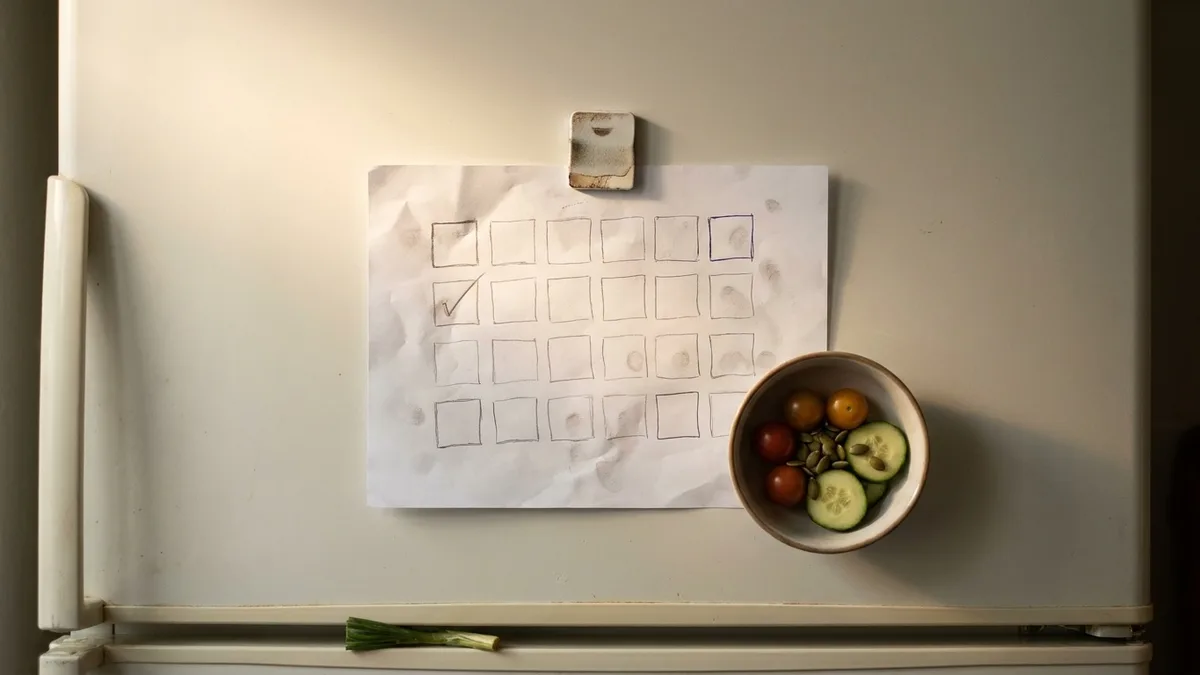
The first thing most people assume about the 20 Plants a Week challenge is that it is another diet, and that assumption is wrong.
You have seen the posts by now. Twenty plants a week, brightly photographed bowls, and a caption implying you have been eating wrong for decades. So the suspicion arrives before the curiosity does: is this twenty servings a day, a vegan reset, or one more plan that collapses by Thursday?
None of those. The count is twenty distinct plant foods across seven days, and it is an add-on variety target, not a menu you swap your life for. Meat, dairy and eggs stay exactly where they are.
The tools are deliberately plain. A 20-box paper tracker on the fridge door, a familiar basket that runs $42 to $48 at a mid-priced supermarket, 35 minutes of Sunday prep, then 10 to 15 minutes of assembly at each weekday meal. What counts, what to buy, what to cook ahead, and which three plant foods go into tomorrow's breakfast – all of it fits in one week, and you get to run it as a trial before you commit to anything.
A weekly variety target, not a serving quota
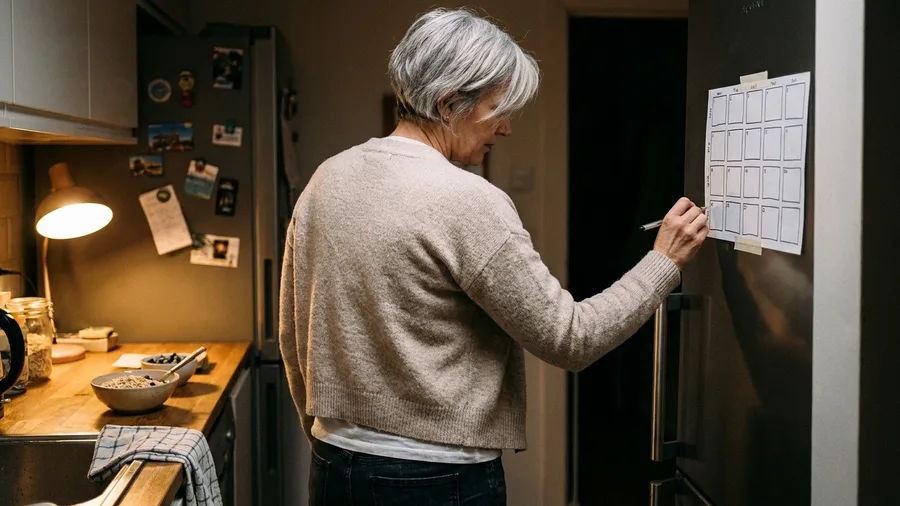
The 20 Plants a Week challenge is a seven-day tally of distinct plant foods, and nothing more demanding than that. You sit down once, write 20 boxes on a sheet of paper, stick it on the fridge, and check a box each time a plant food you have not eaten yet this week turns up on your plate.
Meat, dairy and eggs stay exactly where they are. The target sits beside your current breakfast, lunch and dinner as an addition, not in place of them, which is the difference between a variety nudge and a second diet wearing a friendlier name.
What usually goes wrong starts with a misread. People see the number and assume it means 20 servings a day, and suddenly every meal becomes a ledger they have to balance, so breakfast feels like a failure before the coffee is poured. The actual unit is one check per distinct plant across the whole week, which means a spoon of lentils on Monday and again on Thursday is still one box.
One more thing to settle before you draw the grid. Counting rules differ from version to version of this challenge, and the version you follow decides what gets checked, so pick your rules on day one and keep them rather than comparing your boxes to someone else's post.
The count is a variety marker, not a portion quota. Read it that way and the tracking takes about ten seconds a day.
Twenty is a starting line, not a pass-fail test
The number 20 is a starting line, not a score you pass or fail. You will see a 30-plant version circulating online, and 30 is often framed as the more ambitious goal, so 20 sits deliberately below it as a beginner-friendly first target rather than a badge of virtue.
That framing is practical, not a research claim, and it helps to be clear-eyed about the difference. The number is a useful inventory prompt, not a threshold with health guarantees attached to it.
What the count actually does is find gaps. A blank box is not a verdict on your week, it is a pointer to a category you skipped, and a run of empty vegetable boxes tells you more about next Sunday's shopping than any streak total ever will. The vegetables worth adding turn that pointer into a short shopping list instead.
Fifteen distinct plants in a week still beats the same five plants on rotation, and that comparison is the one worth making. Your baseline is your own last month, not a stranger's checklist.
Perfectionism is what turns a missing box into a grade. The moment the tracker becomes something you can fail, the temptation is to abandon the whole week over two empty squares, which is how a simple count ends up with its own rules and rules are what people quit.
Keep the next plant more important than the final total. A week that ends on 17 with three new foods in your regular rotation is a better outcome than 20 reached and never repeated.
Fruits, vegetables, grains, nuts, seeds and herbs count
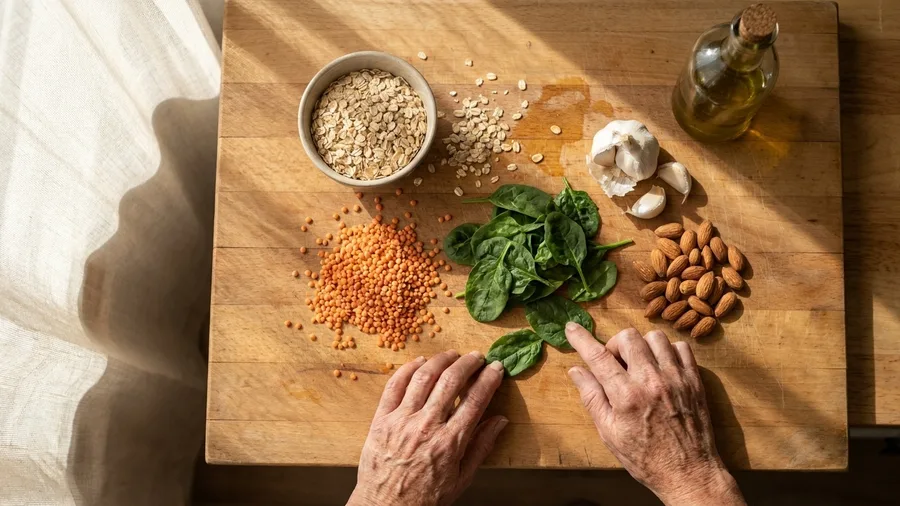
A plant counts here if it grew in the ground and reaches your plate close to that state, which keeps the boxes reachable on an ordinary supermarket run. That means produce sections, bags of dried beans, the grain aisle, the nut jars, and the spice rack all feed the same twenty boxes.
Picture the five items sitting in one bag: a bag of red lentils, a canister of rolled oats, a bag of spinach, a tub of almonds, and a head of garlic. Five checks from one short aisle loop.
Legumes deserve a separate look because they open nine boxes at once, since lentils, black beans and chickpeas are each their own point. Whole grains behave the same way, with brown rice, oats and whole-wheat bread counting individually rather than as one grain category. Nuts and seeds split the same way, so almonds and peanut butter land as two, not one.
Oils and processed plant foods are the honest gray zone. The sample basket counts its olive oil once, but nothing in the week leans on oil to reach twenty, so the count stands on food you actually chew.
The test that keeps this simple: if it sits in a normal grocery cart rather than a supplement shelf, it belongs in a box.
One point per distinct plant per week is simplest
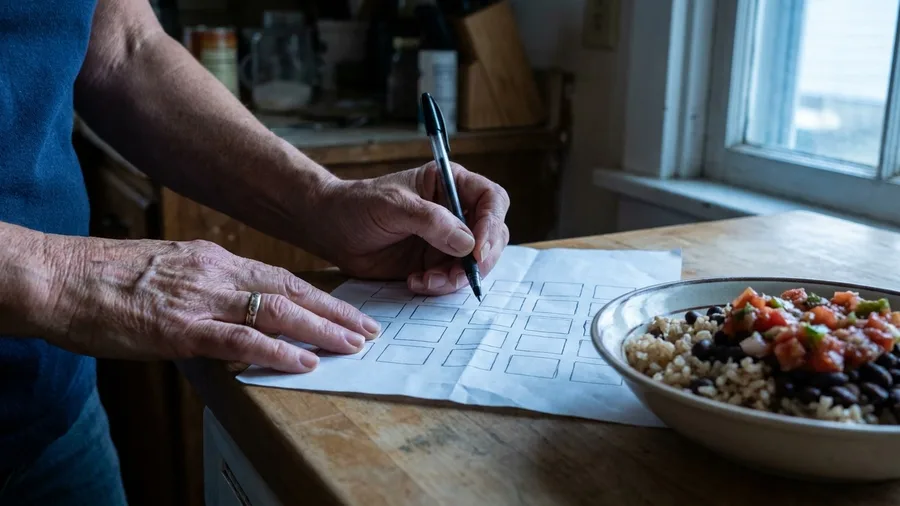
Repeated servings of the same plant do not add a second point, which turns the whole thing into one check per distinct plant food per week.
So a dinner of rice, black beans and salsa earns three points once. Eat that exact bowl again Thursday and you are still at three, not six. Each plant gets one box on the paper grid, and the grid has twenty of them.
That is the entire tool. No app to download, no subscription, no account to set up and forget by day four. A sheet of paper taped to the fridge with twenty empty squares drawn on it does the same job.
Here is where it beats a diet calculation. There is no weighing, no measuring, no portion question, no tally of ounces or cups to argue with yourself about over the counter. You ate broccoli this week – check broccoli once. The bookkeeping takes a second per food, and it happens after the meal, not before it.
For anyone who has tracked food before, this is the relief in the plan. Old habits say count every serving, then the count becomes something you cannot keep up with by Wednesday, and that is the thing that gets abandoned. One point per plant stays small enough to finish.
Your meals do not change to satisfy this. The card just records what they already contained.
⚠️ COMMON MISTAKE
The most common counting error
Counting repeat servings of the same plant as separate points. Spinach on Monday and spinach on Thursday is one check for the week, not two. The count rewards variety, not volume.
Herbs and spices close gaps, not fill the list

You can count herbs and spices, once each in this plan, but you cannot build the week on them.
The loophole is obvious the moment a strict count meets a spice rack. Ten jars of cumin, paprika, oregano and thyme look like ten checks on paper and almost nothing on the plate. That is padding, not variety, and it misses the food the count exists to widen – the backbone of fruits, vegetables, legumes and grains that carries fiber, potassium and the rest.
Garlic and onion are the useful middle case. The sample basket carries both, and they earn their boxes honestly: they add flavor and they add substance to a pan of lentils or a tray of roasted carrots. They are flavor plants that hold their own.
The intended use is the gap, and it is narrow. It is Saturday night, you have 17 boxes filled, and you want to land on 20 without a fresh grocery run. Slicing a tomato and stirring cumin into the beans covers the last two or three points from food you already own.
Ten spices as your strategy, though, is a week that ends full of checks and short on vegetables. Ask what any dietitian would say about a twenty-plant week built on seasoning and the answer is quick: the count is fine, the plate is thin.
Let flavor plants finish the list. Let fruits, vegetables, legumes and grains fill it.
Four myths about the 20-plant count
The challenge fails when it becomes a second diet

People abandon the 20-plants challenge when it stops being an add-on and turns into a second diet running alongside their normal one.
The slide is quiet. You read the challenge, decide to do it properly, and by Monday you have written a new menu, bought a jar of something from the health aisle you will use twice, and cleared the meat and bread out of the plan. One missed day follows, then the guilt, and the whole thing feels like a failure rather than a checklist with fifteen boxes still open.
That is the abandonment trigger, and it stacks: a new meal plan for breakfast, lunch and dinner, foods now off-limits, plus an extra shopping trip on top of your regular one. Any one of those is a project. Three together is a diet.
The add-on version looks almost too easy by comparison. You keep your current meals. You add one plant to each. Oats get blueberries, the sandwich gets spinach, the salad gets chickpeas.
Decision fatigue and perfectionism are what turn a one-second check into a set of rules. Every new rule is another chance to break one, and each break reads as evidence you cannot do this. The habits behind staying curious show how a lighter, questioning frame keeps a routine alive.
The test is simple. If a move drops your usual meals and adds a shopping trip, it is a second diet. If it drops one food onto a plate you were already making, it is the challenge as intended.
Planning for exceptions beats trying to avoid them

Decide the rule before the restaurant, and an eating-out meal keeps working for the count instead of ending the week.
The move is simple: order one bowl, plate or taco order with at least three distinct plant foods in view, and count each one a single time. A bean burrito bowl with rice, salsa, lettuce and onion adds four or five points in one sitting, no special menu required.
So a stir-fry with broccoli, pepper and onion counts three. A side of chips and a diet soda counts nothing, and that is fine too, because it is one meal out of twenty-one.
Low days belong in the plan rather than outside it. A day that lands at one plant does not restart the week; the next meal simply gets one more added plant, and the boxes carry on from where they were.
Travel takes the same approach. A banana from a hotel breakfast, a packet of oats made with hot water, a handful of nuts from a gas station, a can of beans heated in a microwave: each of those is a point, and none of them needs a kitchen or a grocery run.
What makes exceptions work is that the counting rule exists before the busy day arrives. Sneak a restaurant meal or a travel day into the week with no convention and the afternoon turns into a small negotiation about whether the salsa really counts. Settle it in advance and the challenge stays an add-on.
Cost rises mostly from fresh produce that spoils

A week of 20 plants runs about $42 to $48 at a mid-priced US supermarket, and the way to hit the low end is to buy less fresh produce than you think you need.
The trap is loading a cart with 20 fresh plants on Sunday. A bunch of spinach, a head of romaine, three bell peppers, a bag of carrots and a punnet of blueberries will not all survive the week, and the money that spoils in the crisper drawer is the real cost of this challenge, not the receipt at checkout.
The practical rule is five fresh items at a time. Pick the greens and vegetables you will actually eat in the first four days, then let frozen and pantry plants carry the rest of the list.
Frozen broccoli and spinach cost less per serving than fresh and keep for months. Canned black beans and chickpeas, dried lentils, oats, brown rice, peanut butter and almonds sit in the cupboard without any clock running on them.
That mix is what keeps the cost near $42 rather than creeping past $50. The plant count does not care whether the broccoli was frozen or picked that morning, since it counts distinct foods across the week, not freshness.
One last habit: keep the frozen and canned backups where you can see them. A bag of lentils at the back of a shelf is money spent that never lands in a meal.
Prep time is front-loaded, not daily

The time cost is 35 minutes on Sunday and 10 to 15 minutes per meal after that, which is less weekday cooking than most people already do.
The Sunday block covers four jobs in sequence. Start the rice, start the lentils, wash the greens, then get carrots and broccoli onto a sheet pan and into a hot oven.
The equipment is a pot, a sheet pan and a few containers you will actually see in the fridge. No pressure cooker, no subscription, no new gadget to justify.
What this buys you is the removal of the daily decision. On Wednesday, when you get home hungry and the fridge feels empty, the components are already there: cooked rice, cooked lentils, washed greens, roasted vegetables. Assembly is spooning them into a bowl and adding one plant you have not ticked yet, maybe a handful of spinach or half an avocado.
That is the difference between an add-on and a second job. The challenge depends on having components ready, not on cooking something new every night.
If the week ahead looks brutal, freeze half of Sunday's output on the spot. Then the plan leans on what is already made instead of on the fresh cooking you may not get to.
⏱️ What the 35-minute Sunday prep actually looks like
Minute 0-3: rice and lentils on
Both pots before you touch anything else. Rice 1 cup to 2 cups water, lentils 1 cup to 2 1/2 cups.
Minute 3-10: oven on, sheet pan loaded
Set to 425 F. Carrots and broccoli cut to the same size so they finish together, not one tray of char and one of raw.
Minute 10-20: greens washed and dried
Spinach and romaine into containers with a paper towel. Do not dress them now or they wilt by Tuesday.
Minute 20-30: lentils done first, then rice
Lentils finish in about 20 minutes, rice in 25 to 30. Season each pot now so Wednesday needs no thinking.
Minute 30-35: containers at eye level
Front shelf, lids off the ones you will use first. Freeze whatever you will not reach by Thursday.
Leftovers are a counting trap, not a failure

That container of lentil soup you eat Monday, Tuesday and Wednesday earns exactly one check on the tracker. Under this plan's convention, a plant counts once per week no matter how many times it lands on your plate.
This trips people up because the arithmetic feels wrong. You ate lentils three times, so it should be three boxes, right? But the whole point of the count is variety, not volume, and variety is measured in distinct foods rather than repeat servings. Leftovers keep the count steady without moving it.
The fix is small. Keep the leftover meal, and add one new plant alongside it instead of cooking a second dinner. Soup on Tuesday gets a handful of spinach stirred in at the end, or a side of sliced bell pepper. That is one new box, ten seconds of work, no second pot.
Leftovers save real time and money, and nothing here asks you to stop eating them. They simply stop adding points after the first check. That is the count working as intended, not your week going sideways.
The variety is planned across the week, not forced into every meal. A rice-and-bean lunch can repeat four days while the rest of the week pulls in spinach, broccoli, blueberries and almonds. If you find yourself stacking new plants onto every serving to chase the number, that is the sign the add-on has drifted into a diet rule. Keep the leftovers, add one plant when it is easy, and let the week carry the rest.
A visible tracker does more work than motivation

Write 20 squares on a sheet of paper, tape it to the fridge at eye level, and tick a box the moment a new plant food goes in. The check happens over the plate, not at 9 p.m. from memory.
That timing is the part people skip. Racking your brain at night for what you ate is an exercise in reconstruction, and reconstruction is where counts go fuzzy and guilt creeps in. The immediate tick takes two seconds and closes the loop while the food is still in front of you. It also cuts the memory load to near zero.
There is another benefit that matters more than it sounds. Twenty empty boxes are a daily visual reminder sitting in your kitchen, and the count becomes something you can see rather than a plan you meant to follow. The intention stops being abstract and becomes a prompt the room keeps giving back to you.
This is not a willpower test. If the tracker only works when you remember to use it, it is not a support, it is a second job. Keep it in the same sightline as the milk, keep a pen taped beside it, and let it do its quiet work. A pen beside the tracker is the whole setup.
💡 PRO TIP
Check the box before you clear the plate
The check goes in the moment you finish eating, while the meal is still in front of you. Waiting until evening turns the count into a memory test, and you will undercount every time.
Attach one new plant to an existing meal
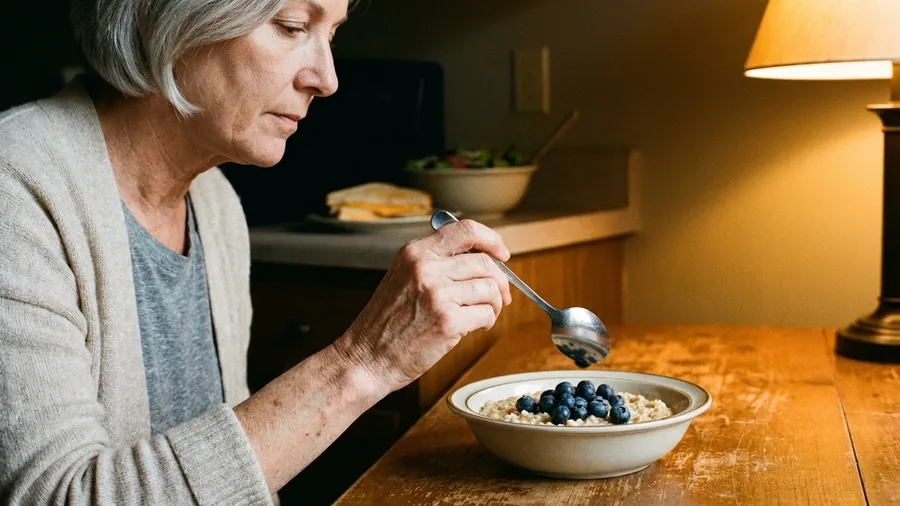
A tracker records what you ate, but the first plant has to land inside a meal you already sit down to. The three easiest attachments are berries stirred into morning oats, a handful of spinach laid into a sandwich, and a scoop of beans added to a salad you were making anyway.
Pick one of those. Not all three.
Three swaps in one week is how a simple count starts to feel like a project with its own rules, so the first week gets a single meal and a single plant. The rest of your eating stays exactly as it is, and that is the point.
Habit stacking works because the cue and the routine are already there. The oats are already cooking, the bread is already out, the salad bowl is already on the counter, so the new plant borrows a moment that exists instead of creating a new one.
Before the week begins, write the pairing down where you will see it: the meal, the plant, the day. Oatmeal, Tuesday, blueberries. A sandwich, Wednesday, spinach.
Naming it in advance removes the mid-morning decision about whether today is the day, which is usually the moment the plan quietly dies. When the cue arrives, the plant is already chosen, and you are adding to a meal rather than planning one.
Fewer store decisions mean more plants at home

Shop by category, not by the number 20. A short list does the work: one grain, one legume, two vegetables, one fruit, one nut or seed. Six decisions instead of twenty, and a basket that lands at a typical $42 to $48 at a mid-priced supermarket.
That cart is not a health-food haul. It is oats, lentils, spinach, a bag of carrots, blueberries, almonds, and a jar of peanut butter most weeks already has.
The trap it avoids is the one that ends the challenge before Wednesday: buying twenty separate fresh items, watching half of them soften in the crisper drawer, and defaulting to toast.
Keep the frozen and canned backups where you will see them. A bag of frozen broccoli at eye level on the freezer shelf gets used; the same bag behind the ice cream does not.
Two vegetables, not five. If the store has good tomatoes, that is your second vegetable alongside spinach, and the two of them cover a dozen meals.
One nut or seed is enough for a week. Almonds in a jar on the counter get eaten; a specialty bag in the pantry does not.
The point of the short list is repetition you can trust. You are not trying to buy variety all at once. You are buying enough familiar plants that the fridge stays a place you can count from.
Add-on or second diet? Two ways to run the same week
The add-on version
- Keep your current meals and add one plant to each.
- Shop by category: grain, legume, vegetable, fruit, nut.
- One 35-minute Sunday prep, then assemble in 10–15 minutes.
- Check the box the moment you eat the plant.
- A missed day is a missed day; the count continues.
The second-diet version
- Replace your meals with a new strict menu.
- Buy 20 fresh plants at once and watch half spoil.
- Cook a new meal from scratch every single day.
- Track from memory at night and undercount.
- One missed day becomes a reason to quit the week.
A weekend review prevents all-or-nothing thinking

A missed week is a restart, not a verdict. Five minutes on Sunday, three questions: how many boxes are checked, which two categories are thin, and which two plants go in next week.
Even a good shopping list produces an uneven week. You eat the same blueberries five mornings and never touch the chickpeas. That is normal, and it is not a sign the challenge failed.
The review catches it before it becomes a story about you. Instead of 'I am bad at this,' you get 'I have no legume this week, so I am adding lentils on Tuesday.'
The distinction matters more than it sounds. A missing box read as a grade invites quitting; a missing box read as a category to add invites one more trip down the canned aisle.
Readers who stay with this tend to hold the count loosely. They miss days, review on Sunday, and keep going. The ones who chase a perfect twenty tend to stop the first week they fall to fourteen.
Fourteen distinct plants still beats the same five repeated for a month. That is the number to remember when a box sits empty.
Fold the review into whatever you already do on Sunday. Not a project. A five-minute check before you write the list.
Social accountability helps only when it is low-pressure

Tell one person, and pick the kind who will not turn it into a scoreboard. A friend who gets a photo of your fridge tracker and texts back a photo of theirs is the right kind of accountability.
The wrong kind is a public streak challenge. Leaderboards, daily check-ins, and posts that count other people's boxes turn a variety habit into a performance, and for most people in this age group that pressure is what ends the run.
The difference is what the comparison does to your next meal. A low-pressure buddy makes the count visible when you have not thought about it since breakfast. A streak challenge makes a missed Tuesday feel like something you owe an audience.
Sharing the shopping list is the lowest-risk version. Two people comparing which six categories they bought keeps the conversation on the cart, not on your discipline.
Skip the social layer entirely if food tracking starts to feel stressful. That is a real signal, not a failure of willpower, and the challenge works fine as a private habit.
Accountability is useful when it keeps the tracker in sight. It is not useful when it makes you dread opening the fridge.
Where the effort actually goes
Two gauges: how much of the week's effort is front-loaded versus spread across the week
A sample week hits twenty plants with familiar meals

A week of this looks like breakfast you already eat, with two plants riding along. Start with a bowl of oats topped with blueberries and a sliced banana – three checks before you have finished your coffee, and none of them required a new recipe.
Lunch is lentil soup with spinach stirred in at the end and carrots softened into the base. That is three more boxes, and the lentils and spinach are doing the same work they always did.
Dinner is where the count quietly climbs: a rice bowl with black beans, roasted broccoli and a spoon of salsa over the top. Rice, beans, broccoli, salsa – four distinct plants in one ordinary bowl, each counted once no matter how much of it you eat.
The snacks are what usually surprise people. A handful of almonds mid-afternoon, peanut butter spread on whole-wheat bread, half an avocado mashed onto whatever needs it – three more foods, none of them a supplement or a specialty product.
The 20-plant basket at a glance
🌾 Grains
Oats, brown rice, whole-wheat bread
🫘 Legumes
Lentils, black beans, chickpeas
🥜 Nuts & seeds
Almonds, peanut butter
🥦 Vegetables
Spinach, romaine, tomatoes, carrots, broccoli, bell pepper, onion, garlic
🍌 Fruits
Blueberries, banana, avocado
🫒 Oil
Olive oil – counted once
Skip the fresh-only trap
Frozen broccoli and carrots and canned lentils and beans count the same – and they land near $42, not $48. The only plants that earn no box are ones you keep buying and never open.
The shopping list is shorter than a new diet's
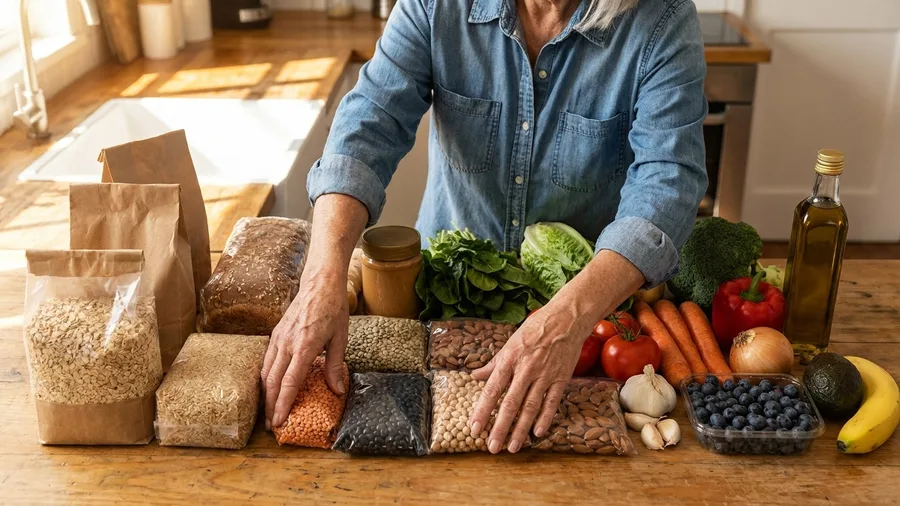
The basket is twenty familiar items, and most of them live in the pantry or the freezer aisle rather than the health-food section. Grains: oats, brown rice, whole-wheat bread.
Legumes: lentils, black beans, chickpeas. Nuts and seeds: almonds, peanut butter.
Vegetables carry the most boxes – spinach, romaine, tomatoes, carrots, broccoli, bell pepper, onion, garlic. Fruits: blueberries, banana, avocado. One bottle of olive oil rounds out the list.
At a mid-priced supermarket, that basket typically lands between $42 and $48. Swap the fresh spinach and broccoli for frozen and the blueberries for a frozen bag, and the total settles toward the low end of that range – which is the version most people should buy first, since nothing spoils on day four.
The list covers one person for a week with a few leftovers built in. Two people eating the same dinners should scale the vegetables and legumes rather than doubling every line. Twenty familiar items, no subscription, no specialty haul.
Sunday prep covers the three biggest friction points
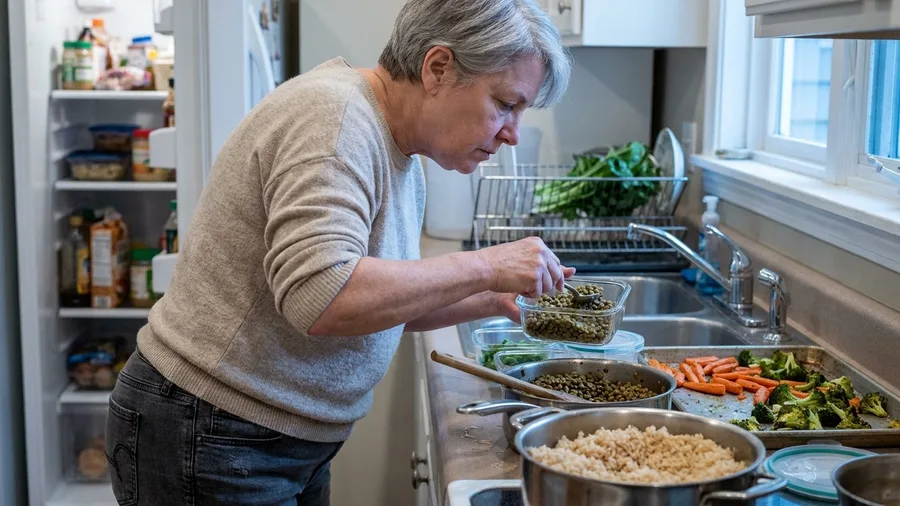
Sunday prep is one 35-minute block, and it removes the three decisions that sink the count on a Tuesday night.
Start the rice and the lentils first, since they cook while you do everything else. While those pots work, wash and dry the greens and get carrots and broccoli onto a sheet pan into a hot oven.
By the time the tray comes out and the pots come off the heat, you have a grain, a legume and a tray of roasted vegetables – the three components every weekday meal is built from.
Store them in containers you will actually see when you open the fridge door, not pushed to the back. Visibility is the whole point: a container of cooked lentils at eye level gets used; one behind the milk does not.
If the week ahead looks crowded, freeze half the batch. The plan should not depend on fresh cooking happening on a Wednesday. Weekday assembly then runs 10 to 15 minutes a meal – reheat, add greens, add a sauce, check the box.
Eating out adds points when you order by components

A restaurant meal counts the same way a prepped container does: one check per distinct plant you can see. Order a bean burrito bowl with rice, salsa, lettuce and onion and that is four boxes filled from one counter order, no special menu, no asking the kitchen for anything.
The rule that keeps this simple is visible components.
Unknown sauces and garnishes do not get a check, because you cannot tell what is in them and the point is not detective work. Count what you ordered on purpose. A stir-fry with broccoli, pepper and onion lands three points; the sauce it swims in lands none.
One dinner out typically adds three to five plants to the week's grid, which matters most on a Thursday when the fridge is thinning and the alternative is toast.
Ordering a bowl, a plate or tacos puts the plants where you can see them before the food arrives. That is the whole method: choose the format where the components are named, count each one once, and let the mystery sauce go. Nothing on the menu needs to change for the week's grid to fill.
The same front-loaded prep that removes weekday decisions also makes this counting honest. When you know what a portion of lentils or roasted carrots looks like on your own plate, you can spot them in a bowl across a table and check the box without a second thought.
Frequently Asked Questions
Do I have to hit exactly 20 plants every week?
No. Twenty is a beginner-friendly target that sits below the more common 30-plant version. A week with 15 distinct plants still beats the same five plants repeated, and the count is a gap-finder rather than a pass-fail grade.
Does a second serving of the same vegetable count again?
Under this plan's convention, no. One check per distinct plant food per week is the rule, and repeat servings add nothing new. That is deliberate — it rewards variety rather than volume and keeps the tracking to a paper grid.
How much does the sample week cost?
A typical US basket for the 20 foods runs $42–$48 at a mid-priced supermarket. Frozen and canned versions keep it near the low end, and buying fewer fresh items reduces spoilage and waste.
Can I count herbs and spices to reach 20?
They count once each in this plan, but using ten spices as your strategy misses the food backbone. Herbs and spices are best for closing a two- or three-point gap near the end of the week, not for replacing vegetables, grains and legumes.
What if I eat out or travel during the week?
Order one bowl or plate with at least three distinct plant foods and count each once. Travel-friendly points include a banana, a packet of oats, nuts and a can of beans. A low day does not restart the week; the next meal gets one added plant.
Do I need an app to track the count?
No. A paper grid of 20 boxes on the fridge works better than most apps because you see it every time you open the door. Check the box right after eating rather than at night from memory.
Start with one meal and one paper tracker

Pick three plant foods for tomorrow's breakfast, draw twenty boxes on a sheet of paper, and put it on the fridge. That is the entire first action, and it takes about ten minutes tonight.
The three plants should be things already in the kitchen. Blueberries stirred into oats, a spoon of peanut butter on whole-wheat toast, half a banana sliced on top, a handful of spinach folded into eggs. Name the meal and the plants before you go to bed, so tomorrow morning asks no decisions of you.
Then run it for seven days before you judge it.
A week is long enough to hit the awkward nights, the takeout Thursday and the day the produce drawer looks sad, which is exactly the data you need. Deciding on day two, when the novelty has worn off and the grid is half empty, tells you nothing useful. Check each new plant once, immediately after eating rather than from memory at 10 p.m.
Keep the whole thing an add-on. " The count sits beside whatever you already eat; it does not replace meals or forbid anything. If you have a medical condition or a diet restriction, run the plan past your clinician or a registered dietitian before the trial week, because this sample week is a trial and not a treatment plan.
Seven days, twenty boxes, one breakfast. Then decide whether to keep going.
The 20-box grid on the fridge is the whole start
The 20 Plants a Week challenge is not a diet, not a serving quota, and not a reason to buy specialty products or download an app.
It is 20 boxes on a piece of paper, a familiar $42–$48 basket, and 35 minutes on Sunday. The add-on frame is what makes it survive a normal week — keep the meals you already eat, add one plant at a time, and let the grid do the remembering.
Draw the 20 boxes tonight, pick three plant foods for tomorrow's breakfast, and check them off as you eat. Repeat for seven days before deciding whether to continue.
Draw the grid, pick three plants, start tomorrow
Tape a 20-box tracker to the fridge and add three plant foods to tomorrow's breakfast. Seven days is all it takes to see whether the add-on version fits your week.