
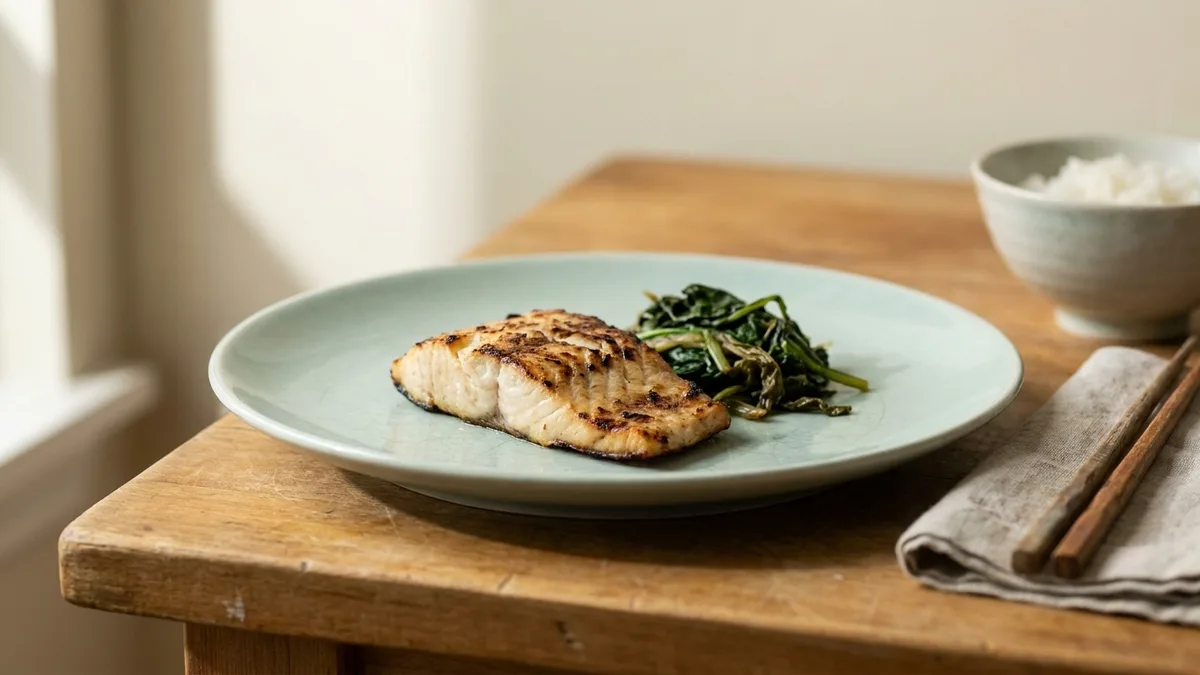
The habit that changes how much you eat is not on your plate. It is the plate. Change the diameter under the same 4-ounce piece of fish and the same half-cup of vegetables, and dinner reads as a full meal on a 6-inch dish and as a half-empty one on a 12-inch dish, with the body registering the difference before the first swallow.
You have already tried the other route. A phone app, three weeks of logging, a dinner typed in bite by bite, then a quiet quit, because the number was never the part that changed the meal. What governs intake at an ordinary table is setup: plate diameter, how many dishes sit in view, which food gets touched first, and how long the meal runs from first bite to last.
Japanese home cooking leans on ten structural moves that each take a decision out of the meal instead of adding a rule about numbers. You act once at the counter, not all evening. Each one gets weighed by the effort it takes and the case where it stops working. Start tonight with a 6-inch plate and soup or vegetables first, and skip the 80 percent stop if your history with eating makes hunger rules unsafe for you.
Overeating, at a normal table, is mostly a setup problem. Fix the setup and the portion is settled before you sit down.
Quick Tips Before You Start
Measure at the counter
Portion out of serving dishes at the counter, never at the table where the platter sits within reach.
Buy one small bowl
A single 8-ounce bowl for soup or a 6-ounce one for rice does more than a set of six.
Set a clock
Twenty minutes from first bite to last is the pacing target — check it once, then stop watching.
Switch the utensil
Chopsticks or a dessert fork slows the bite without any conscious effort.
Decant snacks at purchase
Split a big bag into 1-ounce portions the day you bring it home, not when hunger asks.
Set the table and the plate
Everything in this first group happens before you take a bite. That ordering matters. A tempo rule cannot save a meal whose portion was never fixed, but a fixed portion buys you slack even when you eat too fast.
Start with the objects, because they are the cheapest things to change and the only ones that stay changed once the meal is underway.
1. Each food gets its own small dish
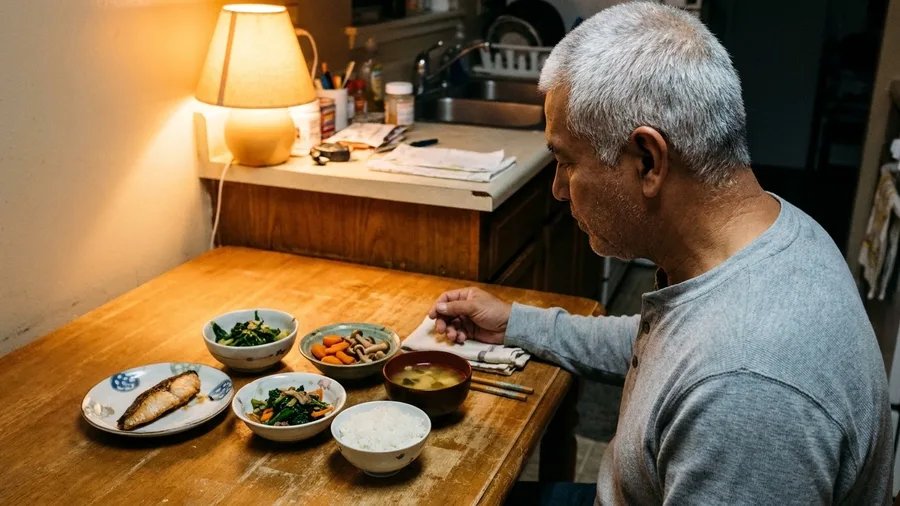
Picture a Japanese dinner table and you will not see one wide plate. You will see four or five small vessels clustered around a rice bowl, each holding somewhere between half a cup and a cup.
The entire dinner is on the table before anyone lifts a utensil. Nothing is still in a pan, nothing is waiting to be carved. That matters because the portion gets settled at the counter, once, by a person who is not yet hungry — not by the same person twenty minutes in, leaning over a serving dish.
A five-vessel dinner in this example runs like this: a 6-inch plate with a 4-ounce piece of fish on it, three vegetable dishes at roughly half a cup apiece, an 8-ounce bowl of miso soup, and a 6-ounce bowl of cooked rice — the ichiju sansai logic in practice. Nothing is stacked under anything else.
💡 Tip: Wash the small dishes as you cook, not after dinner — five vessels stacked by the sink is the reason most people quit this one in week two.
| Habit | What it makes harder | Effort to start | Skip it if |
|---|---|---|---|
| Each food in its own small dish | Eating past the portion without noticing | Medium — 3 to 5 extra dishes | No counter, no cooking, no washing up |
| A smaller plate | Refilling before the meal is over | Low — switch one plate | You keep the serving dishes on the table |
| Rice in a measured bowl | Starch expanding to fill the plate | Low | You need the calories — size it up, not down |
| Soup and vegetables first | Reaching the dense food still hungry | Low | Reflux or a binge-eating history — test carefully |
| Small bites over 20 minutes | Clearing the plate before fullness arrives | Medium — needs an actual 20-minute break | Your lunch break is 10 minutes |
| Stop at 80 percent | Eating until the stuffed feeling lands | High — needs two check-ins per meal | History of restrictive or binge eating |
| Vegetables across half the table | Filling up on calorie-dense food first | Medium — three 1/2-cup dishes | You will not actually eat the vegetables |
| Fish and soy as small portions | Protein becoming the reason to overeat | Medium | Heavy physical work or strength training |
| A sit-down breakfast | Grazing through the morning | High — needs 10 to 15 minutes at home | Shift work, or you cannot eat early |
| Plated snacks | A bottomless bag eaten standing up | Low for nuts and crackers | The snack is really evening boredom |
2. A smaller plate makes a normal portion feel complete
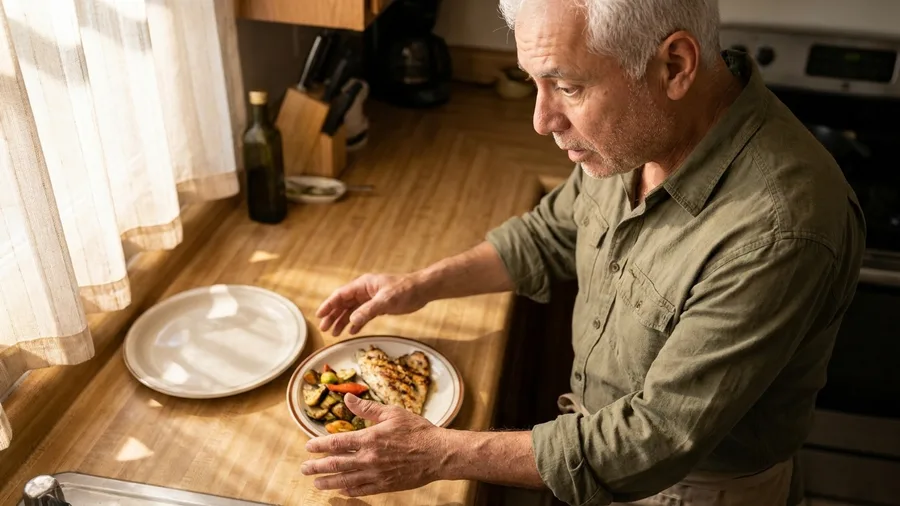
A small dish fixes the portion only if the biggest plate on the table is actually small, which puts the plate itself at the center of the next decision.
Watch what a 4-ounce piece of fish and a half-cup of vegetables do on two different plates. On a 6-inch plate they cover most of the surface. On a 12-inch plate the same food sits in one corner with a wide empty ring around it.
3. Rice comes in a bowl, not a mound
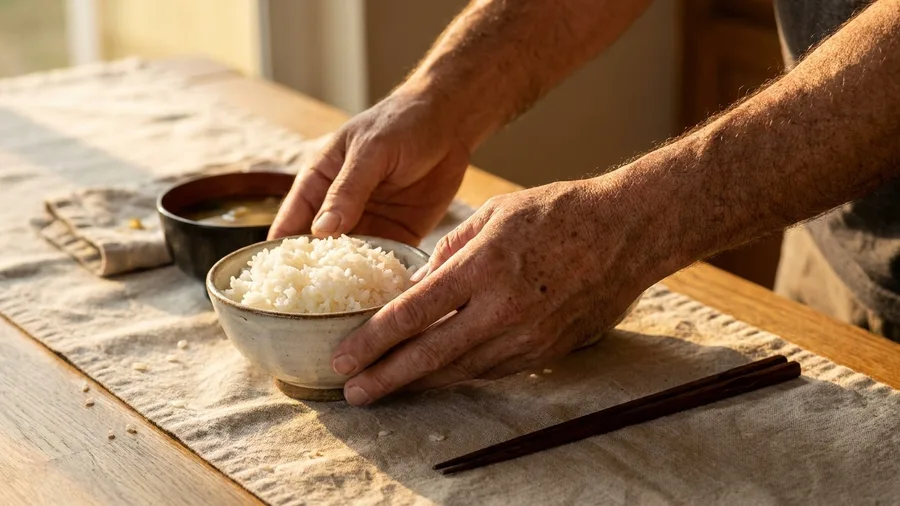
The plate settles how much food sits in front of you. The rice is the exception, because it arrives in whatever vessel you reach for — and in most kitchens that is the widest one on the shelf.
⚠️ COMMON MISTAKE
The bowl is not the halo
Buying Japanese crockery does not change a meal. If the same large portions get decanted into small bowls, nothing shifts — the portion is what counts, not the vessel. Weigh or scoop the rice and fish once at the start; after that the dishes are just dishes.
Slow the meal and set a stop
The plate fixes the amount. It does not fix the speed, and speed is where a correctly sized meal still gets eaten past the point of comfort.
This group covers the tempo of the meal and the rule that ends it. Both are practices rather than measurements, which means both need a little repetition before they feel natural.
4. Soup and vegetables go first, rice later
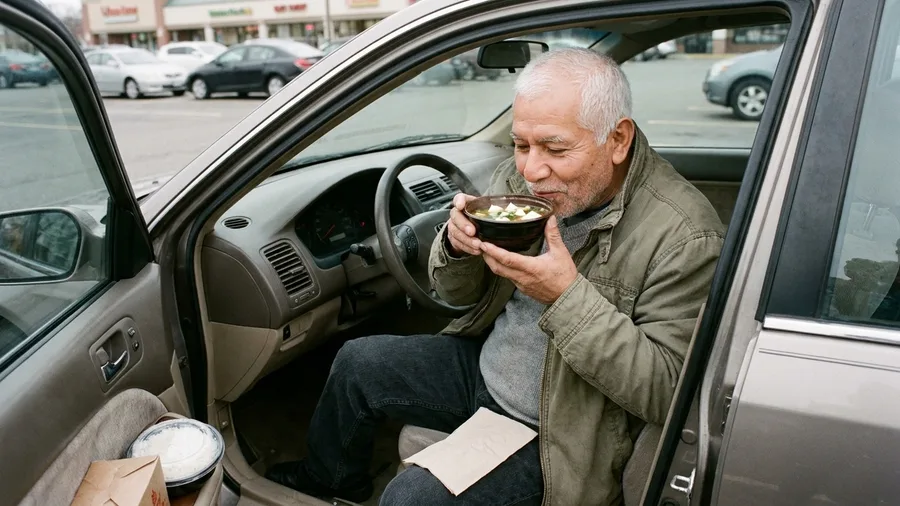
A bowl settles how much rice reaches the table. What happens before it lands decides how much of everything else you eat without noticing.
So the hot bowl and a vegetable dish go down first, and the rice waits at the counter until the soup is half gone. Eight ounces of miso broth and a half cup of pickled greens or braised mushrooms are what an eater meets at the start, and both are mostly water and fiber, which is why they fill volume without crowding the stomach with calories.
They also take time. You cannot rush hot broth, and cold pickles ask for small bites, so the opening five minutes of dinner go to the slowest food on the table instead of the densest.
The practical effect lands later, on the second helping. By the time the fish and rice are in reach, hunger has already been trimmed, and the decision to take more is made by someone who is no longer hungry rather than someone eating fast to catch up. That is the whole mechanism: fullness arrives earlier than it would have, and the denser food is met by a smaller appetite.
Two groups should test it and watch. People with reflux often find a bowl of broth loosens the valve at the top of the stomach and brings burning back, and people with a history of binge eating sometimes find that a first course primes more eating rather than less, not because the soup is wrong but because the pattern is. Try it on an ordinary Tuesday, watch what happens after, and drop it if the evening gets worse.
It travels well, within limits. A table with a bowl and a plate can reorder the meal in one move, but a sandwich eaten in the car has no first course to rearrange. This is a habit for meals that happen sitting down.
5. Small bites stretch a meal to 20 minutes

Order tells you which food gets touched first. The clock tells you whether the meal is over before your body has a say in it.
The target here is twenty minutes from the first bite to the last, and the way you get there is smaller mouthfuls with the utensil set down on the plate between them. That last part is the one that does the work. A pause of a few seconds, repeated forty times across a meal, is what stretches the clock, not the object in your hand.
The implement matters as a nudge, not a rule. Chopsticks or a small fork rather than a serving spoon means each load arrives smaller, more lifts follow, and the fullness signals have somewhere to land while food is still on the plate. A bigger fork simply lets you get further ahead of your own stomach.
What this makes harder is the specific failure of a fast dinner: the plate is empty and clean before your gut has registered that food arrived, so the second helping gets decided by an appetite that never caught up.
Two things will sink it. Shoveling with chopsticks is still shoveling; changing the tool while keeping the tempo changes nothing. And a lunch break that runs ten minutes has no twenty to spend, so the habit needs a meal long enough to hold it before it can do anything at all.
Where it stops, then, is a schedule that forbids the time. The people who get something from this are the ones who set the fork down between bites, not merely the ones who swapped forks.
💡 Tip: Put the utensil down completely between bites — resting it on the rim still reads as holding it, and the bite follows faster.
💡 PRO TIP
One check at the halfway mark
Practitioners who teach paced eating suggest a single midpoint check rather than constant monitoring. When half the plate is gone, stop for a beat and ask whether the next bite is hunger or momentum. One question, asked once, is a habit. Twenty questions is a diet.
6. Stop at eight parts in ten, before full

Twenty minutes gives you somewhere to go only if there is a moment to act on the fullness that shows up. Hara hachi bu supplies the moment.
In this example it means pushing back from about eight parts in ten full, before the stuffed sensation arrives. The cue is a slight emptiness at the edge of satiety, not a growling stomach and not the tight, overfull feeling that comes twenty minutes after the last bite. It is a practice, not a tally: no numbers, no app, no scale.
Two check-ins carry the whole rule. Halfway through the plate, ask yourself where you are, and once more before you reach for any second helping. That is the entire method, and its virtue is that it asks a question twice rather than counting a hundred times, which is the reason it survives a week when logging does not.
Some people should not use it. Anyone with a history of restrictive eating or binge eating needs a clinician's guidance before adopting hunger-and-fullness rules, because the rule assumes a hunger signal that reports accurately, and where that signal has been distorted it can steer a person toward harm rather than away from overeating.
It also needs a plate you can see the end of. A meal eaten with attention on the food works; a buffet, a family-style platter, or a bag of anything has no halfway point and no visible finish, and the rule has nothing to bite on.
So the stop lands between the food and the appetite. Set the fork down, watch the plate shrink, and at eight parts in ten, stop – not because you counted, but because you looked.
Build the food and the day
A small plate and a twenty-minute pace still fail if the food on them is all dense. Composition is the third layer, and it is the one that decides how much appetite is left when the protein arrives.
From there the habits move outward again, to the first meal of the day and to the snack that undoes an otherwise well-built dinner. Each layer only holds if the one beneath it has already fixed the amount.
7. Vegetables take half the table, not a side

An 80 percent stop only feels generous if 80 percent was a lot of food to begin with, and the food that makes that true is vegetables.
The setup is not a bigger salad. Dinner carries three half-cup vegetable dishes at once, and they are dishes in their own right: a mound of quick-pickled cucumber, a bowl of wilted greens with a splash of soy, sliced mushrooms, a small plate of seaweed. Each sits in its own vessel, at the same level of importance as the fish.
The pickle dish is not decoration beside the main course. It is a course.
Volume arrives before the protein does, and it arrives cheap: a half-cup of cucumber or mushrooms carries a fraction of the calories of a half-cup of rice, so the first five minutes of eating fill space at almost no cost. You reach the fish already partway fed, and the second scoop of the dense food gets decided by someone with less appetite left.
Then there is the arithmetic nobody mentions. Three half-cups is a cup and a half of food, and eaten one small dish at a time it takes real minutes to work through – minutes that fall inside the same twenty-minute meal, doing the pacing work whether or not anyone is watching a clock.
The honest part: this habit assumes you will eat them. Three dishes of vegetables you dislike is three dishes scraped into the bin, and no cultural framing makes a food you dread taste better. Start with the two vegetables you already order in restaurants and build the third later.
It rewards one Sunday of prep – pickle a jar, roast a tray of mushrooms, wash a head of greens – and then holds for days out of the fridge. It collapses with takeout, where vegetables show up as a garnish portion by default, three sad leaves in a corner of the container. Order a side dish or two, or cook on the nights you can.
The Illustrative Dinner — At a Glance
🍽️ Plate
6 inches
🥣 Soup
8 oz miso
🍚 Rice
6 oz cooked
🐟 Protein
4 oz fish or 1/2 block tofu
🥬 Vegetables
Three 1/2-cup dishes
🧼 Dishes to Wash
Five vessels
Why It Works
The volume comes from the vegetable dishes and the broth, so the dense food arrives after appetite has already dropped.
8. Fish and soy are small portions, not centerpieces
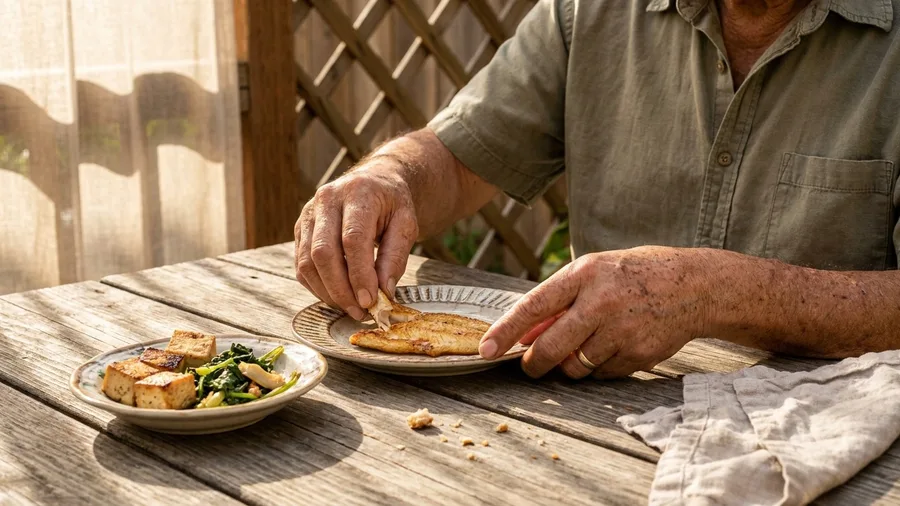
Give vegetables half the table and the protein is left with roughly a quarter, which changes what the fish is for.
A four-ounce piece of cooked fish is about the size of a deck of cards; half a block of tofu is a similar slab. Either one lands on the plate as one element among three to five, not as a twelve-ounce steak with two things arranged around it and the whole meal organized to honor the meat. Nothing here requires sushi – a fillet from the freezer aisle, baked at 400 degrees for the time it takes to steam rice, does exactly this job, and firm tofu from the supermarket chiller needs only to be seared in a hot pan.
Once protein is demoted, it stops being the reason the meal gets big. The vegetable dishes supply the bulk, the fish supplies the density and the savor, and the overall size of dinner is set by the vegetables rather than by the protein. No numbers to hold in your head: the geometry does it.
There is a real exception. If your work is physical or you train with weights, this plate was not built for your appetite – the protein portion is genuinely small, and you should size yours up rather than copy a template meant for a lighter day.
And it fails cleanly if you dislike both fish and tofu. Then this is not your entry to adopt. No amount of cultural framing will make dinner enjoyable when the main dish is something you dread, and a meal you resent is a meal you will abandon inside a week.
Same Meal, Two Setups
Setup that holds
- Portion decided at the counter before sitting
- 6-inch plate, rice in a 6-ounce bowl
- Soup or vegetables eaten first
- Serving dishes left out of reach
- Utensil set down between bites
Setup that gives way
- Platter on the table within arm's reach
- 12-inch plate with rice spread underneath
- Everything eaten in whatever order
- Seconds from the pan at the stove
- A nine-minute meal at a screen
9. Breakfast is a small, sit-down meal

Dinner now has a shape: a 6-inch plate, five small vessels, vegetables across half the table, a four-ounce protein. The next question is whether any of it survives the morning, which is the meal most people eat standing up.
Picture the plate. A bowl of miso soup, about eight ounces, hot enough to need both hands. Four ounces of cooked rice – a small, level bowl, not a mound. One egg, scrambled or fried. A little dish of pickles off to the side. You sit down at the table with it, and it takes ten to fifteen minutes to finish: no bag, no car, no desk, nowhere to be until the bowl is empty.
That is the whole trick. A portion set once at the counter replaces the grazing that happens when breakfast has no edges – the handful from the cupboard, the pastry at the register, the crackers at eleven because the day began with coffee and nothing solid. The decision gets made once in your kitchen instead of at every surface you pass before lunch. You will likely find it carries you further than the bagel did, because a sit-down meal registers as a meal in a way a bar eaten on the move does not.
The counterweight is real. Some people cannot face food at seven in the morning, and forcing it down builds an aversion, not a habit. A planned snack at ten is a better answer than a rushed pastry at eight.
The habit needs ten minutes at home in the morning – that is the entire cost. Shift work can make it impossible; someone eating at four in the morning does not have a morning to sit down in. In that case, a smaller version of the same idea, plated and sat with, still beats the dashboard.
How Fast Each Habit Gives Way
Where a meal breaks down, from the easiest fix to the hardest
- Snack eaten from the open bag: Cheapest fix on the list — one bowl, one ounce.
- Dinner platter left on the table: Solved by moving serving dishes to the counter.
- Rice spread under the whole meal: A measured 6-ounce bowl undoes it in a week.
- No 20-minute window to eat in: Needs a calendar change, not a table change.
- No stop rule at all: The hardest to install and the one that decides the rest.
Ordering reflects how much effort each fix takes, not how much it matters.
10. Snacks are plated, never eaten from the package
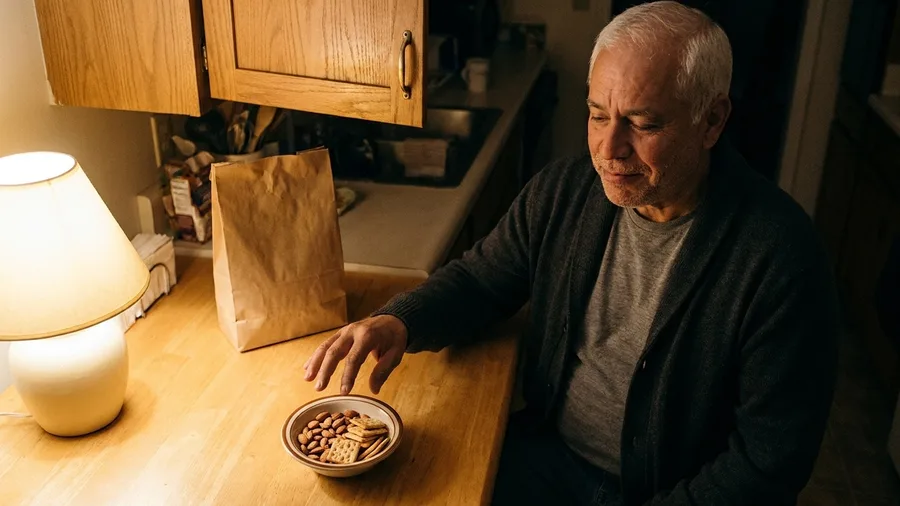
Evening is where the tally quietly climbs, and the snack is almost always eaten standing, one hand in a bag, eyes elsewhere.
That is why the same plate habit that settles dinner and breakfast has to be carried to the smallest meal of the day, where there is no plate at all.
The portion for this example is 1 ounce of nuts or crackers, poured into a small bowl.
Then the package goes back in the cupboard before the first handful disappears, not afterward, while the bowl is still full and the decision is still cheap to make.
The timing is the point. A bag set down after eating is a note written after the bill is paid.
Standing at the counter is optional; nothing about the snack requires it. Sit at the table with that one small bowl in front of you and the snack acquires a beginning, a middle and an end.
The bowl shows how much is left. The bag shows nothing: a hand goes in and comes out, and there is no moment when the supply visibly narrows toward zero.
Put the snack in a bowl and you can watch the pile fall to a handful, then a few pieces, then crumbs.
The counterweight is where this habit earns its keep or loses it.
Plating fixes the container. It does not touch the reason the container got opened. If the snack is standing in for the end of a hard day, an ounce of almonds in a dish will feel like a mean joke, because the need was never about food volume in the first place.
That is a different problem, and no dish size solves it.
For the reader who can buy single portions, or who is willing to decant at the counter before sitting down, this is the least-effort habit on the list: ten seconds, one bowl, one cupboard door.
It fails, honestly, in a shared kitchen where the bag belongs to everyone and no one is watching except you.
💡 Tip: Decant the whole bag the day you bring it home, into 1-ounce portions. Doing it while full is the entire advantage.
💡 PRO TIP
One habit at a time beats ten at once
Add a second habit only after the first feels automatic, which usually means two to three weeks. Stacking all ten in one night produces a table you cannot keep and a dinner nobody enjoys.
Frequently Asked Questions
Do I have to cook Japanese food for these habits to work?
No. The habits are about vessels, order, pace and portion, not cuisine. A 6-inch plate works the same for a piece of chicken, a scoop of lentils, or a baked potato. Soup first can just as easily be a broth, a clear vegetable soup, or a bowl of steamed greens.
How long before a smaller plate stops feeling like a diet?
Most people report a week or two of noticing the plate and then roughly three weeks before it reads as normal. The early stretch is the hard part, and it is why keeping serving dishes off the table matters more in week one than in week six.
Is hara hachi bu safe for everyone?
No. Anyone with a history of restrictive eating or binge eating should not adopt hunger-and-fullness stop rules without professional support. The practice assumes you can read your body's signals reliably, and that is exactly what an eating disorder disturbs. Bring it up with your own clinician first.
What if I eat lunch at my desk in ten minutes?
Then the 20-minute pacing habit is not available to you, and forcing it will only make you feel rushed. Use the plate and the bowl size at lunch instead, and save the pacing work for dinner, where the clock is yours.
Does the rice bowl actually matter if I am not watching carbs?
It matters for portion, not for carbohydrates. A measured 6-ounce bowl stops rice from becoming the base that everything else is scaled against. If you need more calories — heavy training, physical work, a tight budget — make the bowl bigger deliberately rather than letting it spread across the plate.
Which two habits should I start with tonight?
Use a 6-inch plate, and put soup or vegetables in front of you before anything denser. Those two fix the amount and the order of the meal without requiring new shopping, new cooking, or a single number written down.
Two changes tonight, the other eight in a month
This is not a diet. Each of the ten is an arrangement of objects and timing that settles the amount before the first bite, so willpower gets spent once at the counter rather than continuously through the meal, and not one of them asks you to count a calorie.
Tonight, use a 6-inch plate, and put the soup or the vegetables in front of you before the denser food arrives. Add a third habit only once those two feel automatic, usually two to three weeks, and pick it by the effort it takes and the skip-it condition that applies to you. Anyone with a history of restrictive or binge eating should leave the 80 percent rule alone; that belongs to a clinician who knows your history, not to a cultural habit copied from a page.
The app was never measuring the thing that decided the meal. The plate diameter, the number of dishes, and which food was eaten first were all sitting there uncounted, and two of them can change tonight.
Pick your two and set the table
Go back to habit one and habit four, read them once more, and run both at dinner tonight. Then come back for the rice bowl once the plate feels normal.